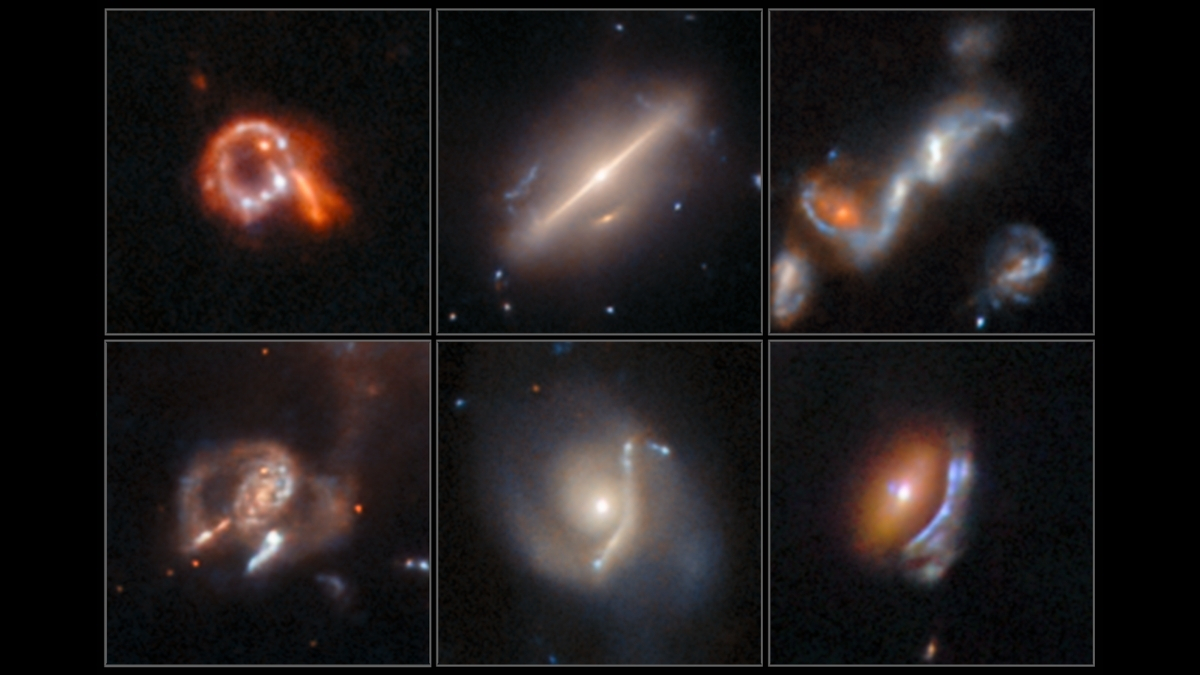
Leveraging an advanced artificial intelligence system, scientists have meticulously examined extensive archives of information sourced from NASA’s Hubble Space Telescope, identifying more than 1,300 celestial irregularities, with over 800 representing novel discoveries for scientific understanding.
This groundbreaking research, conducted by David O’Ryan and Pablo Gomez of the European Space Agency (ESA), has been disseminated in the esteemed journal Astronomy and Astrophysics.
“The historical observations captured by the Hubble Space Telescope now span approximately 35 years, furnishing an invaluable repository of data ripe for the discovery of astrophysical anomalies,” stated O’Ryan.
Astrophysical anomalies hold significant scientific importance as they often represent exceptional cases that reveal novel aspects of the universe’s workings. While experienced researchers may possess the intuition to readily identify such phenomena, the sheer volume of data presents an insurmountable challenge.
Indeed, the prodigious output from our sophisticated network of astronomical observatories is overwhelming. The James Webb Space Telescope alone contributes around 57 gigabytes of data daily, a figure contingent upon its observational schedule.
The Vera C. Rubin Observatory, equipped with the largest digital camera ever constructed, is poised to dwarf this rate, generating an estimated 20 terabytes of raw data each night, necessitating specialized infrastructure for its management.
With the imminent deployment of next-generation telescopes, including the Giant Magellan Telescope and the Extremely Large Telescope, the influx of astronomical data requiring scientific interpretation is escalating into an unmanageable torrent.
These immense data reservoirs are inherently populated with countless undiscovered wonders. Our current technological capabilities have outstripped the human capacity for exhaustive data processing. However, artificial intelligence is rapidly advancing to meet the challenge posed by astronomy’s prolific data generation.
“The archives of astronomical observations contain vast reservoirs of unprocessed information that potentially hold rare and scientifically significant cosmic phenomena,” the researchers elaborate.
“We have employed novel semi-supervised methodologies to extract such celestial objects from the Hubble Legacy Archive.”
The investigators utilized a recently developed anomaly detection framework, dubbed AnomalyMatch, to conduct an expedited survey of nearly 100 million image snippets extracted from the Hubble Legacy Archive, which encompasses imagery dating back roughly 35 years.
AnomalyMatch operates as a neural network, a form of machine learning inspired by the intricate structure and function of the human brain.
“AnomalyMatch is engineered for large-scale operational deployment, enabling the efficient processing of predictions for approximately 100 million images within a three-day timeframe on a solitary GPU,” the authors noted in a preceding publication introducing the tool.
The AnomalyMatch system processed this extensive dataset in merely two to three days, a significantly reduced duration compared to manual human analysis. This marks the first comprehensive and systematic search for anomalies within the Hubble Legacy Archive.
AnomalyMatch generated a compilation of potential anomalies, numbering close to 1,400 objects, a quantity that falls within the manageable scope for human review.
O’Ryan and Gomez subsequently undertook a manual examination of these 1,400 objects, confirming that 1,300 of them indeed represented anomalies, with more than 800 being previously uncatalogued.
The most frequently identified category of anomaly within the Archive comprised interacting and merging galaxies, with 417 instances recorded.
The research team also identified 86 novel candidates for gravitational lenses. These celestial phenomena are of considerable interest as they enable the observation of objects that are otherwise too distant to be detected.
Furthermore, they serve as crucial tools for scientists in their endeavors to map the distribution of dark matter across the cosmos, ascertain cosmic distances and the rate of universal expansion, and rigorously test the principles of general relativity.
“Our analysis has revealed numerous gravitational lenses that have already been documented in scientific literature, alongside a substantial number of potential new lenses,” the authors report.
Beyond these, the Archive contained a variety of other anomalies. AnomalyMatch detected other rare celestial formations, such as jellyfish galaxies, which occur in galaxy clusters where ram pressure strips gas from the galaxy, creating a luminous tail indicative of ongoing star formation. Thirty-five such galaxies were identified in the Archive.
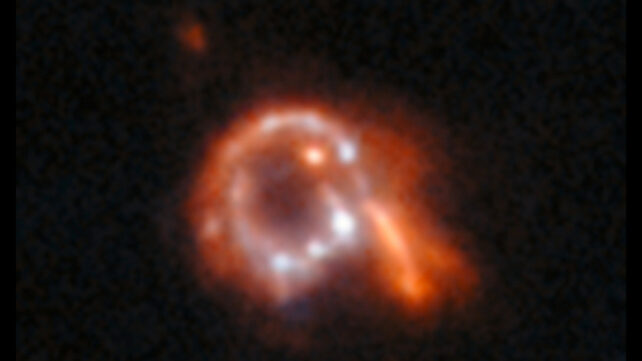
The investigation also brought to light several anomalies whose nature remains enigmatic. One particularly unusual discovery is a galaxy characterized by a swirling central region and outward-expanding lobes.
The exhaustive analysis of vast astronomical datasets represents an ideal application for artificial intelligence, a task unlikely to be replicated through human endeavors alone.
In addition to the aforementioned anomalies, the researchers also discovered overlapping galaxies, agglomerated galaxies, ring-shaped galaxies, and even high-redshift galaxies situated at the very edge of detection limits, rendering them challenging to discern. They also identified jetted galaxies and galaxies hosting active galactic nuclei (AGN).
Should all astronomical observations cease tomorrow, scientific discoveries would not halt. Advanced AI tools are destined for continuous improvement in power and capability. The colossal existing datasets from missions like Hubble and ESA’s Gaia serve as fertile ground for the development and application of future analytical tools.
The potential for future revelations hidden within this vast wealth of data remains boundless.
“This represents a compelling illustration of how artificial intelligence can significantly enhance the scientific value derived from archival datasets,” remarked Gomez.
“The identification of such a large number of previously unrecorded anomalies within Hubble data underscores the substantial potential of this technology for future observational surveys.”
This article was initially presented by Universe Today. Access the original publication here.