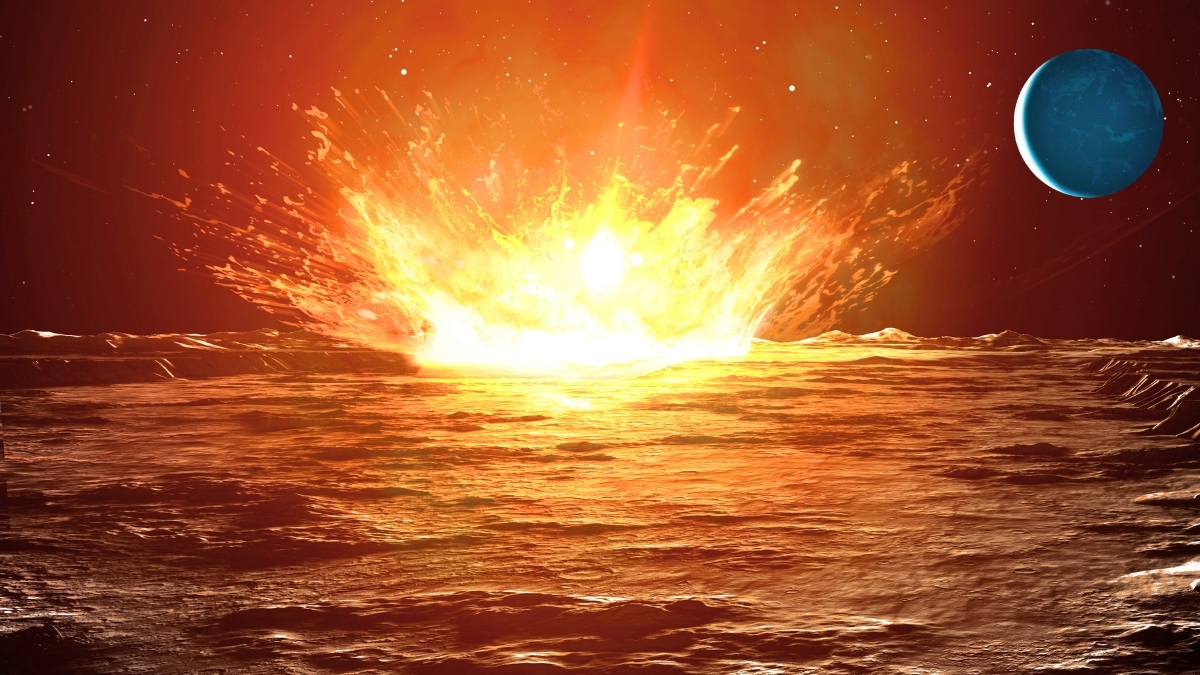
Every circumstance possesses a positive facet. By 2032, the Moon might exhibit a notably luminous side, should it be impacted by a 60-meter-wide asteroid.
The probability of such an occurrence remains comparatively low, estimated at approximately 4 percent, yet it is not entirely negligible.
Consequently, scientific bodies are commencing preparations to address both the adverse ramifications, such as substantial risks to orbital assets and significant meteor showers descending upon vast terrestrial regions, and the advantageous prospects, offering an unparalleled opportunity to conduct in-depth investigations into the geological, seismological, and chemical composition of our celestial companion.
A recent scholarly work, authored by Yifan He from Tsinghua University and his colleagues, disseminated as a preprint on arXiv, explores the beneficial scientific potential that could arise if a collision indeed transpires.
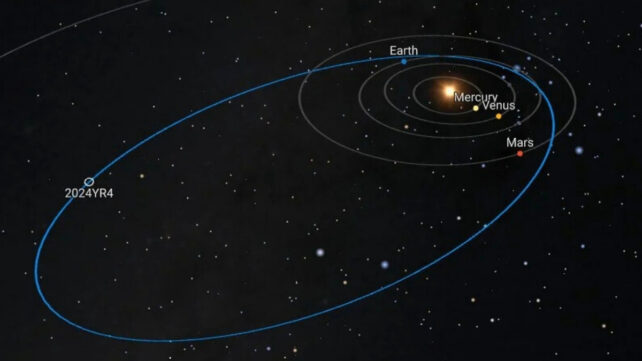
On December 22nd, 2032, Asteroid 2024 YR4 carries a 4 percent likelihood of impacting the Moon. Such an event would unleash energy equivalent to detonating a medium-sized thermonuclear device against our closest celestial neighbor.
This magnitude of energy release would be six orders of magnitude greater than that of the most recent significant lunar impact, which occurred in 2013 and was instigated by a considerably smaller meteoroid.
Should the impact with the Moon materialize, it would represent a fortuitous development for researchers specializing in high-energy collisions. While theoretical models can extensively simulate such events, direct observation during the actual impact would furnish invaluable, unprecedented empirical data, exceedingly difficult to acquire through any other means.
The collision is anticipated to vaporize lunar material, generating plasma, and will be readily discernible from the Pacific Hemisphere, which will be experiencing nighttime at the time of the event.
Even days post-impact, the molten residue from the impacted zone will continue to cool, enabling instruments like the James Webb Space Telescope to gather extensive thermal imaging data, illuminating the cooling dynamics and the precise mechanisms of crater formation on the lunar surface.
A crater approximately 1 km in diameter and ranging from 150 to 260 meters in depth is expected to form, featuring a central pool of molten rock roughly 100 meters across. Comparisons with existing craters across the lunar landscape will facilitate an enhanced understanding of its bombardment chronology.
Furthermore, the impact is projected to trigger a global seismic event on the Moon, registering a magnitude 5.0 moonquake. This would constitute the most powerful moonquake ever recorded by lunar seismometers, and it is anticipated that numerous smaller seismic activities will precede this event as space agencies accelerate their lunar exploration efforts, deploying a comprehensive array of scientific instruments.
Analyzing the propagation patterns of the impact-induced moonquake will provide critical insights into the Moon’s internal structure and assist scientists in discerning its composition without the necessity of artificial subsurface destabilization.
A final scientific dividend would be the resulting debris field. An estimated 400 kg of this material is expected to survive atmospheric reentry to Earth, effectively constituting a gratuitous, large-scale lunar sample return mission for astronomers, irrespective of the inevitable charring of the samples due to their fiery passage through Earth’s atmosphere.
At its zenith, around the Christmas period of 2032, simulations predict an influx of up to 20 million meteors per hour entering our atmosphere, with a substantial proportion, particularly on the planet’s leading hemisphere, being visible to the naked eye. This influx would include approximately 100-400 larger fragments, or fireballs, per hour.
However, this scenario presents a significant drawback. The aforementioned 400 kg of meteoric material must land somewhere, and current projections indicate that South America, North Africa, and the Arabian Peninsula are the most probable impact zones.
While these are not the most densely populated regions globally, even a few kilograms of extraterrestrial rock descending upon a city like Dubai could inflict considerable damage. Potentially more perilous, however, is the threat posed to the vast satellite constellations that are indispensable for modern navigation and internet connectivity.
Such an event could precipitate a “Kessler Syndrome,” leading to the catastrophic failure of the entire network within a few years and simultaneously rendering orbital insertion hazardous for any future endeavors for an extended duration.
In light of these potential risks, certain space agencies are contemplating a mission to alter the trajectory of Asteroid 2024 YR4, thereby averting a potential lunar collision; however, this course of action has not yet been definitively decided.
Similarly, the occurrence of the actual impact itself remains uncertain. Its probability stands at a mere 4 percent – not an astronomical odds-defying chance like winning the lottery, but also not as high as achieving a natural 20 roll in a game of Dungeons & Dragons.
Should this probability escalate in the forthcoming years, humanity will eventually face the quandary of whether to invest the resources required for its deflection. Undertaking such an effort might mean foregoing substantial scientific discoveries, but it could simultaneously safeguard our entire orbital infrastructure and, directly, save numerous lives.
This article was originally published by Universe Today. Read the original article.