
During 2023, a notable downturn was observed in the number of infants welcomed in the EU, with a decrease of 5.4 percent amounting to 3.67 million births. This represented the most significant annual reduction in several decades, as official figures released on Friday highlighted the Union’s persistent demographic challenges.
Across the 27 member states of the European Union, the fertility rate registered at 1.38 live births per woman. This figure marks a decline from 1.46 in the preceding year and falls substantially below the “replacement level” of 2.1, the threshold essential for maintaining a stable population size.
“This constitutes the most substantial year-on-year decline documented since 1961,” stated the bloc’s statistical authority, Eurostat, referencing the earliest year for which comprehensive EU-wide data is obtainable, in relation to the fall in natality. Eurostat commented on the decrease in births.
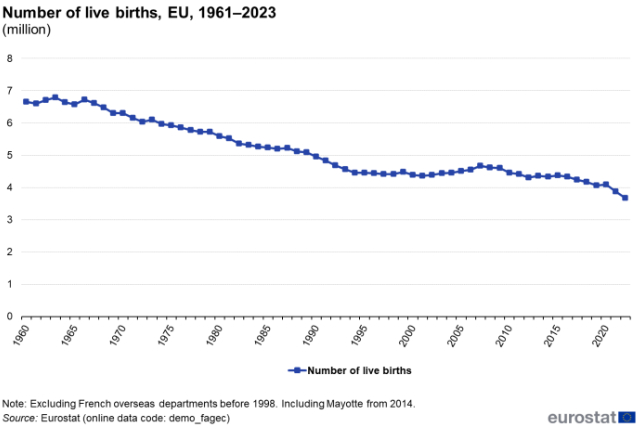
According to the EU’s statistical body, the trend of diminishing births in Europe has been consistent since the mid-1960s, with only minor, sporadic upticks observed over the past two decades.
Consequently, the population within the bloc is aging at an accelerated pace, and certain nations are encountering workforce deficits at a juncture where the ascendancy of right-wing political movements has prompted numerous governments to tighten restrictions on immigration.

Eurostat data indicates that in 1964, a record 6.8 million infants were born within the Union, a figure nearly double that recorded in 2023.
Bulgaria registered the highest overall fertility rate within the EU in 2023, at 1.81 births per woman, followed by France with 1.66 and Hungary with 1.55.
Conversely, Malta reported the lowest rate, with 1.06 births per woman, succeeded by Spain at 1.12 and Lithuania at 1.18.
The average maternal age for a woman’s first childbirth continued its upward trajectory, reaching 29.8 years, an increase from 28.8 years a decade prior in 2013, as reported by Eurostat.
Notwithstanding a higher number of fatalities compared to live births, the total population of the EU expanded by 1.6 million individuals in 2023, bringing the total to 449.2 million, primarily attributed to migratory inflows.