A collaborative effort spearheaded by the University of Wisconsin-Madison has successfully recreated a rudimentary nitrogen-fixing enzyme, offering profound insights into Earth’s early life forms that flourished prior to significant atmospheric oxygenation and establishing a dependable chemical indicator for the potential detection of extraterrestrial life.
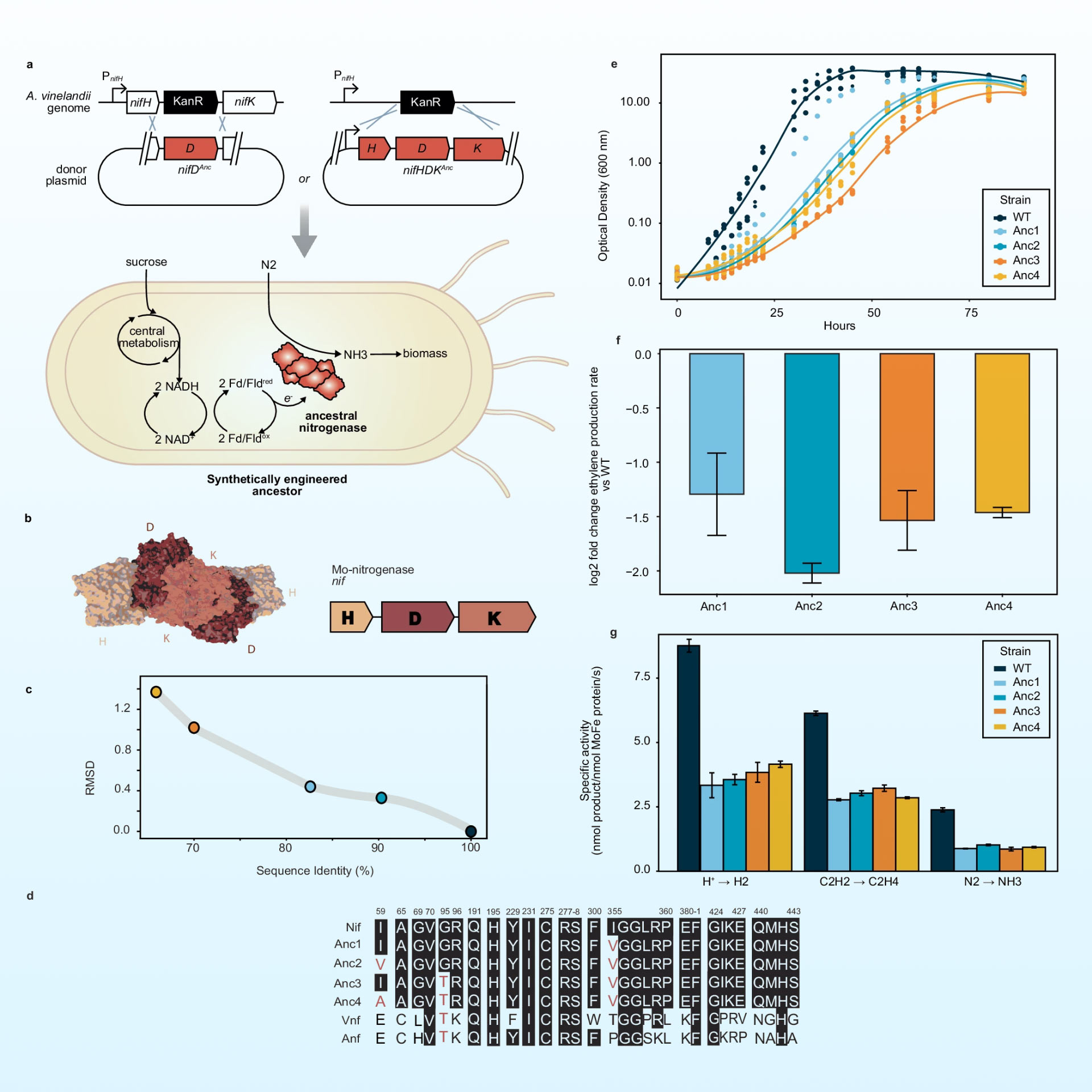
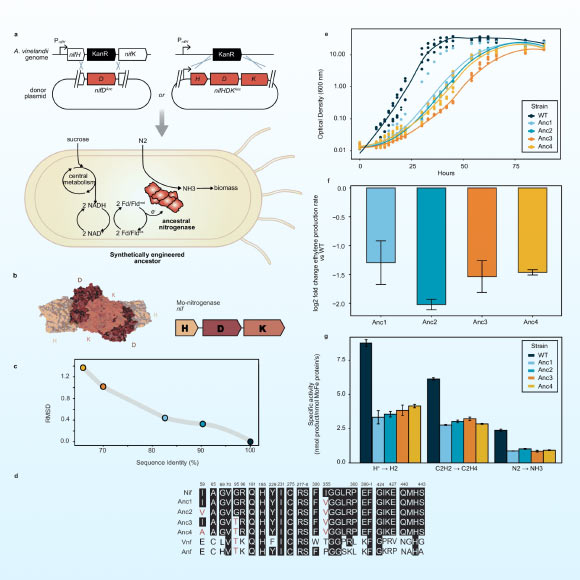
Resurrection and characterization of ancestral nitrogenases. Image credit: Rucker et al., doi: 10.1038/s41467-025-67423-y.
Professor Betül Kaçar and her research team from the University of Wisconsin-Madison concentrated on an enzyme known as nitrogenase, which plays an indispensable role in transforming atmospheric nitrogen into bioavailable compounds essential for myriad life processes.
“Our selection focused on an enzyme that fundamentally shaped terrestrial life, prompting an in-depth investigation into its evolutionary trajectory,” stated Professor Kaçar.
“The existence of life as we comprehend it hinges on the function of nitrogenase.”
Traditionally, scientific understanding of ancient life has been derived from evidence embedded within the geological strata.
Exceptional fossilized remains and rock formations are infrequently discovered, often necessitating considerable serendipity in their retrieval.
Professor Kaçar and her associates propose that synthetic biology offers a complementary methodology to enhance this vital scientific endeavor, bridging knowledge gaps through the construction of tangible replicas of archaic enzymes, their subsequent integration into microorganisms, and their subsequent detailed examination within contemporary laboratory environments.
“The Earth three billion years ago presented a dramatically different environment compared to present conditions,” remarked Holly Rucker, a doctoral candidate at the University of Wisconsin-Madison.
“During the period preceding the Great Oxidation Event, the atmosphere was richer in carbon dioxide and methane, and life predominantly comprised obligate anaerobic microorganisms.”
“The capacity to ascertain how these microbes obtained access to a nutrient as critical as nitrogen provides a more precise depiction of how life persisted and evolved during the epoch when organisms dependent on oxygen had not yet begun to fundamentally alter the planet’s environment.”
“Although direct fossil evidence of enzymes is unavailable for study, these enzymatic molecules can leave behind identifiable traces in the form of isotopes, which are amenable to measurement in geological samples.”
“However, a significant portion of this prior research was predicated on the assumption that ancient enzymes yield isotopic signatures identical to their modern counterparts.”
“It has been determined that this is indeed the case, at least for nitrogenase. The isotopic signatures observed in the geological past are congruent with those detected today, thereby corroborating our understanding of the enzyme’s fundamental properties.”
The researchers’ findings indicate that despite variations in the DNA sequences between ancestral and contemporary nitrogenase enzymes, the underlying mechanism responsible for the isotopic signatures imprinted in the rock record has remained conserved.
“As practitioners of astrobiology, our comprehension of life beyond Earth is intrinsically linked to our understanding of our own planet,” Professor Kaçar elaborated.
“The pursuit of extraterrestrial life commences with an examination of our terrestrial origins, which span approximately four billion years.”
“Consequently, a thorough grasp of our own planetary history and the evolution of life preceding our present era is prerequisite to comprehending future life forms and life elsewhere in the cosmos.”
The published research findings are now available online in the esteemed journal Nature Communications.
_____
H.R. Rucker et al. 2026. Resurrected nitrogenases recapitulate canonical N-isotope biosignatures over two billion years. Nat Commun 17, 616; doi: 10.1038/s41467-025-67423-y