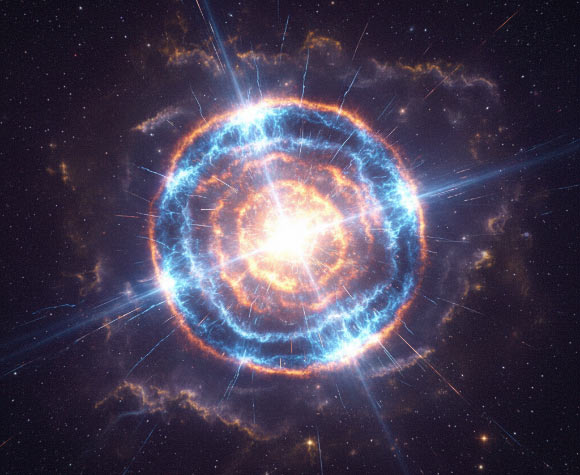
Researchers affiliated with the University of Massachusetts Amherst have posited that an exceptionally high-energy neutrino, detected by the KM3NeT observatory, might represent the definitive signature of a ‘quasi-extremal primordial black hole’ undergoing an explosive demise, thereby indicating the presence of novel physics extending beyond the established Standard Model.
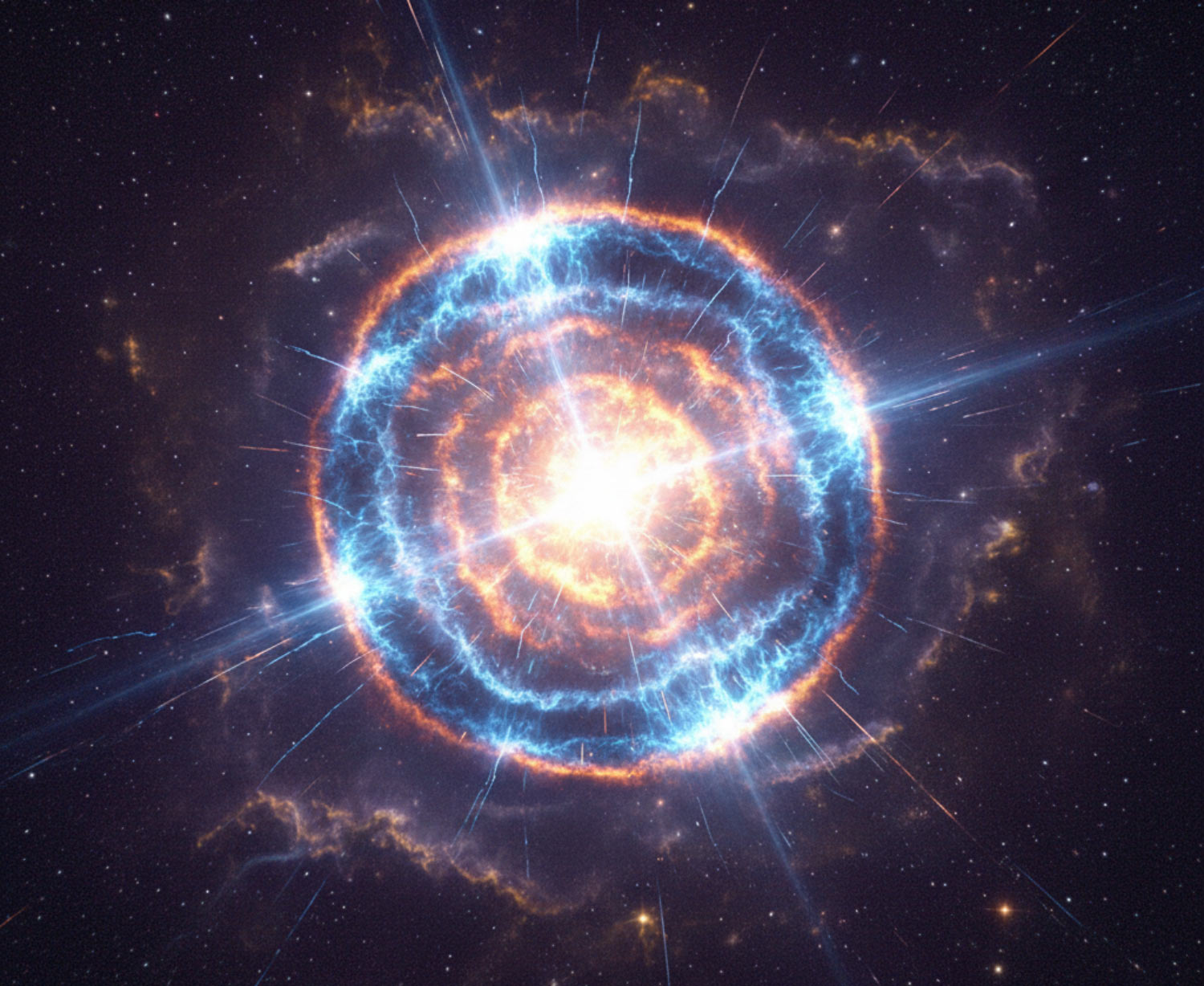
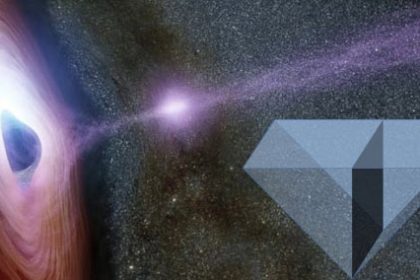
The KM3NeT experiment has recently observed a neutrino with an energy around 100 PeV, and IceCube has detected five neutrinos with energies above 1 PeV; while there are no known astrophysical sources, exploding primordial black holes could have produced these high-energy neutrinos. Image credit: Gemini AI.
The existence of black holes is well-established, and our comprehension of their evolutionary trajectory is robust: a colossal, aging star depletes its nuclear fuel, succumbs to an implosive supernova of immense power, and ultimately leaves behind a region of spacetime characterized by gravitational forces so overwhelming that not even light can escape its grasp. These celestial bodies are characterized by their substantial mass and inherent stability.
However, as conceptualized by physicist Stephen Hawking in 1970, a distinct category of black hole—the primordial black hole—could have originated not from stellar collapse, but from the nascent conditions of the cosmos in the immediate aftermath of the Big Bang.
To date, primordial black holes remain theoretical constructs. Akin to their conventional counterparts, they possess such extreme densities that the escape of virtually any matter or energy is rendered impossible. Nevertheless, notwithstanding their formidable density, these theoretical entities could possess significantly less mass than the black holes heretofore observed.
Furthermore, Hawking elucidated that primordial black holes, under conditions of sufficiently elevated temperature, could gradually release particles through a process now designated as Hawking radiation.
“The less massive a black hole is, the greater its temperature and the more particles it is expected to emit,” stated Dr. Andrea Thamm, a physicist based at the University of Massachusetts Amherst.
“As primordial black holes progressively lose mass, they become lighter and consequently hotter, emitting an escalating quantity of radiation in a self-accelerating cascade culminating in an explosive event.”
“It is precisely this Hawking radiation that our observational instruments are designed to detect.”
“Should such an explosive phenomenon be witnessed, it would furnish us with a comprehensive inventory of all existing subatomic particles, encompassing those already identified, such as electrons, quarks, and Higgs bosons, along with those merely hypothesized, like dark matter particles, and indeed, any other entity currently unknown to scientific inquiry.”
In the year 2023, the KM3NeT experiment successfully captured an anomalous neutrino—precisely the type of M evidence Dr. Thamm and her collaborators had anticipated we might soon encounter.
However, a complicating factor emerged: a comparable experiment, designated IceCube and also tasked with the detection of high-energy cosmic neutrinos, not only failed to record this event but had never registered any particle possessing even one-hundredth of its recorded energy.
If the universe were densely populated with primordial black holes, and if their explosive decay were a frequent occurrence, should we not anticipate a pervasive flux of high-energy neutrinos? What explanation could resolve this apparent inconsistency?
“Our hypothesis is that primordial black holes possessing a ‘dark charge’—which we term quasi-extremal primordial black holes—represent the missing explanatory element,” posited Dr. Joaquim Iguaz Juan, a physicist at the University of Massachusetts Amherst.
“This dark charge essentially functions as a parallel to the familiar electromagnetic force, but it incorporates an exceedingly massive, hypothetical iteration of the electron, which we refer to as a dark electron.”
“Alternative, more parsimonious models of primordial black holes are also under consideration,” remarked Dr. Michael Baker, also associated with the University of Massachusetts Amherst.
“Our proposed dark-charge model is more intricate, suggesting it may offer a more precise representation of reality.”
“The remarkable aspect is observing how our model can elucidate a phenomenon that otherwise defies comprehension.”
“A primordial black hole endowed with a dark charge exhibits distinctive characteristics and behaves in a manner divergent from other, simpler primordial black hole theoretical frameworks,” observed Dr. Thamm.
“We have demonstrated that this concept can effectively reconcile all seemingly discordant experimental observations.”
The research team expresses strong conviction that their dark-charge model of primordial black holes not only accounts for the detected neutrino anomaly but also holds the potential to resolve the enduring enigma of dark matter.
“Observations of galactic structures and the Cosmic Microwave Background radiation provide compelling evidence for the existence of some form of dark matter,” stated Dr. Baker.
“If our hypothesized dark charge proves to be accurate, then we posit the existence of a substantial population of primordial black holes, a scenario consistent with other astrophysical findings and capable of accounting for the entirety of the universe’s missing dark matter,” elaborated Dr. Iguaz Juan.
“The detection of the high-energy neutrino was a truly extraordinary occurrence,” Dr. Baker affirmed.
“It has unveiled a novel perspective on the cosmos. We may now be poised on the precipice of experimentally validating Hawking radiation, thereby obtaining evidence for both primordial black holes and novel particles beyond the Standard Model, while simultaneously unraveling the mystery of dark matter.”
These groundbreaking discoveries have been published in the esteemed journal Physical Review Letters.
_____
Michael J. Baker et al. Explaining the PeV neutrino fluxes at KM3NeT and IceCube with quasi-extremal primordial black holes. Phys. Rev. Lett, published online December 18, 2025; doi: 10.1103/r793-p7ct