It is highly probable that Mars once harbored substantial quantities of water. Prior observations indicated that the majority of atmospheric water dissipation occurred during the Red Planet’s austral summer, a period characterized by elevated temperatures and increased dust, which facilitates water vapor’s ascent to significant altitudes without condensation, ultimately enabling its escape into space. In a recent investigation, planetary scientists have identified a previously unacknowledged mechanism of water loss, observed for the first time during the opposing season. Their findings demonstrate that a potent, localized, and brief dust event in Martian Year 37 (corresponding to August 2023) induced a substantial upward surge of water vapor during the northern hemisphere’s summer.

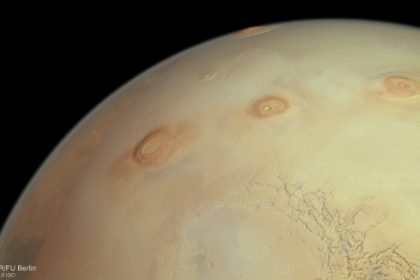
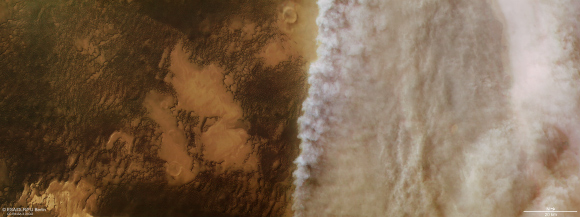
This close-up color image of a small-scale dust storm on Mars was acquired by the HRSC instrument on ESA’s Mars Express in April 2018. Image credit: ESA / DLR / FU Berlin / CC BY-SA 3.0 IGO.
“Our discoveries illuminate the influence of this storm type on the planet’s climatic evolution and introduce a novel avenue for comprehending the extensive water depletion that Mars has undergone over time,” stated Dr. Adrián Brines, a researcher affiliated with the Instituto de Astrofísica de Andalucía and the University of Tokyo.
Dust storms have long been acknowledged for their role in Martian water escape; however, previous discourse primarily centered on large-scale, planet-encircling dust phenomena.
Conversely, Dr. Brines and his collaborators have demonstrated that smaller, regional storms possess the capacity to significantly enhance the transport of water to high atmospheric levels, from which it can be more readily lost to the vacuum of space.
Furthermore, prior research predominantly focused on the warm, dynamic conditions of the southern hemisphere’s summers, given that this period is typically the principal phase of water depletion on Mars.
The present study documented an atypical elevation in water vapor within Mars’s mid-atmosphere during the northern hemisphere’s summer in Martian Year 37, an occurrence directly attributable to an anomalous dust storm.
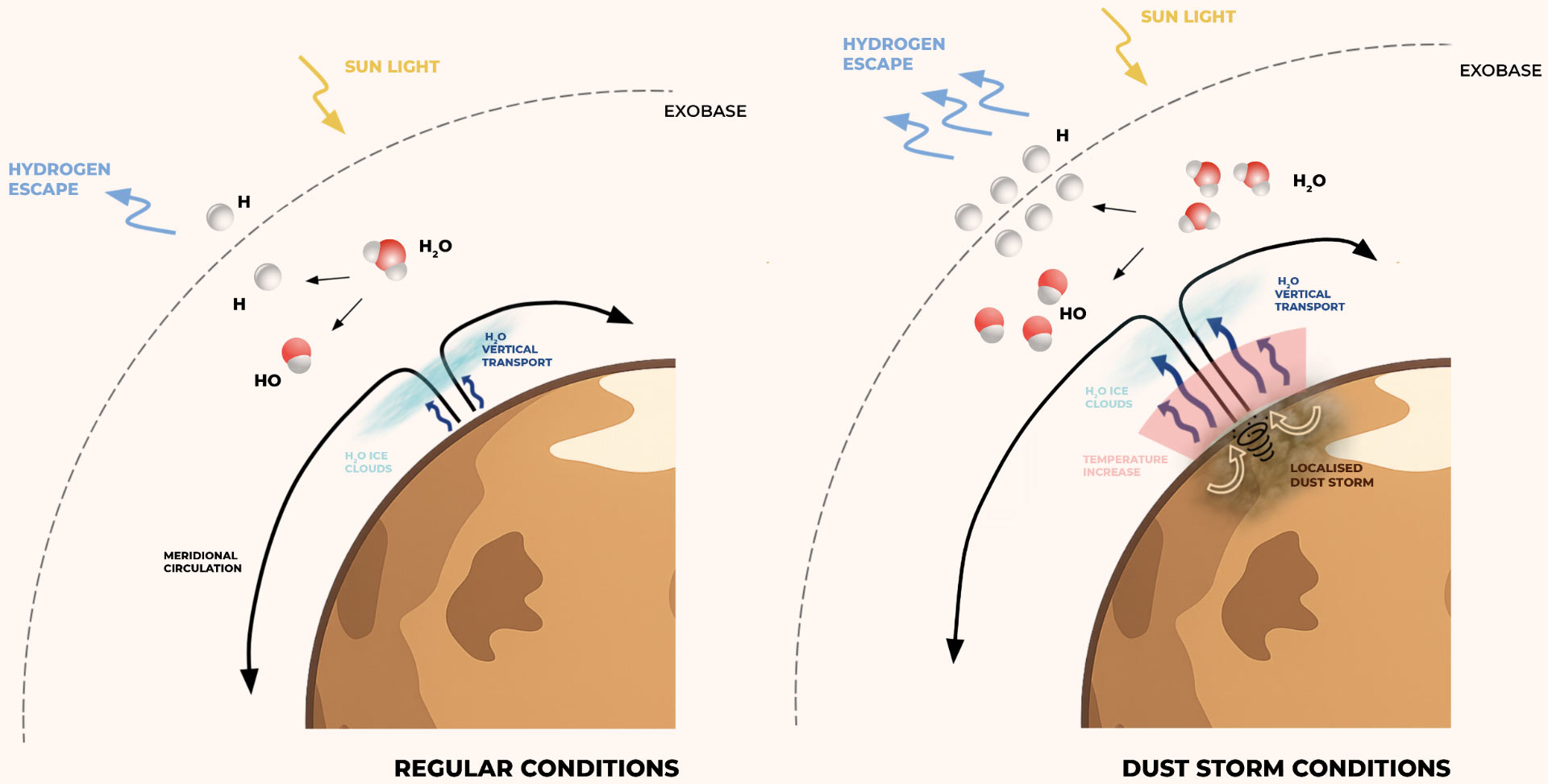
At these altitudes, the concentration of water reached levels up to tenfold the typical amount, a situation unprecedented in prior Martian years and not accounted for by current climatic models.
Subsequently, the quantity of hydrogen detected in the exobase, the atmospheric boundary merging with space, rose markedly, becoming 2.5 times greater than observed in previous years during the equivalent season.
A critical element in ascertaining the extent of water loss on Mars involves quantifying hydrogen escape into space, as this element is readily liberated when water molecules dissociate within the atmosphere.
“These findings provide an essential new component to the incomplete understanding of how Mars has lost its water over eons, and demonstrate that transient yet intense events can play a significant role in the Red Planet’s climate evolution,” commented Dr. Shohei Aoki, a researcher at the University of Tokyo and Tohoku University.
The findings are published this week in the esteemed journal Communications: Earth & Environment.
_____
A. Brines et al. 2026. Out-of-season water escape during Mars’ northern summer triggered by a strong localized dust storm. Commun Earth Environ 7, 55; doi: 10.1038/s43247-025-03157-5