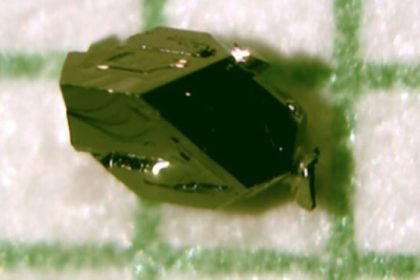
In a significant stride towards enhancing the efficiency and economic viability of renewable energy capture, researchers at Korea University have developed gold nanospheres meticulously designed to absorb light across the entire solar spectrum.
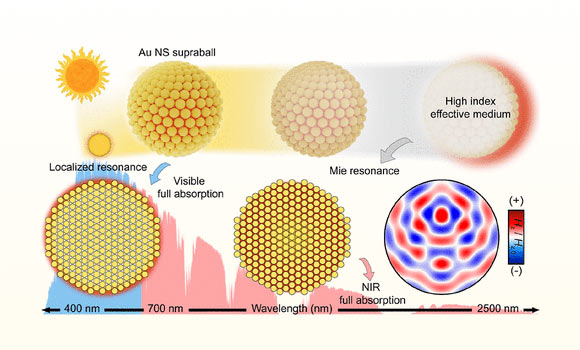
Hun Rho et al. have unveiled plasmonic colloidal supraballs, which are solution-processable aggregations of gold nanospheres, presenting a resilient and adaptable framework for capturing solar energy across a broad spectrum. Image attribution: Hun Rho et al., doi: 10.1021/acsami.5c23149.
The scientific community is actively pursuing novel materials capable of absorbing the full range of light emitted by the sun to augment solar energy conversion.
While gold and silver nanoparticles have been proposed as cost-effective and easily manufactured solutions, their current light absorption capabilities are confined primarily to the visible light frequencies.
To extend light capture to additional wavelengths, including those in the near-infrared region, a team led by Seungwoo Lee at Korea University has put forth the concept of utilizing self-assembling gold supraballs.
These sophisticated structures are formed when gold nanoparticles aggregate organically to create minute spherical entities.
The dimensions of these supraballs were intentionally calibrated to optimize the absorption of the prevalent wavelengths found within sunlight.
Initially, the researchers employed computational modeling to refine the design of individual supraballs and to forecast the performance characteristics of films composed of these supraballs.
The outcomes of these simulations indicated that the supraballs should be capable of absorbing upwards of 90% of the solar spectrum’s wavelengths.
Subsequently, the scientists fabricated a film of gold supraballs by allowing a liquid suspension containing these structures to dry on the surface of a readily available thermoelectric generator, a device engineered to convert light radiation into electrical energy.
These films were produced under standard atmospheric conditions, negating the need for specialized cleanroom environments or extreme temperature controls.
During trials using an LED solar simulator, the thermoelectric generator treated with the supraball coating demonstrated an average solar absorption rate of approximately 89%. This performance is nearly double that of a thermoelectric generator using a conventional film made from individual gold nanoparticles, which achieved a 45% absorption rate.
“Our plasmonic supraballs provide a straightforward method for harnessing the entirety of the solar spectrum,” stated Dr. Lee.
“Ultimately, this coating technology holds the potential to substantially reduce the prerequisites for achieving high-efficiency solar-thermal and photothermal systems in practical energy applications.”
The research undertaken by the team is published in the esteemed journal ACS Applied Materials & Interfaces, accessible via the following link.
_____
Kyung Hun Rho et al. 2026. Plasmonic Supraballs for Scalable Broadband Solar Energy Harvesting. ACS Appl. Mater. Interfaces 18 (1): 2523-2537; doi: 10.1021/acsami.5c23149