The detection of a singular, faint transit within the archived observations from NASA’s Kepler extended K2 initiative has enabled astronomers to identify a novel exoplanet in orbit around the proximate K-dwarf star designated HD 137010.
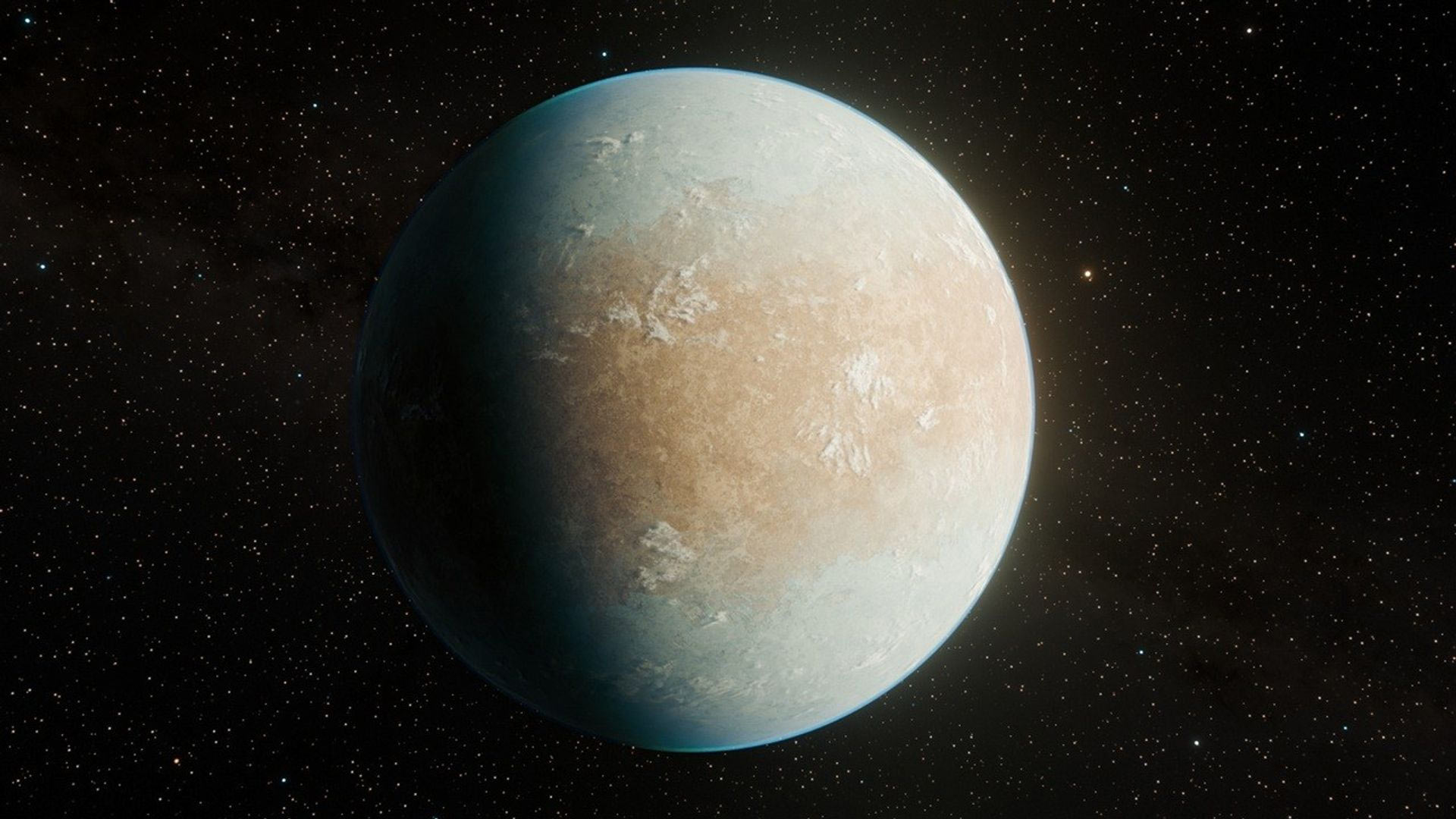
HD 137010b is estimated to be only 6% larger than Earth, with a surface temperature more similar to Mars — potentially below minus 70 degrees Celsius. Image credit: NASA / JPL-Caltech / Keith Miller, Caltech & IPAC.
Situated approximately 146 light-years distant within the constellation of Libra, HD 137010 is classified as a K3.5V dwarf star.
Its estimated age spans between roughly 4.8 and 10 billion years, and its minimal magnetic activity aligns with the characteristics of an ancient, comparatively quiescent star.
This celestial body, also recognized by designations such as BD-19 4097, HIC 75398, 2MASS J15242123-1944215, or TYC 6179-1111-1, possesses a visual magnitude of 10.1. This makes it one of the most luminous stars known to harbor a planet comparable in size to Earth, exhibiting temperate orbital characteristics.
The exoplanet, identified as HD 137010b, was brought to light during K2 Campaign 15, a period in 2017 when NASA’s Kepler space telescope maintained observations of the host star for close to three months.
“Prior discoveries of terrestrial-sized planets situated within habitable zones have predominantly been associated with stars termed red dwarfs, which are considerably smaller and less luminous than our Sun,” stated Alexander Venner, an astronomer at the University of Southern Queensland and the lead author of the research. “Researchers harbor concerns that such planets might experience complete atmospheric dissipation due to high-energy radiation emanating from their parent stars, rendering them inhospitable to known forms of life.”
“Conversely, the host star of HD 137010b exhibits properties much more akin to our Sun, which, according to prevailing theoretical models, enhances the probability that the planet could retain an atmosphere.”
In their comprehensive investigation, Dr. Venner and his collaborators meticulously analyzed K2 observational data, photometric light curves of neighboring stars, archived imagery, measurements of radial velocity, and astrometric information to ascertain the nature of the detected signal, which persisted for approximately 10 hours.
These rigorous examinations strongly suggest that the observed transit originated from the intended target star and possessed an astrophysical basis, rather than stemming from background stellar interference, a nearby eclipsing binary system, or an object within our solar system.
From the measured transit depth, the astronomical team deduced a planetary radius approximately 1.06 times that of Earth.
Leveraging the transit duration and the host star’s characteristics, they have estimated an orbital period of about 355 days.
At its current orbital distance from its parent star, HD 137010b is projected to absorb approximately 29% of the stellar energy flux that Earth receives from the Sun, positioning it near the outer boundary of the star’s habitable zone.
“Should HD 137010b possess an atmosphere comparable to that of Earth or Mars, it would likely experience temperatures colder than Antarctica,” Dr. Venner remarked.
“However, a more substantial atmosphere could potentially raise the planet’s temperature sufficiently to support liquid water, possibly creating a conducive environment for life.”
“Although current astronomical instrumentation is not yet capable of fully characterizing this recently identified planet, it holds promise as a primary candidate for future radial velocity instruments specifically designed to detect Earth analogues.”
“Future space missions dedicated to the direct imaging of Earth-like planets, such as NASA’s Habitable Worlds Observatory, may also possess the capability to capture visual representations of HD 137010b.”
This significant discovery has been formally documented in a publication within the esteemed Astrophysical Journal Letters.
_____
Alexander Venner et al. 2026. A Cool Earth-sized Planet Candidate Transiting a Tenth Magnitude K-dwarf from K2. ApJL 997, L38; doi: 10.3847/2041-8213/adf06f