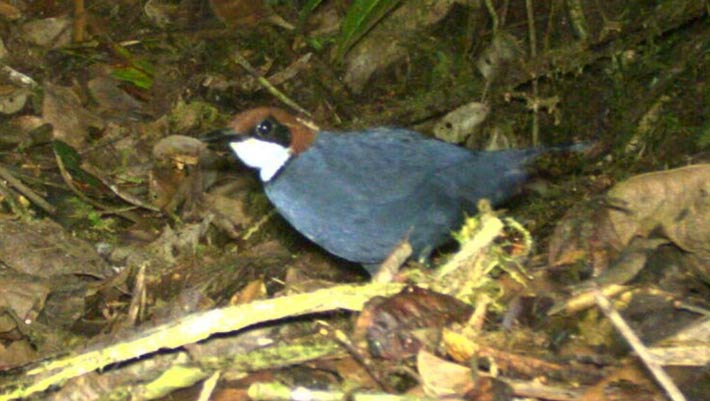
Utilizing remote camera surveillance, ornithologists have documented a previously uncatalogued species of jewel-babbler within the limestone karst formations of the Southern Fold Mountains in Papua New Guinea.
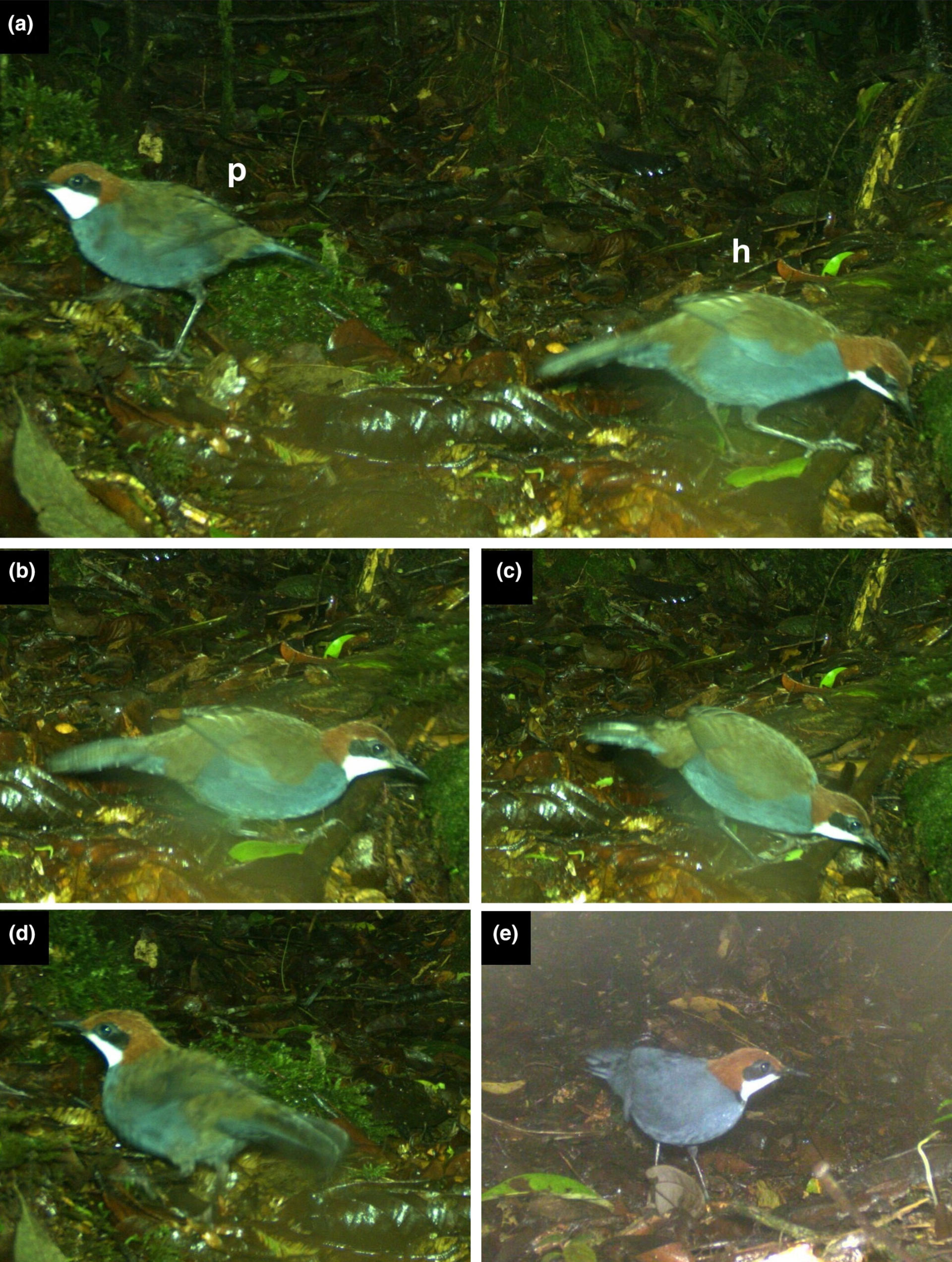
Camera trap images of the holotype and two paratypes of Ptilorrhoa urrissia, captured during a three-month observational period across a dense network spanning 0.5 hectares: the holotype (indicated by ‘h’ in a-c) and a paratype (marked ‘p’ in a and d), presumed to be an adult female and a juvenile exhibiting female plumage characteristics, were photographed concurrently on January 1, 2020. These visual records are part of an 87-second sequence comprising 20 distinct photographs. A presumed adult male paratype (e) was recorded less than 40 meters distant on March 8, 2020. Image attribution: Woxvold et al., doi: 10.1111/ibi.70016.
This newly identified avian entity falls under the genus Ptilorrhoa, a genus encompassing small birds within the Cinclosomatidae family.
These birds, commonly referred to as jewel-babblers, are indigenous to the island of New Guinea.
“The jewel-babblers constitute a group of terrestrial, insectivorous passerine birds native to New Guinea and a select few adjacent land-bridge islands,” stated ornithologist Iain Woxvold of the Australian Museum Research Institute, alongside his collaborating researchers.
“These are robust, short-winged avians characterized by a dark facial marking, a pale throat or cheek area, and downy plumage that typically displays patterns of blue and/or reddish-brown hues across most species.”
“They are vocally active yet discreet denizens of the interior woodlands, more frequently perceived through auditory cues than visual observation.”
“Currently, four species are officially recognized, with three inhabiting the majority of New Guinea but exhibiting distinct altitudinal preferences: the blue jewel-babbler (Ptilorrhoa caerulescens) found in lower elevations, the chestnut-backed jewel-babbler (Ptilorrhoa castanonota) in hilly and lower mountainous regions, and the spotted jewel-babbler (Ptilorrhoa leucosticta) inhabiting montane forests.”
“The fourth species, the brown-headed jewel-babbler (Ptilorrhoa geislerorum), is distributed across two geographically disparate areas—one in the hills and lowlands of northeastern Papua New Guinea, and another, recently discovered population (believed to be this species), situated considerably to the west on Yapen Island.”
In 2017, Dr. Woxvold and his associate, Leo Legra from Lihir Gold Limited, initiated a biannual camera trap surveillance program focused on ground-dwelling avifauna and mammals. This study was conducted on Iagifu Ridge (known locally in the Fasu language as uri [mount] urrissia), a wooded limestone anticlinal structure located at the southeastern extremity of the Agogo Range within the Southern Highlands Province of Papua New Guinea.
Within the collected imagery, an unmistakable and hitherto undescribed variant of the jewel-babbler was identified.
“Spanning over 1,800 days of camera deployment, ten photographic instances of the bird were procured across three distinct detection events. These events were recorded by two cameras positioned approximately 600 meters apart, with an unpaved access road in between,” the researchers reported.
“During an eight-day period in November 2018, our efforts involving mist-netting and direct searches for the bird yielded no positive results.”
“Camera trap monitoring was subsequently reinstated in 2019, 2021, and 2024.”
“In total, 94 photographs (from 22 sequences) and seven 30-second video clips (from four sequences), involving a minimum of three to six individuals, were acquired by eleven cameras spread across a 16-hectare area.”
A thorough analysis of existing museum specimens and field photographic evidence substantiated that the birds captured in the authors’ photographs are definitively distinct from all previously cataloged Ptilorrhoa types.
“Based on these findings, we propose that the avian subjects documented on Iagifu Ridge represent a novel species, to which we assign the designation: the hooded jewel-babbler (Ptilorrhoa urrissia),” they announced.
Ptilorrhoa urrissia appears to maintain a permanent presence on Iagifu Ridge, with individuals being photographed consistently over a seven-year span during each of ten consecutive months (June through March).
The estimated total population of this newly identified species detected throughout the sampling period is likely less than ten individuals.
“Jewel-babblers are typically observed as solitary individuals, in pairs, or in small familial groupings of three to four,” the scientific team observed.
“Available data suggest a comparable social structure for Ptilorrhoa urrissia: pairs were routinely photographed together, and the majority of records (excluding three instances of an isolated male) were gathered within a 7-hectare territory and potentially implicate a resident pair with a single offspring from two separate breeding events.”
“We hypothesize that Iagifu Ridge may harbor a segment of a highly fragmented population inhabiting isolated low-lying mountains that do not support the presence of Ptilorrhoa leucosticta, a species preferring higher altitudes,” they further commented.
“Potential habitats conducive to this species might be confined to the region situated between Mount Bosavi and Mount Karimui in southern Papua New Guinea.”
No vocalizations clearly attributable to any Ptilorrhoa species, with the exception of Ptilorrhoa castanonota, have been detected on Iagifu Ridge by the research expedition.
In terms of vocal behavior, the new species seems to exhibit less vocal activity than Ptilorrhoa caerulescens and Ptilorrhoa castanonota, aligning more closely with Ptilorrhoa leucosticta in this regard.
“The jewel-babblers inhabiting Iagifu Ridge are confronted by a spectrum of threats,” the scientists elaborated.
“Confirmed native predators present include a minimum of three marsupial species—the New Guinea quoll (Dasyurus albopunctatus), Woolley’s three-striped dasyure (Myoictis leucura), and one or more species from the genus Murexia. Additionally, several avian predators are present, such as the Papuan eagle (Harpyopsis novaeguineae), the gray-headed goshawk (Tachyspiza poliocephala), and the greater sooty owl (Tyto tenebricosa). Each of these predators scavenges from the ground and poses a risk of predating adult birds or their offspring.”
“Non-native predators introduce an additional, potentially grave, danger, particularly to ground-nesting species like the jewel-babblers.”
“Domestic cats (Felis catus) were captured on camera traps on Iagifu Ridge on three separate occasions in 2021 and 2024.”
“Domestic dogs (Canis familiaris) are also routinely observed at the site, either accompanying human hunters or as strays or members of small feral packs.”
“Finally, the pervasive issue of climate change presents a significant hazard to tropical montane bird populations, especially those with limited migratory capabilities and lacking access to higher elevations, a category that includes Ptilorrhoa urrissia at its Iagifu Ridge habitat.”
A scholarly article detailing this discovery was disseminated on November 26, 2025, through the esteemed journal Ibis.
_____
Iain A. Woxvold et al. A new species of jewel-babbler (Cinclosomatidae: Ptilorrhoa) from the Southern Fold Mountains of Papua New Guinea. Ibis, published online November 26, 2025; doi: 10.1111/ibi.70016