An extraordinary scientific revelation has emerged from northern Ontario, Canada, where researchers have successfully extracted ancient gases and fluids preserved within 1.4-billion-year-old halite crystals. Detailed analysis of these inclusions has provided direct quantitative data on atmospheric conditions during the Mesoproterozoic era (spanning from 1.8 to 0.8 billion years ago). The findings indicate that oxygen levels were approximately 3.7% of present-day concentrations, while carbon dioxide existed at concentrations roughly ten times preindustrial levels. These discoveries suggest a period of remarkable climatic stability and reveal that atmospheric oxygen, at least intermittently, reached concentrations sufficient to support the metabolic needs of early animal forms significantly predating their actual appearance.
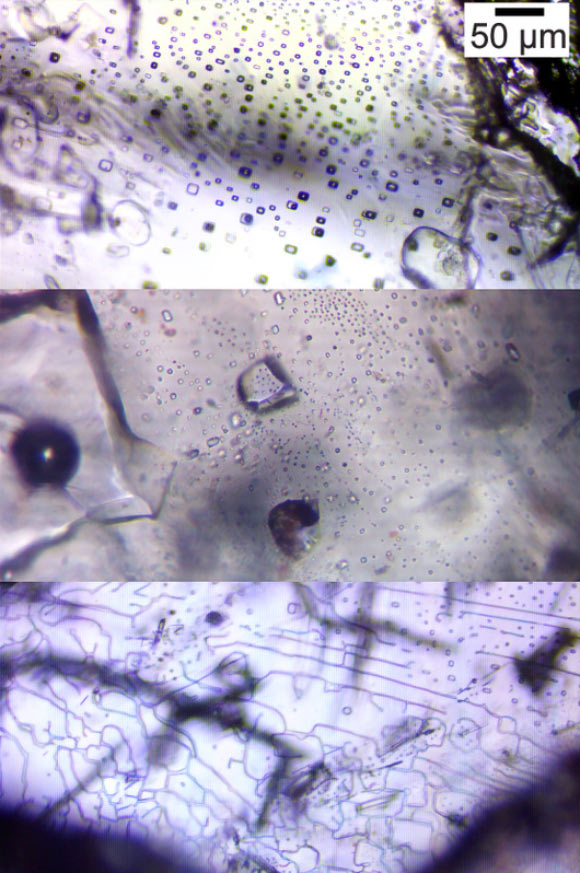
Example photographs of primary, mixed, and secondary halite inclusion assemblages. Image credit: Park et al., doi: 10.1073/pnas.2513030122.
It has long been understood that fluid inclusions embedded within halite formations represent precious samples of Earth’s ancient atmosphere.
However, obtaining precise measurements from these inclusions has presented a substantial technical hurdle. They contain a mixture of air bubbles and dissolved salts, and atmospheric constituents like oxygen and carbon dioxide exhibit distinct behaviors in an aqueous environment compared to their behavior in gaseous form.
“The sensation of analyzing air that predates the age of dinosaurs by a billion years is truly unparalleled,” remarked Justin Park, a graduate student at Rensselaer Polytechnic Institute.
Professor Morgan Schaller, also from Rensselaer Polytechnic Institute, highlighted the novelty of the findings: “The carbon dioxide measurements we have managed to acquire are unprecedented.”
“Never before have we possessed the capability to investigate this specific epoch of Earth’s past with such a high degree of fidelity. These samples are, in essence, direct specimens of ancient air!
The data obtained reveals that the Mesoproterozoic atmosphere contained approximately 3.7% of the oxygen present today, a figure surprisingly elevated and sufficiently high to sustain the development of sophisticated multicellular animal life, which did not emerge for hundreds of millions of years thereafter.
Concurrently, carbon dioxide concentrations were approximately ten times higher than current levels, a circumstance potent enough to counteract the ‘faint young Sun’ effect and maintain a climate comparable to modern conditions.
A pertinent question naturally arises: given the presence of oxygen adequate for animal life, why was there such a prolonged delay in its evolutionary manifestation?
“The analyzed sample represents a specific point within a vast geological timescale,” Park explained.
“It is plausible that this indicates a brief, ephemeral oxygenation event within this extended period that geologists have somewhat facetiously dubbed the ‘Boring Billion’.”
“This epoch in Earth’s history was characterized by low oxygen levels, a general absence of atmospheric and geological upheaval, and minimal evolutionary advancement.”
“Despite its moniker, the availability of direct observational data from this era is critically important, as it significantly enhances our comprehension of the origins of complex life on our planet and the evolutionary trajectory of our atmosphere to its current state.”
Prior estimations of carbon dioxide levels during this period, derived through indirect methods, suggested lower concentrations that were incongruent with other geological evidence indicating the absence of significant glaciation throughout the Mesoproterozoic Era.
The direct measurements of elevated carbon dioxide by the research team, when considered alongside temperature estimations derived from the salt itself, support the conclusion that the Mesoproterozoic climate was more temperate than previously theorized, exhibiting similarities to present-day conditions.
“The proliferation of red algae occurred around this juncture in Earth’s history, and they continue to be a substantial contributor to global oxygen production even today,” stated Professor Schaller.
“The relatively high oxygen concentrations observed may be a direct consequence of the increasing prevalence and sophistication of algal ecosystems.”
“It is conceivable that our captured sample corresponds to a particularly significant moment squarely within the ‘Boring Billion’.”
The scholarly article detailing this research has been published today in the Proceedings of the National Academy of Sciences and can be accessed via the following link: paper.
Justin G. Park et al. 2025. Breathing life into the boring billion: Direct constraints from 1.4 Ga fluid inclusions reveal a fair climate and oxygenated atmosphere. PNAS 122 (52): e2513030122; doi: 10.1073/pnas.2513030122