A novel genus and species of tiny, bipedal dinosaur has been identified through fossil discoveries within Spain’s Burgos province.
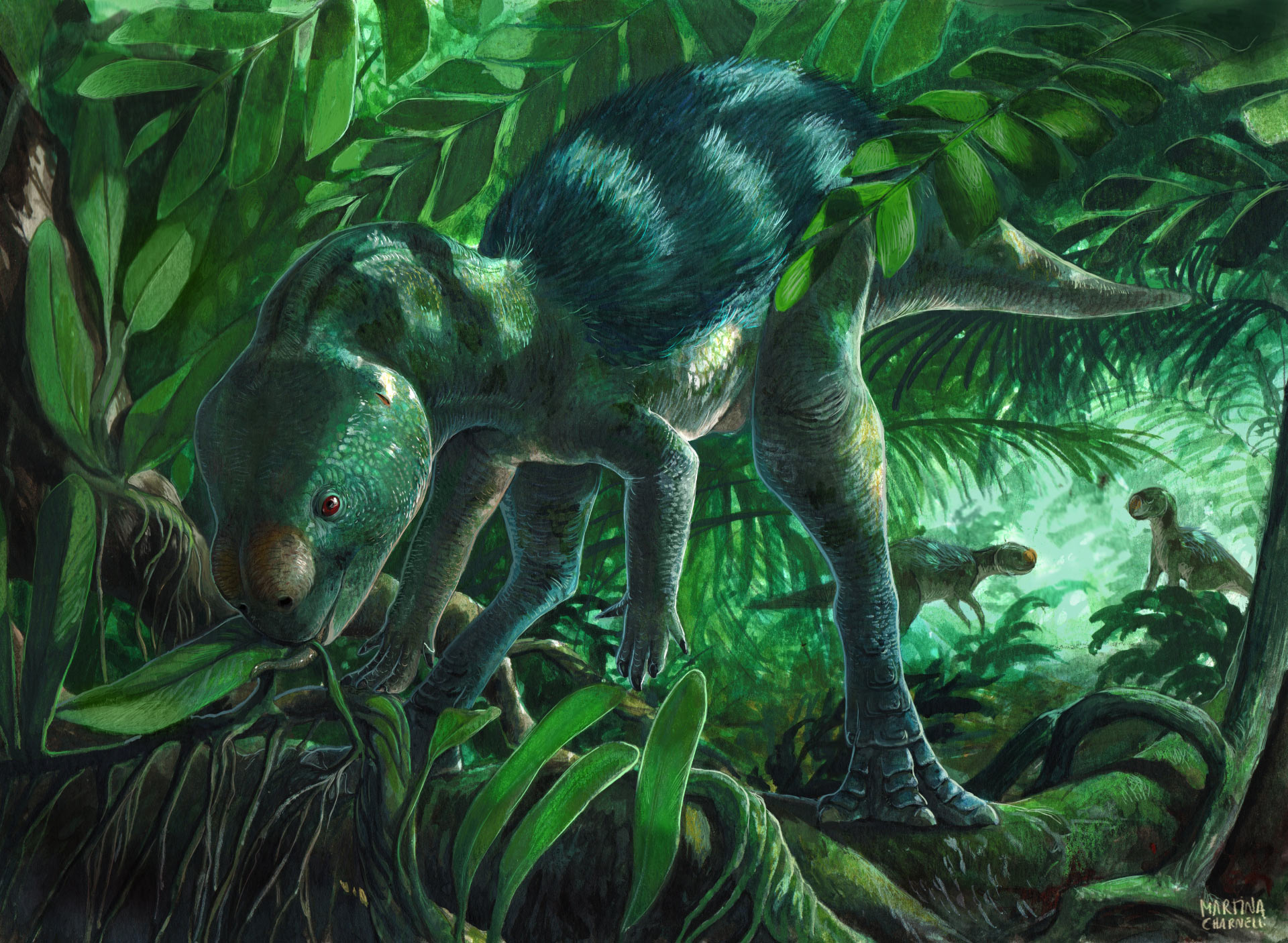
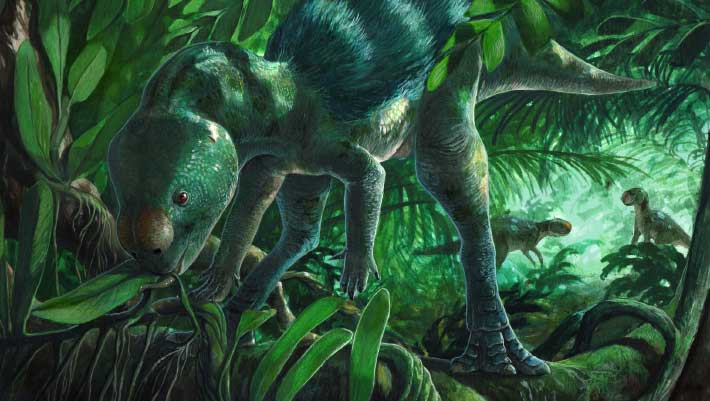
Life reconstuction of Foskeia pelendonum. Image credit: Martina Charnell.
Foskeia pelendonum inhabited Earth during the Early Cretaceous period, approximately 120 million years ago.
This newly identified species belonged to the Rhabdodontomorpha lineage, a classification of ornithischian dinosaurs prevalent from the Early to Late Cretaceous eras.
The ancient creature was remarkably small, comparable in stature to a modern chicken, distinguishing it from numerous larger ornithischian kin.
“From the outset, these skeletal remains were recognized as extraordinary due to their minuscule dimensions,” stated Dr. Fidel Torcida Fernández-Baldor, a paleontologist affiliated with the Dinosaur Museum of Salas de los Infantes.
“It is equally compelling how the examination of this organism challenges prevailing global perspectives on ornithopod dinosaur evolution.”
“The process of miniaturization did not equate to evolutionary simplification; this skull exhibits peculiar and highly evolved characteristics,” remarked Dr. Marcos Becerra, a paleontologist from the Universidad Nacional de Córdoba.
“Foskeia pelendonum helps bridge a significant 70-million-year hiatus, serving as a minor key that unlocks a vast, previously missing chapter of evolutionary history,” commented Dr. Thierry Tortosa, a paleontologist at the Sainte Victoire Natural Reserve.
“This specimen is certainly not merely a ‘miniature Iguanodon‘; it represents something fundamentally distinct,” noted Dr. Tábata Zanesco Ferreira, a paleontologist at the Universidade Federal do Rio de Janeiro.
“Its anatomical composition is unusual in a manner that necessitates a revision of established evolutionary trees,” explained Dr. Penélope Cruzado-Caballero, a paleontologist from the Universidad de La Laguna.
The fossilized remnants belonging to a minimum of five individuals of Foskeia pelendonum were unearthed at the Vegagete excavation site in Spain’s Burgos province.
“The geological context of the site comprises red-clay floodplain sediments belonging to the Castrillo de la Reina Formation, situated between the municipalities of Villanueva de Carazo and Salas de los Infantes,” the research team reported.
Histological examination confirmed that the most substantial specimen represented a sexually mature adult.
“The microscopic structure of the bone indicates that at least one individual had reached adulthood and possessed a metabolic rate approaching that of small mammals or birds,” shared Dr. Koen Stein, a researcher at Vrije Universiteit Brussel.
“Understanding the growth and developmental patterns is paramount for effectively comparing the anatomy of Foskeia pelendonum with that of other species.”
“Immature individuals are susceptible to alterations in their anatomical features as they mature.”
Based on phylogenetic analysis, Foskeia pelendonum is positioned as a sister species to the Australian dinosaur Muttaburrasaurus within the Rhabdodontomorpha clade, thereby expanding the European Rhabdodontia group.
“Our findings suggest that herbivorous dinosaurs constitute a distinct taxonomic unit, which we have termed Phytodinosauria,” stated Dr. Paul-Emile Dieudonné, a researcher at the National University of Río Negro.
“This proposed hypothesis warrants further validation through the acquisition of additional data.”
Despite its diminutive size, Foskeia pelendonum displays specialized dental structures and evidence of postural adjustments throughout its growth, suggesting a reliance on rapid locomotion within dense forest environments.
“These fossil discoveries provide compelling evidence that evolutionary experimentation occurred with equal radicality across both small and large body sizes,” emphasized Dr. Dieudonné.
“The trajectory of future paleontological inquiry will hinge upon careful consideration of the humble, the incomplete, and the minute.”
The unearthing of Foskeia pelendonum is detailed in a publication featured in the journal Papers in Palaeontology.
_____
l-Emile Dieudonné et al. 2026. Foskeia pelendonum, a new rhabdodontomorph from the Lower Cretaceous of Salas de los Infantes (Burgos Province, Spain), and a new phylogeny of ornithischian dinosaurs. Papers in Palaeontology 12 (1): e70057; doi: 10.1002/spp2.70057