Recent microwave telemetry gathered by NASA’s Juno mission indicates that Europa’s icy exterior may extend to a depth of nearly 29 kilometers (18 miles), fundamentally altering planetary scientists’ hypotheses regarding the mechanisms by which the moon’s concealed ocean might facilitate the exchange of life-sustaining chemical compounds with its surface.
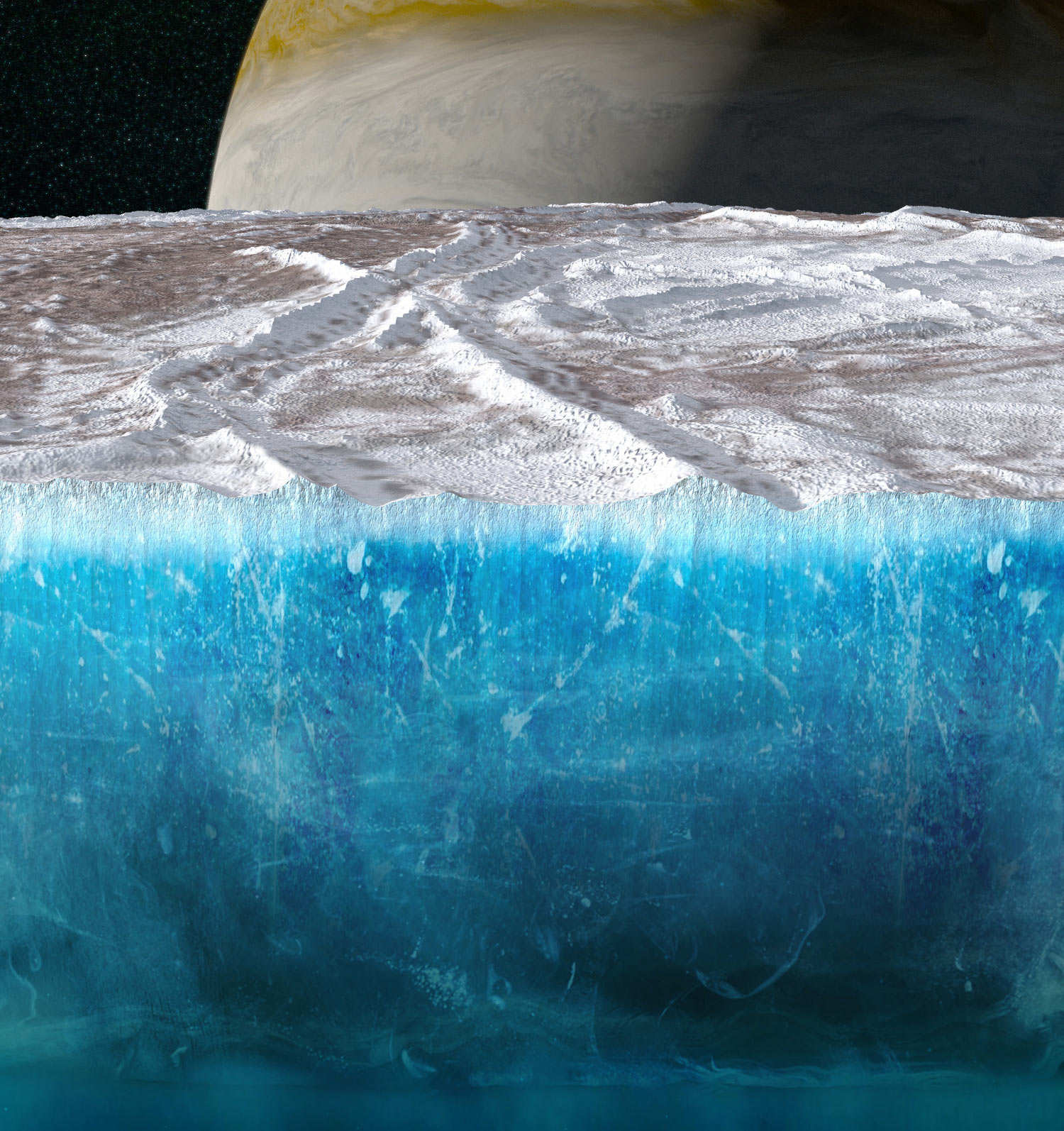
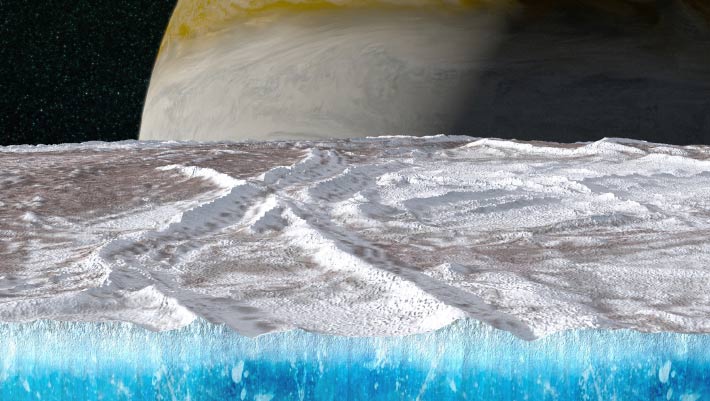
This artistic rendering illustrates a cross-section of Europa’s icy mantle. Credit: NASA / JPL-Caltech / SwRI / Koji Kuramura / Gerald Eichstädt.
For over four decades, Europa has been a focal point for planetary researchers.
The question of whether this Jovian satellite is a viable candidate for habitability has been a subject of considerable discussion for many years.
Interest in its potential for supporting life significantly escalated following findings from NASA’s Galileo spacecraft, which suggested the presence of an electrically conductive, saline ocean situated beneath its frozen crust, accompanied by visible fissures on the surface ice.
On September 29, 2022, NASA’s Juno spacecraft executed a close flyby of Europa, passing at an altitude of 360 kilometers (220 miles).
During this encounter, Juno’s Microwave Radiometer (MWR), originally engineered for the study of Jupiter’s deep atmospheric layers, captured data on brightness temperatures across various strata within Europa’s icy crust.
Leveraging the MWR telemetry, the lead scientist for the Juno mission, Steve Levin, along with his research associates, deduced that the ice shell possesses an average thickness of approximately 29 kilometers.
“The 29-kilometer estimation pertains to the cold, rigid, and conductive outermost stratum of a pure water ice shell,” stated Dr. Levin. “Should an interior layer, characterized by slightly warmer convective properties, also be present, which is a distinct possibility, the overall thickness of the ice shell would be even more substantial.”
“If the ice shell incorporates a moderate concentration of dissolved salts, as proposed by certain theoretical models, our current assessment of the shell’s thickness would consequently be reduced by approximately 5 kilometers (3 miles).”
“The extensive thickness of the ice shell, as indicated by the MWR data, implies a more protracted pathway for the transport of oxygen and essential nutrients, connecting Europa’s surface to its subterranean ocean.”
“Comprehending this intricate process could prove instrumental in subsequent investigations into Europa’s habitability.”
Furthermore, the MWR data are furnishing novel perspectives on the composition of the ice situated immediately beneath Europa’s outer surface.
The instrument detected the existence of ‘scatterers’—anomalies within the near-surface ice, such as fissures, pores, and empty spaces, which deflect the microwaves emitted by the instrument as they rebound from the icy terrain.
These scatterers are estimated to not exceed a few inches in diameter and appear to extend to depths measured in hundreds of feet below Europa’s surface.
The limited dimensions and shallow extent of these features, as modeled within this investigation, suggest that they are improbable conduits for oxygen and nutrients to traverse from Europa’s surface to its saline ocean.
“The precise depth of the ice shell and the presence of fractures or voids within it are critical components of the complex challenge in discerning Europa’s potential for supporting life,” remarked Juno’s principal investigator, Dr. Scott Bolton, a distinguished researcher at the Southwest Research Institute. “These findings offer invaluable context for NASA’s Europa Clipper and the European Space Agency’s Juice missions, both of which are currently en route to the Jovian system.”
“Europa Clipper is scheduled to reach its destination in 2030, with Juice following a year later.”
The research team’s groundbreaking findings were formally published on December 17, 2025, in the esteemed scientific journal Nature Astronomy.
_____
S.M. Levin et al. 2026. Europa’s ice thickness and subsurface structure characterized by the Juno microwave radiometer. Nat Astron 10, 84-91; doi: 10.1038/s41550-025-02718-0