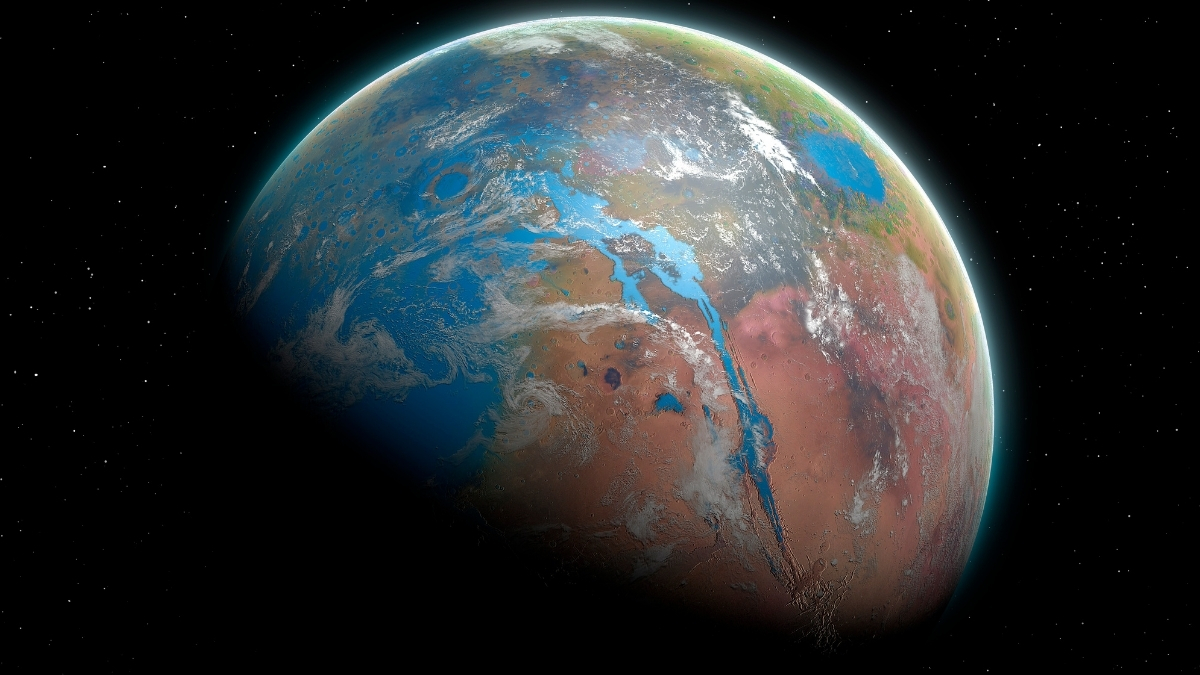
Abundant evidence strongly suggests that the Red Planet was once a vividly blue world, adorned with shimmering lakes, meandering rivers, and expansive oceans. Recent scientific endeavors have successfully determined the approximate “sea level” during the most historically water-rich epoch on Mars.
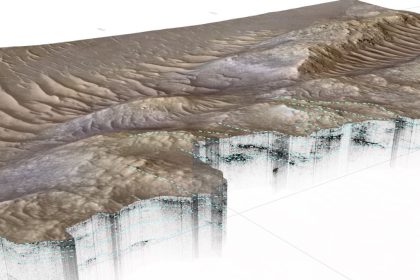
Utilizing data acquired from three distinct satellites, researchers based in Italy and Switzerland meticulously scrutinized a specific chasm known as Coprates Chasma. This geological feature is an integral part of Valles Marineris, which stands as the most extensive canyon system within our Solar System.
Within this region, satellite imagery revealed fan-shaped geological formations that bear a striking resemblance to terrestrial river deltas, which are typically created when fluvial systems converge with standing bodies of water.
“Deltaic structures invariably form where rivers discharge into oceanic environments, a phenomenon well-documented through numerous terrestrial examples,” stated Fritz Schlunegger, a geomorphologist affiliated with the University of Bern in Switzerland.
“The formations we’ve identified in these images unequivocally represent the confluence of a river with an ocean.”
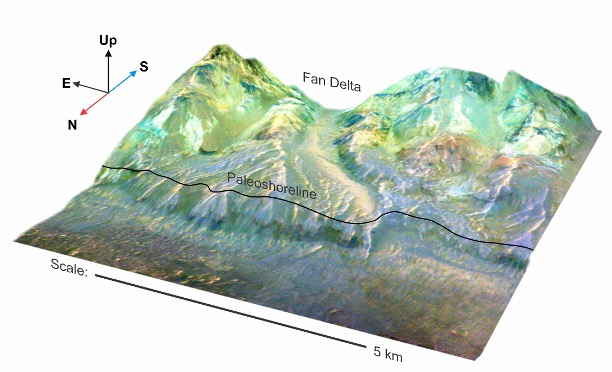
All of the delta-like formations were located at elevations ranging from 3,650 to 3,750 meters (11,975 to 12,300 feet) below the established Martian geoid reference datum. This positioning places them approximately 1,000 meters higher than the lowest point within Valles Marineris, suggesting an ancient ocean comparable in scale to Earth’s Arctic Ocean.
“Our findings provide definitive evidence for the most profound and extensive ancient ocean identified on Mars to date – an ocean that once spanned the planet’s northern hemisphere,” commented Ignatius Argadestya, a geologist also at the University of Bern.
The research team posits that these deposits originated approximately 3 billion years ago, marking a period characterized by “the greatest abundance of surface water on Mars” according to their publication. Notably, this timeframe is several hundred million years subsequent to prior estimations regarding the existence of a Martian ocean.
Regardless of whether this water subsequently dissipated into space or seeped into the planet’s interior, mounting evidence points towards a once-lush and potentially life-sustaining past for our currently arid and dusty planetary neighbor. Given the relatively rapid emergence of life on Earth, the possibility exists that early microbial life may have briefly flourished on Mars.
The scientists involved in this study propose that these newly delineated ancient coastlines could represent prime locations for the potential discovery of biosignatures from extinct extraterrestrial life.
This groundbreaking research has been formally presented in the scientific journal npj Space Exploration.