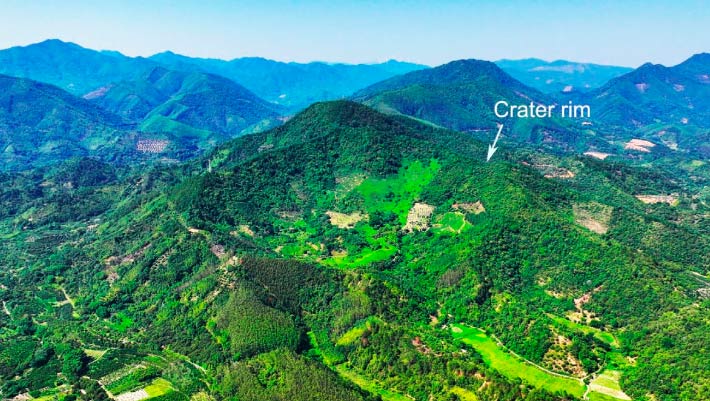
Geoscientists have documented the existence of an impact structure situated on a granite massif, which is overlaid by a substantial regolith layer, in the southern region of China. The Jinlin crater, located in Zhaoqing within China’s Guangdong province, stands as one of the approximate 200 impact features identified globally and is estimated to be less than 11,700 years old.

Panoramic aerial drone image of the Jinlin crater, taken on May 12, 2025. Image credit: Chen et al., doi: 10.1063/5.0301625.
Earth has experienced countless impact cratering events throughout its geological timeline.
However, the majority of ancient craters have undergone significant erosion, deformation, or burial due to tectonic forces and intense surface weathering processes.
To date, approximately 200 impact craters have been cataloged worldwide.
Within China, only four impact craters had been previously documented, all located in the country’s northeastern territories.
The recently identified impact structure, designated as the Jinlin crater, is situated in a low-lying mountainous and hilly terrain in the northwestern part of Guangdong province, adjacent to Jinlin Waterside village in Deqing county, Zhaoqing city.
With a measured diameter of 900 meters, this structure represents the most substantial impact crater recognized from the current Holocene epoch, substantially surpassing the 300-meter Macha crater, which held the record for the largest known Holocene impact feature until this discovery.
“This finding indicates that the magnitude of impacts from smaller extraterrestrial bodies on Earth during the Holocene epoch is substantially greater than previously understood,” stated Dr. Ming Chen, a researcher affiliated with the Center for High Pressure Science and Technology.
In this particular instance, the projectile responsible was a meteorite, as opposed to a comet, which would have likely resulted in a crater at least 10 kilometers in width.
Nevertheless, Dr. Chen and his research associates have not yet definitively established whether the impacting meteorite was composed of iron or was stony.
A remarkably noteworthy characteristic of this crater is its exceptional state of preservation, particularly considering the prevailing monsoonal climate, abundant precipitation, and high humidity of the region—all environmental factors that typically accelerate erosive processes.
Within the underlying granite strata, which contribute to the protection and integrity of its impact morphology, the researchers unearthed numerous quartz fragments exhibiting distinctive microstructural characteristics. These features, known as planar deformation features, are recognized by geologists as definitive indicators of impact events.
“On Earth, the development of planar deformation features in quartz is exclusively attributable to the immense shockwaves generated by the impact of celestial bodies. The formation pressures associated with these features range from 10 to 35 gigapascals, a shock effect unattainable through any terrestrial geological mechanism,” explained Dr. Chen.
“It is widely accepted that across the Earth’s history, every surface location has faced relatively comparable probabilities of encountering an extraterrestrial object strike.”
“However, variations in geological conditions dictate that the historical traces of these impacts have eroded at differing rates, with some having completely vanished.”
“Consequently, the identification of the Jinlin crater assumes particular scientific importance.”
“This impact crater serves as an authentic historical record of Earth’s impact chronology.”
“The discovery of this terrestrial impact crater offers a more objective foundation for comprehending the distribution patterns, geological evolution, and historical impact regime and control mechanisms of smaller extraterrestrial entities.”
The scientific findings of the research team were formally published on October 15, 2025, in the esteemed journal Matter and Radiation at Extremes. The paper provides comprehensive details of their investigation.
_____
Ming Chen et al. 2026. Jinlin crater, Guangdong Province, China: Impact origin confirmed featured. Matter Radiat. Extremes 11, 013001; doi: 10.1063/5.0301625