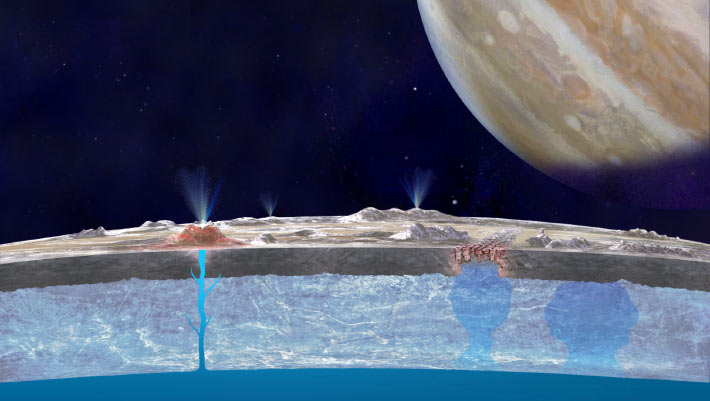
A groundbreaking investigation by geophysicists affiliated with Washington State University and Virginia Tech has illuminated a credible mechanism for the transport of nutrients from Europa’s radiation-exposed surface into the subterranean ocean of Jupiter’s enigmatic moon.
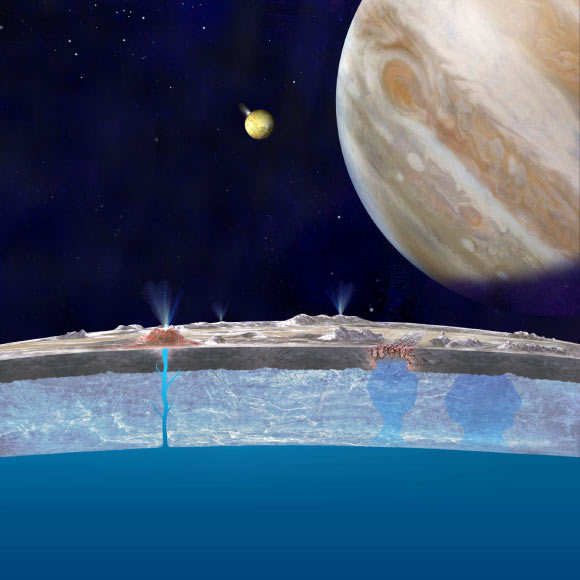
Artist’s concept of ocean on Jupiter’s moon Europa. Image credit: NASA / JPL-Caltech.
Europa harbors a volume of liquid water that surpasses the combined totality of Earth’s oceans; however, this global reservoir is sequestered beneath a formidable icy crust that precludes solar penetration.
Consequently, any potential life dwelling within Europa’s ocean must subsist on nutrient and energy sources independent of solar radiation, thereby perpetuating enduring inquiries regarding the moon’s potential habitability.
Furthermore, Europa is relentlessly subjected to intense radiative bombardment originating from Jupiter.
This energetic radiation interacts with surface salts and other constituents, yielding essential nutrients conducive to oceanic microorganisms.
Despite the existence of several prevailing theories, planetary scientists remain uncertain regarding the precise process by which this nutrient-laden surface ice navigates through the substantial ice shell to reach the underlying ocean.
While Europa’s frigid crust exhibits considerable geological dynamism, primarily driven by Jupiter’s gravitational influence, the ice predominantly undergoes lateral displacement rather than the vertical movement indispensable for the exchange between the surface and the ocean.
Dr. Austin Green, representing Virginia Tech, and Dr. Catherine Cooper, from Washington State University, turned their attention to terrestrial geological phenomena to discern potential explanations and resolutions for this surface material recycling conundrum.
“This represents a novel concept within planetary science, drawing inspiration from a firmly established principle in Earth science,” remarked Dr. Green.
“What is particularly exhilarating is that this novel hypothesis addresses a persistent challenge to Europa’s habitability and offers encouraging prospects for the existence of extraterrestrial life within its oceanic depths.”
The researchers focused their attention on the phenomenon of crustal delamination, a process whereby a segment of the crust is subjected to tectonic compression and chemical densification, leading to its eventual detachment and descent into the mantle.
They posited that this mechanism might be operative on Europa, given that specific regions of its icy surface are demonstrably enriched with densifying salts.
Previous research has established that impurities incorporated into ice’s crystalline lattice serve to weaken its structure, rendering it less stable than pure ice.
Nevertheless, for delamination to be initiated, the ice surface requires a degree of weakening to facilitate its detachment and subsequent descent within the icy shell’s interior.
The investigative team proposed that denser, salt-rich ice, when situated within a matrix of purer ice, would undergo subsidence into the inner regions of the ice shell, thereby facilitating the recycling of Europa’s surface materials and supplying nutrients to the ocean below.
Employing computational modeling, they ascertained that nutrient-rich surface ice could indeed descend to the base of the ice shell across a broad spectrum of salt concentrations, provided that even a minimal degree of weakening is present in the superficial ice.
This process is also relatively expedient and could constitute a dependable method for the continuous recycling of ice and the delivery of vital nutrients into Europa’s ocean.
The scholarly work undertaken by the team has been disseminated in the Planetary Science Journal and can be accessed at the following link: paper.
_____
A.P. Green & C.M. Cooper. 2026. Dripping to Destruction: Exploring Salt-driven Viscous Surface Convergence in Europa’s Icy Shell. Planet. Sci. J 7, 13; doi: 0.3847/PSJ/ae2b6f