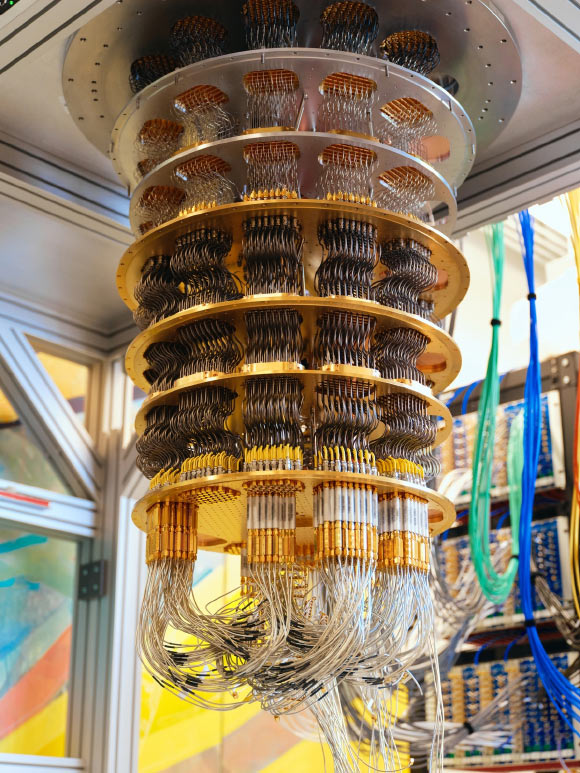
A groundbreaking development in quantum information science has been achieved by researchers from the University of Waterloo and Kyushu University, who have pioneered the inaugural technique for generating duplicated, encrypted versions of qubits. This represents a significant advance toward the realization of practical quantum cloud services and robust quantum infrastructure.
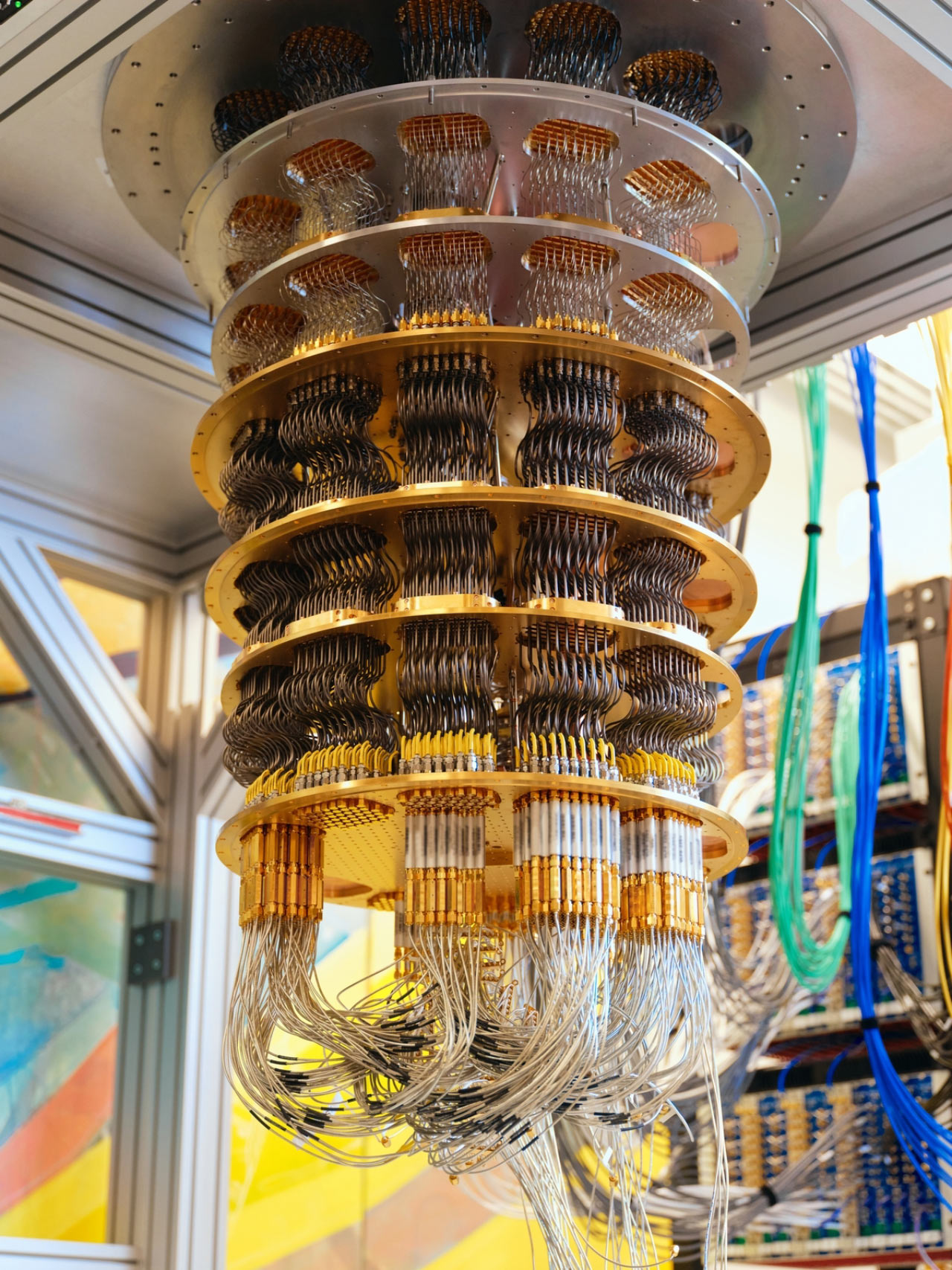
Google’s quantum computer. Image credit: Google.
Within the realm of quantum mechanics, the no-cloning theorem fundamentally dictates that the precise replication of an unknown quantum state is an impossibility.
Drs. Achim Kempf of the University of Waterloo and Koji Yamaguchi of Kyushu University emphasize that this foundational principle remains inviolate.
Instead, their innovation lies in a novel methodology that facilitates the creation of numerous encrypted manifestations of a single quantum bit, or qubit.
“This pivotal advancement will pave the way for quantum cloud storage solutions, akin to a quantum counterpart of Dropbox, Google Drive, or STACKIT, enabling the secure and safe preservation of identical quantum information across multiple servers as a redundant and encrypted safeguard,” stated Dr. Kempf.
“It constitutes a crucial step in the construction of quantum computing infrastructure.”
“The domain of quantum computing holds immense promise, particularly in addressing highly complex computational challenges, yet it also presents distinctive obstacles.”
“One of the preeminent difficulties confronting quantum computing is the principle known as the no-cloning theorem, which asserts that quantum information cannot be duplicated, at least not through direct means.”
“This is attributable to the exquisitely sensitive nature of quantum information storage.”
According to the researchers, the transmission of quantum information can be conceptually understood in a manner analogous to the division of a password.
“Imagine possessing the first half of a password while a colleague holds the second half; neither individual can access the full password independently. However, upon combining your respective halves, the complete and functional password is revealed,” explained Dr. Kempf.
“In a comparable fashion, qubits possess unique properties that allow them to share information in a manner that amplifies as they are aggregated.”
“An individual qubit may not contain substantial information on its own, but when interconnected, multiple qubits can collectively house an immense volume of data that only becomes accessible when these connections are established.”
“This distinctive capacity for shared information across a collective of qubits is termed quantum entanglement.”
“A mere 100 qubits can simultaneously engage in information sharing in 2100 distinct ways. This enables them to distribute such an extraordinary quantity of entangled information that it would be beyond the storage capacity of all present-day classical computers.”
“Despite the vast potential of quantum computing, the no-cloning theorem imposes restrictions on its practical applications.”
“This is because, in contrast to classical computing where information duplication—essential for sharing and data backups—is a ubiquitous practice, quantum computing lacks a straightforward ‘copy and paste’ functionality.”
“We have devised a viable workaround for the no-cloning theorem governing quantum information,” remarked Dr. Yamaguchi.
“It has been discovered that by encrypting quantum information prior to its duplication, we can generate an unlimited number of copies.”
“This technique circumvents the no-cloning theorem because upon selection and decryption of one of the encrypted copies, the associated decryption key automatically becomes invalidated, effectively functioning as a single-use key.”
“Nevertheless, even a single-use key facilitates critical applications, such as the implementation of redundant and encrypted quantum cloud services.”
The team’s research findings are slated for publication in the esteemed journal Physical Review Letters.
_____
Koji Yamaguchi & Achim Kempf. 2026. Encrypted Qubits can be Cloned. Physical Review Letters, in press; arXiv: 2501.02757