Recent scientific inquiry refutes long-established theories, indicating that divergent plate boundaries and continental rift zones, rather than volcanic activity, were the primary drivers of substantial atmospheric carbon fluctuations and prolonged climatic alterations throughout Earth’s ancient history.
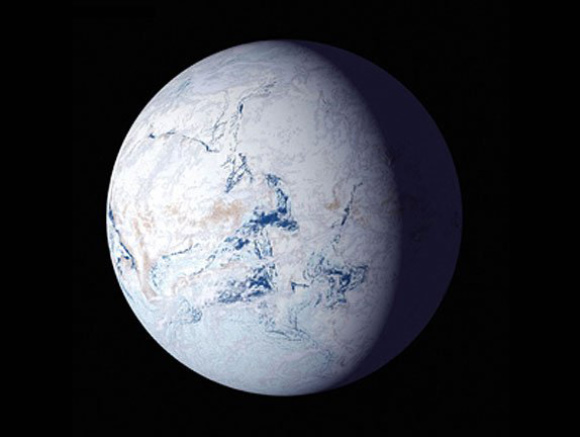
Cryogenian Earth. Image credit: NASA.
The Earth’s climate system has experienced dramatic oscillations between extreme states multiple times over the last 540 million years, transitioning from intensely cold “icehouse” conditions to considerably warmer “greenhouse” environments.
Periods characterized by extreme cold, known as icehouse climates, were prevalent during the Late Ordovician, the Late Paleozoic, and the entirety of the Cenozoic era.
Conversely, warmer epochs were correlated with elevated atmospheric concentrations of carbon dioxide, while declines in this potent greenhouse gas coincided with global cooling trends and extensive glacial coverage.
In a significant research endeavor, Dr. Ben Mather, a scholar at the University of Melbourne, alongside his research team, meticulously reconstructed the intricate pathways of carbon movement between volcanic systems, oceanic reservoirs, and the deep Earth over the past 540 million years.
“Our discoveries challenge a prevailing, deeply ingrained scientific perspective that posited volcanic chains—resulting from the convergence of tectonic plates—as the Earth’s principal natural source of atmospheric carbon,” stated Dr. Mather.
“Instead, our findings indicate that carbonaceous gases released from subterranean fissures and ridges, where tectonic plates are actively separating beneath the oceans, were likely the principal agents responsible for driving major transitions between icehouse and greenhouse climatic regimes for the majority of our planet’s existence.”
“We ascertained that carbon released from volcanism, exemplified by the activity along the Pacific Ring of Fire, did not emerge as a significant contributor to atmospheric carbon until the last 100 million years, a revelation that necessitates a reassessment of current scientific paradigms.”
This comprehensive study furnishes the inaugural robust, long-term empirical evidence demonstrating that global climate was primarily influenced by carbon emissions originating from areas where tectonic plates diverge, as opposed to regions where they converge.
“This novel understanding not only fundamentally alters our comprehension of past climatic dynamics but also offers valuable refinements for the development of future climate projection models,” commented Dr. Mather.
By integrating global plate tectonic reconstructions with sophisticated carbon-cycle modeling, the research consortium meticulously tracked the sequestration, release, and recycling of carbon as continental masses underwent significant geographical shifts.
“The implications of our study are instrumental in elucidating key historical climatic transformations, including the protracted ice age of the Late Paleozoic, the exceptionally warm Mesozoic greenhouse world, and the subsequent advent of the modern Cenozoic icehouse, by illuminating how alterations in carbon flux from spreading plate boundaries sculpted these enduring climatic transitions,” explained Professor Dietmar Müller of the University of Sydney.
Furthermore, this groundbreaking research provides a crucial historical context for appreciating the unprecedented nature of our current climate change trajectory.
“This investigation augments the substantial body of evidence underscoring the critical role of atmospheric carbon levels as a primary catalyst for profound climate shifts,” Dr. Mather affirmed.
“Gaining insight into the mechanisms by which Earth regulated its climate in antiquity starkly highlights the anomalous velocity of contemporary environmental change.”
“Currently, anthropogenic activities are releasing carbon at a rate substantially exceeding any natural geological processes previously observed.”
“The delicate balance of Earth’s climate is being disrupted at an alarming pace.”
The comprehensive study results have been published in the esteemed scientific journal Communications Earth & Environment.
_____
B.R. Mather et al. 2026. Carbon emissions along divergent plate boundaries modulate icehouse-greenhouse climates. Commun Earth Environ 7, 48; doi: 10.1038/s43247-025-03097-0