
While the imperative to implement lockdowns during the COVID-19 pandemic was undeniably driven by the objective of averting mortality, with research indicating an estimated one million lives were preserved in the United States alone within the initial six months of 2020, the ramifications of these measures extended far beyond public health.
The enforced sequestration of individuals within their domiciles and immediate vicinities profoundly reshaped societal dynamics, often with detrimental consequences. Beyond the considerable economic disruption, the COVID-19 lockdowns precipitated a widespread disconnection from educational institutions, workplaces, and other vital social conduits, thereby ushering in an era of pervasive isolation for individuals across all age demographics.
Adolescents were particularly susceptible to these disruptions. Although the full spectrum of these effects is still being elucidated, numerous studies suggest that teenagers experienced a unique vulnerability to the social upheaval that characterized the pandemic period.
Furthermore, a recent investigation posits that the pandemic may have induced an accelerated aging process in the brains of adolescents, hastening the natural thinning of the cerebral cortex that is associated with advancing age. This phenomenon was observed with notably greater intensity among young females.
“While we may perceive the COVID-19 pandemic primarily as a health crisis, it is evident that it instigated other profound transformations in our lives, particularly for individuals in their teenage years,” stated Patricia Kuhl, the senior author of the study and a co-director at the University of Washington’s Institute for Learning & Brain Sciences (I-LABS).
The genesis of this new research initiative can be traced back to 2018, when Kuhl and her colleagues initially embarked on a longitudinal inquiry focused on the typical developmental trajectory of teenage brains.
It is a recognized biological process that the cerebral cortex undergoes a gradual thinning as individuals mature, even during adolescence. The researchers emphasize that the extent of this thinning can serve as a quantifiable metric for overall brain maturation.
The study’s foundation was built upon MRI data acquired in 2018 from 160 participants, all of whom were between the ages of 9 and 17 at that time. Plans were subsequently made to gather additional data from these same individuals in 2020. However, in common with the majority of the global population that year, these meticulously laid plans were irrevocably disrupted by the onset of COVID-19.
The global health emergency necessitated a postponement of the follow-up examinations until 2021. This delay effectively concluded the original research design. Nevertheless, it yielded a valuable pre-pandemic dataset that offered the potential to elucidate the impact of lockdown measures on these subjects, some of whom had transitioned into adulthood since the initial data collection in 2018.
“Once the pandemic gained momentum, our focus shifted towards identifying brain metrics that would enable us to ascertain the specific effects of the pandemic-induced lockdowns on the brain,” explained Neva Corrigan, the lead author and a research scientist affiliated with I-LABS.
“We contemplated the implications for our teenage participants of being confined to their homes, detached from their social circles—absent from school, recreational sports, and casual social interactions,” Corrigan elaborated.
Existing research has demonstrably shown that prolonged periods of chronic stress and adverse experiences can accelerate the thinning of the cerebral cortex. Corrigan and her team further elucidated that this accelerated thinning process is correlated with an elevated propensity for the development of neuropsychiatric and behavioral disorders, including conditions such as anxiety and depression.
The findings of this recent investigation serve to corroborate the conclusions drawn from two prior studies, as the researchers noted in their publication. Both of these preceding papers reported an accelerated rate of cortical thinning among adolescents in the post-2020 period.
Beyond reinforcing the established association with lockdown measures, the research team also uncovered a novel observation: the extent of cortical thinning during the pandemic period was disproportionately greater in female participants.
To arrive at this revelation, the researchers utilized their 2018 baseline data to construct a predictive model of the anticipated cortical thinning trajectory for the teenagers in the intervening years since their initial MRI scans. Subsequently, new MRI examinations were conducted with the same cohort. It is noteworthy that more than 80 percent of the original participants returned for this post-pandemic follow-up assessment.
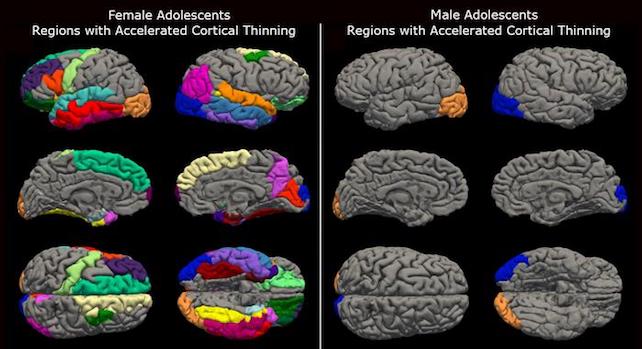
The subsequent MRI results indicated an expedited cortical thinning throughout the adolescent period, the authors reported. However, this acceleration was particularly evident in female subjects, whose brains appeared to be affected across a more extensive network.
While the observed thinning effects were localized to the visual cortex in male participants, they were markedly more widespread in the brains of female participants, manifesting across all cerebral lobes and both hemispheres.
To contextualize these findings, the researchers also quantified the accelerated cortical thinning in terms of equivalent years of typical brain aging.
According to the study’s analysis, the average acceleration of cortical thinning observed between 2018 and 2021 corresponded to an additional 1.4 years of brain aging for males. While this represents a significant deviation, it is considerably less pronounced than the effect observed in females, whose average acceleration was equivalent to an additional 4.2 years of brain aging.
“Adolescents are navigating a particularly precarious phase, striving to establish their identities and life paths,” commented Kuhl. “They are subjected to immense pressures. Then, the advent of a global pandemic abruptly removed their customary avenues for stress alleviation.”
Despite the curtailment of numerous coping mechanisms in 2020, Kuhl further noted, adolescents continued to confront pervasive social pressures and the detrimental effects of cyberbullying, largely facilitated by social media platforms.
The precise reasons underlying the differential impact of lockdowns on males and females remain an area requiring further investigation. However, Kuhl and her colleagues have proposed that this disparity may be attributable to variations in social priorities between the sexes.
“For females, peer relationships assume paramount importance in the cultivation of self-identity, and they rely more heavily on these connections for emotional support compared to males,” the researchers articulated in their study.
They further posited that for teenage boys, peer interactions are more characteristically defined by “companionship and shared activities” rather than an emphasis on emotional solace.
“What the pandemic appears to have accomplished most significantly is the isolation of girls,” observed Kuhl. “Although all adolescents experienced isolation, girls bore a greater burden. The impact on their brains was considerably more pronounced.”
The researchers underscore the necessity for additional inquiry to elucidate these observed differences and to explore the potential for recuperation. While it is improbable that the cerebral cortex will regain the volume lost during 2020, there remains the possibility that the rate of thinning has at least decelerated.
“The pandemic served as a critical case study for demonstrating the inherent fragility of adolescent brain development,” concluded Kuhl. “Our research introduces a new set of critical questions concerning the implications of accelerating the brain’s aging process.”