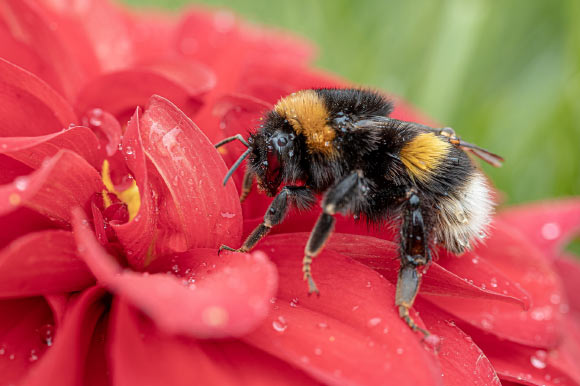
New scientific inquiry reveals that buff-tailed bumblebees (Bombus terrestris) possess the capacity to determine optimal foraging locations by discerning varying lengths of visual signals.

The capacity to process temporal information is fundamental for various animal behaviors, including foraging, reproduction, and evading predators. While circadian rhythms have been extensively explored, there is a paucity of knowledge concerning how insects interpret durations spanning seconds and sub-seconds. Davidson et al. embarked on an investigation to evaluate the ability of buff-tailed bumblebees’ (Bombus terrestris) to differentiate the durations of flashing lights within a free-foraging paradigm. Image credit: Myriam.
Much like in Morse code, where a brief illuminated pulse (‘dot’) signifies a letter ‘E’ and an extended pulse (‘dash’) represents a letter ‘T,’ this research explores a similar capability in insects.
Prior to this study, the skill of distinguishing between ‘dot’ and ‘dash’ durations had exclusively been observed in humans and other vertebrate species, such as macaques and pigeons.
Alex Davidson, a doctoral candidate at Queen Mary University of London, alongside his research team, investigated this temporal discrimination ability in Bombus terrestris bumblebees.
A bespoke maze apparatus was constructed to facilitate the training of individual bumblebees. The objective was to guide them towards a sugar reward located at one of two illuminated targets, each presenting a distinct flash duration – either short or long.
For instance, in a controlled scenario, the short flash (‘dot’) was consistently paired with the palatable sugar reward, while the long flash (‘dash’) was associated with an unappealing bitter substance, which bumblebees tend to avoid.
To ensure that the bees’ choices were not influenced by spatial memory, the positions of the ‘dot’ and ‘dash’ stimuli were varied across different sections of the maze.
Following the successful conditioning of the bumblebees to reliably locate the flashing circle linked to the sugar, subsequent tests were conducted without the sugar reward. This phase was designed to confirm whether the bees’ responses were solely dictated by the flashing light stimulus, rather than any residual olfactory or visual cues emanating from the sugar itself.
The experimental outcomes unequivocally demonstrated that the bumblebees had acquired the skill to differentiate the flashing lights based on their temporal duration. A significant majority navigated directly to the ‘appropriate’ flashing light, previously correlated with the sugar reward, irrespective of the stimulus’s physical placement.
“Our objective was to ascertain whether bumblebees could discern between these distinct durations, and their successful achievement was profoundly exciting,” stated Davidson.
“Given that bumblebees do not typically encounter pulsed visual stimuli in their natural habitat, their proficiency in this task is truly remarkable.”
“The capacity to track the temporal aspect of visual cues might indicate an expansion of a temporal processing faculty that evolved for purposes such as spatial navigation or inter-individual communication.”
“Alternatively, this surprising aptitude for encoding and interpreting time intervals could be an intrinsic characteristic of neuronal function, stemming from fundamental properties of neurons. Further research is imperative to elucidate this aspect.
The precise neural substrates underlying the ability to track time across these specific durations remain largely enigmatic. The established mechanisms for synchronizing with the diurnal cycle (circadian rhythms) and seasonal shifts are demonstrably too slow to account for the nuanced differentiation between a ‘dash’ and a ‘dot’ of varying lengths.
Several theoretical frameworks have been proposed, positing the existence of one or more internal biological clocks.
With the recent discovery of duration discrimination in flashing lights among insects, researchers are now afforded an opportunity to rigorously test various theoretical models within the simplified context of these ‘miniature brains,’ which are less than one cubic millimeter in volume.
“Numerous sophisticated animal behaviors, including navigation and communication, are intrinsically reliant on temporal processing capabilities,” commented Dr. Elisabetta Versace, a researcher at Queen Mary University of London.
“Adopting a broad comparative approach across diverse species, encompassing insects, will be crucial for illuminating the evolutionary trajectory of these abilities.”
“The processing of temporal durations in insects represents a sophisticated problem-solving strategy achieved through a minimal neural architecture.”
“This finding carries significant implications for the development of complex, cognitive-like functionalities in artificial neural networks. Such systems should strive for maximal efficiency and scalability, drawing inspiration from the elegance of biological intelligence.”
The findings of this study were disseminated on November 12, 2025, in the esteemed journal Biology Letters.
_____
Alexander Davidson et al. 2025. Duration discrimination in the bumblebee Bombus terrestris. Biol. Lett 21 (11): 20250440; doi: 10.1098/rsbl.2025.0440