The recent unveiling of a novel mineral, designated as ferric hydroxysulfate, is furnishing significant insights into the Martian environment and its geological past, thereby suggesting the potential for antecedent volcanic, ash-related, or hydrothermal processes.
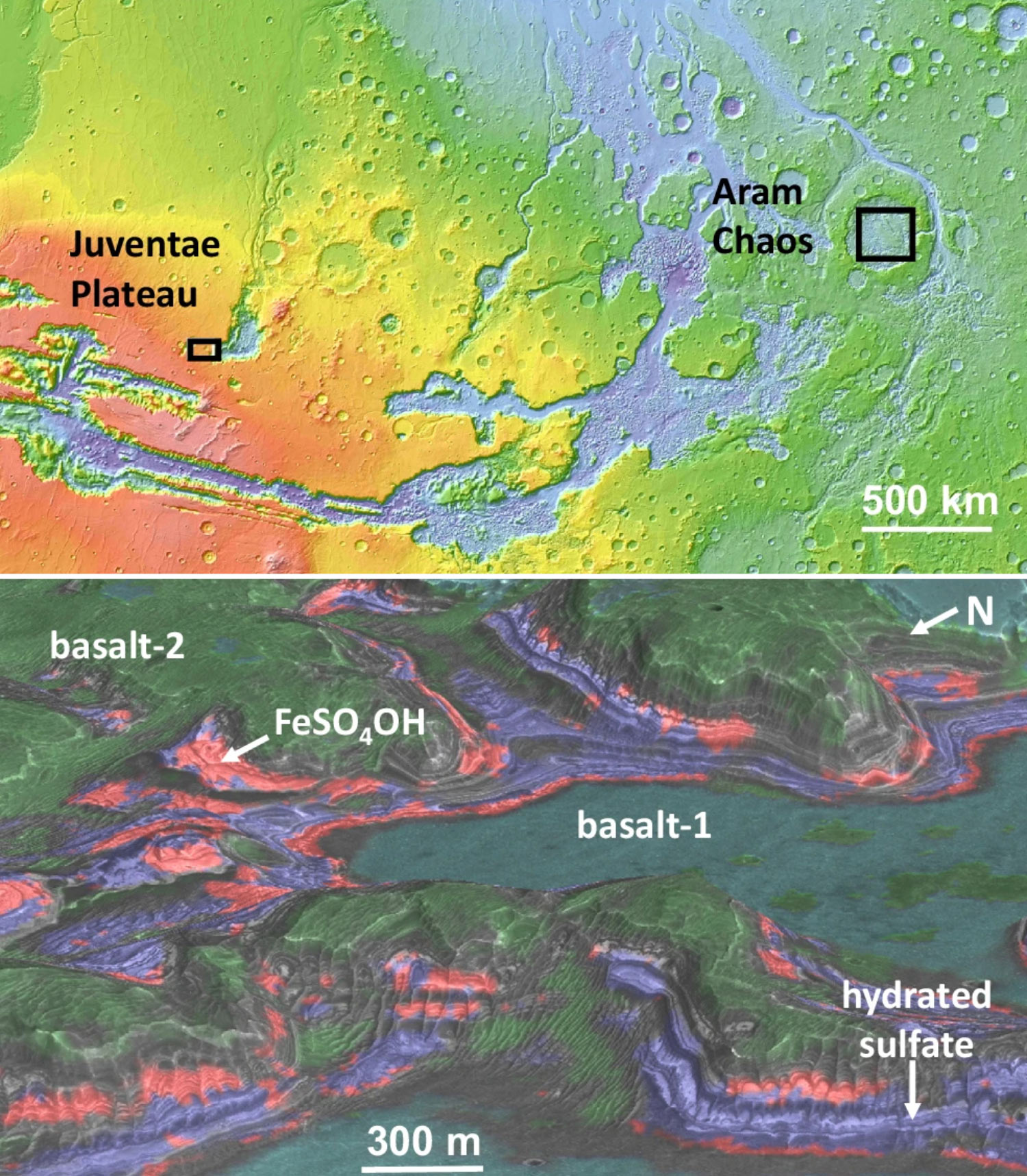
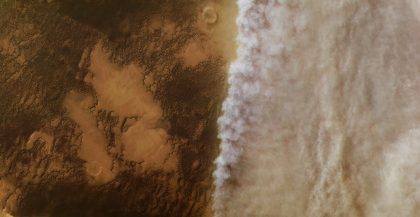
Spectrally distinct units at the Juventae Plateau, Mars. Image credit: Bishop et al., doi: 10.1038/s41467-025-61801-2.
The Compact Reconnaissance Imaging Spectrometer for Mars (CRISM), an instrument aboard NASA’s Mars Reconnaissance Orbiter, has been instrumental in yielding hyperspectral data. This data facilitates the meticulous mapping of a multitude of minerals, which in turn serves to advance our comprehension of the Red Planet’s ancient geochemical narrative.
A diverse array of sulfate minerals has been identified on Mars through the analysis of both orbital and terrestrial missions. This identification process has been facilitated by comparative studies with terrestrial mineral analogues, employing spectral parameter analysis, X-ray diffraction techniques, and elemental abundance measurements.
In the year 2010, an anomalous spectral signature was detected within CRISM spectra originating from Mars. This distinctive signature emanated from the plateau adjacent to Juventae Chasma and within the heavily eroded impact crater known as Aram Chaos.
For an extended period, exceeding fifteen years, this particular spectral band presented a considerable enigma for mineralogical identification, as it did not align with the spectral characteristics of any heretofore recognized minerals.
Initial laboratory investigations posited that dehydrated iron sulfates were the subterranean source of this perplexing material.
“The raw data obtained from the spectrometer requires substantial processing before it can be considered usable,” remarked Dr. Mario Parente, a research scientist affiliated with the University of Massachusetts, Amherst.
“We must conduct rigorous calibration, implement data corrections, and meticulously remove atmospheric influences.”
“The photonic energy, which traverses from the Sun to the mineral and subsequently to the CRISM instrument, must make a double passage through the Martian atmosphere.”
“The atmosphere contains scattering particles and gases capable of absorbing light,” he elucidated. “For instance, Mars exhibits a significant concentration of carbon dioxide, which can profoundly distort the acquired data.”
Utilizing sophisticated deep learning artificial intelligence methodologies, the research team has achieved the capability to map both identified and unidentified minerals, seamlessly recognizing deviations within individual image pixels.
These advanced analytical techniques unveiled additional Martian locations exhibiting the identical spectral signature and elucidated further spectral characteristics.
Based on the newly refined spectral descriptors, the researchers were successful in recreating the mineral in a laboratory setting, definitively identifying the enigmatic compound as ferric hydroxysulfate.
“The material synthesized during these laboratory experiments is very likely a new mineral, owing to its distinctive crystalline architecture and thermal resilience,” stated Dr. Janice Bishop, a distinguished researcher at the SETI Institute and NASA’s Ames Research Center.
“Nevertheless, for official recognition as a novel mineral species, its presence must also be substantiated on Earth.”
Ferric hydroxysulfate precipitates under conditions of elevated temperatures (ranging from 50 to 100 degrees Celsius) within an acidic milieu and in the presence of both oxygen and water.
“Once a mineral attribution is established, and robust indications of a particular material are obtained, one can commence an inquiry into: When did this material originate? Under what specific conditions did it form?” Dr. Parente elaborated.
The scientific cohort concluded that the formation of ferric hydroxysulfate at Aram Chaos was concomitant with geothermal heating, while at Juventae, its genesis was attributed to volcanic heat derived from ash or lava flows.
Their hypothesis suggests that these geological events likely transpired during the Amazonian epoch, a period less than three billion years in the past.
“Factors such as temperature, pressure, and environmental conditions like pH are all critical indicators of past climatic regimes,” Dr. Parente emphasized.
“The demonstrable existence of this mineral adds considerable complexity and nuance to our understanding of historical Martian processes.”
“Certain regions of Mars have experienced chemical and thermal activity more recently than previously surmised—offering new perspectives on the planet’s dynamic surface and its potential capacity to have harbored life.”
The comprehensive study has been formally published in the esteemed journal Nature Communications.
_____
J.L. Bishop et al. 2025. Characterization of ferric hydroxysulfate on Mars and implications of the geochemical environment supporting its formation. Nat Commun 16, 7020; doi: 10.1038/s41467-025-61801-2