A recent investigation into tidal forces and internal geological dynamics indicates that Jupiter’s moon Europa may not possess the extensive seafloor faulting essential for substantial hydrothermal circulation, thereby impacting the availability of chemical energy and the moon’s potential for habitability.
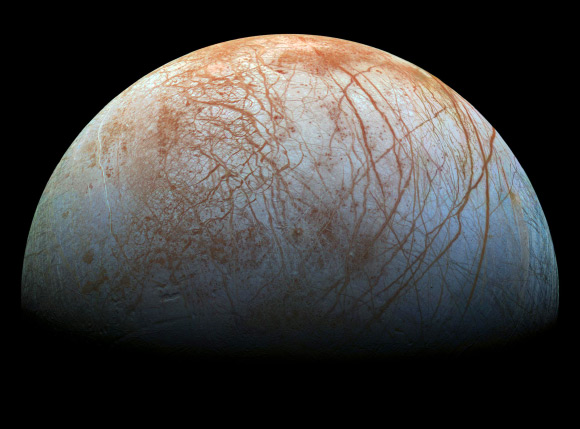
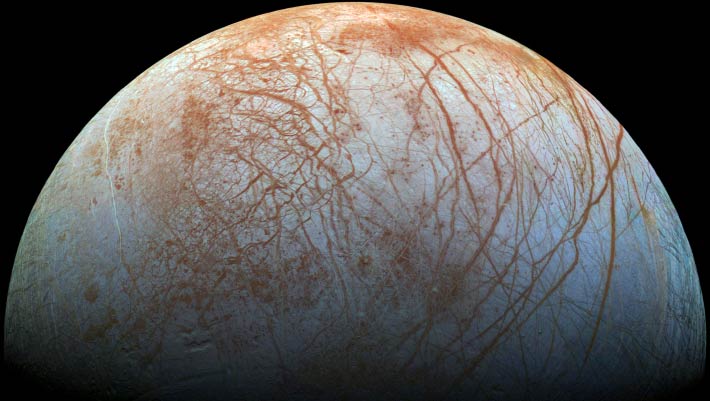
The surface of Europa looms large in this newly-reprocessed color view; image scale is 1.6 km per pixel; north on Europa is at right. Image credit: NASA / JPL-Caltech / SETI Institute.
On Earth, tectonic processes are recognized as contributing factors in supporting life-sustaining environments.
This sustenance is facilitated through the interaction of water with geological materials at and below the seabed, which can furnish chemical energy sources for potential life forms.
Consequently, the presence of tectonic activity on celestial bodies can serve as one of several indicators of an environment potentially capable of sustaining life.
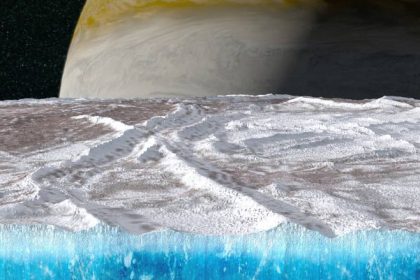
Europa, one of Jupiter’s natural satellites, is understood to harbor a sub-surface ocean concealed beneath its frozen exterior.
Prior scientific inquiries have posited the possibility of volcanic activity on Europa’s ocean floor; however, whether tectonic activity is feasible has not been previously explored.
Dr. Paul Byrne, a researcher affiliated with Washington University in St. Louis, stated, “Should we have the capacity to investigate that ocean with an autonomous submersible, our projections suggest we would not encounter novel fissures, active volcanoes, or effusions of heated water on the ocean floor.”
“From a geological perspective, not much is occurring in that zone. The environment would be characterized by dormancy.”
“And within an ice-covered world such as Europa, a quiescent seafloor could very well signify an inert ocean.”
Dr. Byrne and his associates undertook comprehensive modeling to evaluate the potential for tectonic activity within Europa’s hypothesized sub-surface ocean.
These projections were calibrated against the documented or theorized behavior observed on Earth’s ocean floor and on the moon Enceladus.
The research team scrutinized stresses arising from tidal forces, global contraction, mantle convection, and serpentinization—a geological transformation occurring when rocks react with water.
Nevertheless, their findings indicated that none of these phenomena are likely to be instrumental in driving tectonic activity, even along pre-existing fissures on Europa’s seafloor at the present time.
This conclusion would imply that interactions between ocean water and rock are probably confined to the upper few hundred meters of the seafloor, thereby constricting the potential for habitable conditions on the ocean floor.
Future investigations are intended to gather direct evidence pertaining to Europa’s geological features and tectonic processes.
“Europa likely experiences some degree of tidal heating, which explains why it is not entirely frozen,” Dr. Byrne commented.
“And it might have experienced considerably more heating during its early history.”
“However, we do not presently observe any volcanoes erupting from the ice, unlike the situation on Io, and our calculations suggest that the tidal forces are insufficient to instigate any significant geological activity on the seafloor.”
The outcomes of this research were disseminated this week within the academic journal Nature Communications.
_____
P.K. Byrne et al. 2026. Limited to negligible active faulting is probable at Europa’s seafloor currently. Nat Commun 17, 4; doi: 10.1038/s41467-025-67151-3