While the health and longevity advantages of physical exertion are widely acknowledged, recent scientific investigations reveal that even minor adjustments to our daily routines can yield substantial health improvements.
An extensive analysis of wearable device data, encompassing over 130,000 individuals across multiple nations, indicates that dedicating an additional five minutes to exercise daily, or decreasing sedentary time by thirty minutes, is correlated with a discernible extension of lifespan.
The investigative team from the Norwegian School of Sport Sciences categorized participants into two primary cohorts: a high-risk segment comprising the least physically active 20 percent, and a general population group excluding the most active 20 percent.
“Modest yet achievable increments in moderate-to-vigorous physical activity, such as five minutes per day, could potentially avert up to six percent of all mortality events in a high-risk intervention strategy and ten percent in strategies targeting the general populace,” the authors articulate in their peer-reviewed publication.
“A reduction in sedentary time by thirty minutes daily might contribute to preventing a smaller, yet still significant, proportion of deaths across both risk scenarios.”
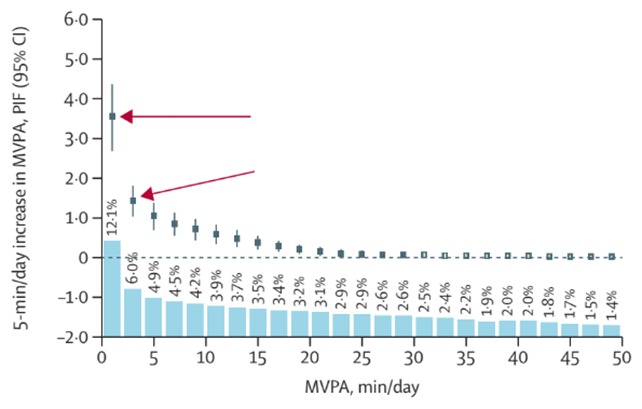
These projections were derived from sophisticated statistical modeling rather than direct longitudinal tracking of participants’ activity levels. Instead, researchers estimated each individual’s mortality risk and benchmarked it against that of their peers, enabling them to simulate the impact of altered activity levels on these risk factors.
Significantly, the most substantial predicted health gains were identified among individuals who were habitually less active and spent a greater portion of their day in a seated position. This implies that those currently engaging in the least amount of physical activity stand to reap the greatest rewards from implementing relatively minor changes in terms of both exercise and reducing sedentary behavior.
Although the observational nature of this study precludes definitive claims of direct causation, the sheer volume of data and the strength of the observed associations warrant further in-depth investigation.
The researchers noted in their published findings, “Our inquiry was confined to overall mortality; consequently, future research should broaden its scope to encompass other health-related outcomes.” They further elaborated, “There is a need for supplementary investigations utilizing device-measured physical activity data, particularly within low- and middle-income countries, where demographic structures, activity patterns, and disease burdens may diverge from those represented in the current study.”
These findings offer a beacon of encouragement for individuals who find it challenging to allocate time or muster the motivation for consistent exercise. Even brief periods of brisk walking or cycling, or dedicating thirty minutes to activities other than sitting, can contribute positively to well-being.
Naturally, increased physical activity remains unequivocally beneficial – the World Health Organization advocates for 150 minutes of moderate-to-vigorous physical activity weekly – however, even incremental steps contribute to significant progress.
“A paramount message we aim to convey is that every form of movement is valuable, and it is by encouraging inactive individuals to undertake some level of activity that we witness the most substantial advancements in health,” states Daniel Bailey, a sedentary behavior scientist at Brunel University of London, who was not affiliated with the research. He adds, “Therefore, healthcare professionals, policymakers, and public health advocates can certainly endeavor to support patients and the general public in making these comparatively small, initial changes, which can then serve as a springboard for increasing their overall activity levels.”