Within the timeframe of October 18th through November 5th, 2025, researchers leveraged the Wide-Field Imager for Solar Probe (WISPR) instrument, a component of NASA’s Parker Solar Probe mission, to conduct observations of the interstellar comet designated 3I/ATLAS.
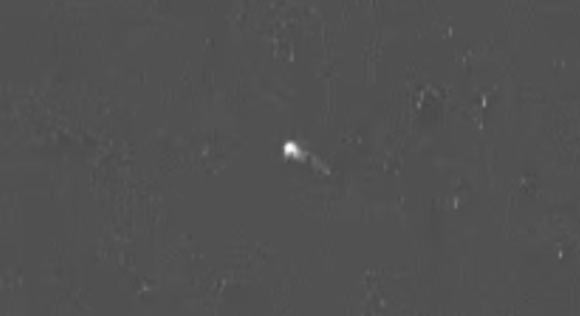
This image from Parker Solar Probe’s WISPR instrument shows the interstellar comet 3I/ATLAS. Image credit: NRL / NASA / JHUAPL / Guillermo Stenborg, JHUAPL.
The celestial body, 3I/ATLAS, was initially identified by the ATLAS survey telescope, a project supported by NASA and situated in Rio Hurtado, Chile, on July 1st, 2025.
This interstellar visitor, also recognized by the designations C/2025 N1 (ATLAS) and A11pl3Z, originated from the direction of the Sagittarius constellation.
3I/ATLAS achieved a close proximity to Mars, maintaining a distance of 0.194 AU on October 3rd, and subsequently reached its nearest point to the Sun, termed perihelion, on October 30th.
On December 19th, the object achieved its closest approach to Earth, coming within approximately 270 million kilometers (168 million miles) of our planet.
The recently acquired imagery of 3I/ATLAS was obtained utilizing the WISPR instrument aboard NASA’s Parker Solar Probe, spanning the observation period from October 18th to November 5th.
“Approximately ten photographic captures of the comet were taken daily by the Parker Solar Probe,” stated members of the WISPR investigative team.
“During this interval, the spacecraft was in the process of receding from the Sun, following its 25th solar close encounter on September 15th.”
“In these preliminary photographic renditions, which are slated for final calibration and data processing, the comet is observable as it traverses behind the Sun from the perspective of the Parker probe.”
“At that juncture, the comet was situated in proximity to its closest solar approach, at a separation of roughly 209 million kilometers (130 million miles), positioning it just beyond the orbital path of Mars.”
“These captured images provide an invaluable perspective on the comet during a period when terrestrial observation was obstructed due to its apparent proximity to the Sun from Earth’s vantage point.”
The WISPR team is presently engaged in refining the collected data to mitigate the interference of scattered solar light and to account for variations in exposure durations, which have contributed to apparent fluctuations in the comet’s brightness.
“The finalized imagery will ultimately serve to enhance our capacity to thoroughly investigate this extraterrestrial visitor,” the researchers commented.