Initial interpretations of data procured from NASA’s Cassini expedition to Saturn led to the hypothesis of a vast subterranean reservoir of liquid water on Titan. However, subsequent simulations conducted by Baptiste Journaux, a scientist at the University of Washington, and his collaborators, which incorporated an ocean in their models of the moon, yielded results inconsistent with the physical characteristics indicated by the observational evidence. Rather than an exposed body of water akin to Earth’s oceans, the prevailing likelihood suggests a composition more analogous to either Arctic sea ice formations or widespread subterranean aquifers.
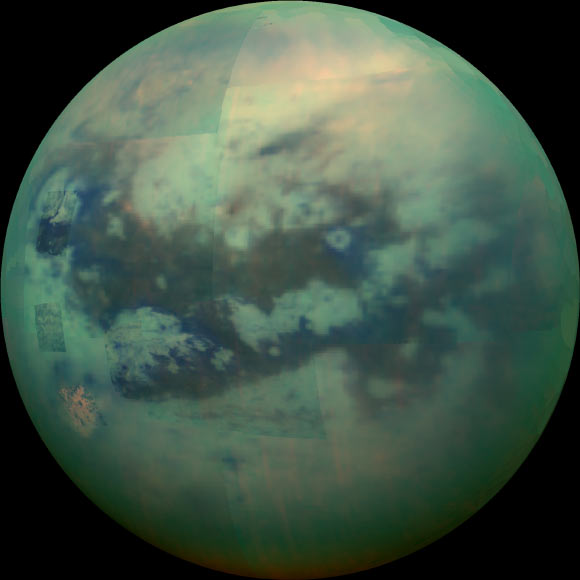
This composite image showcases an infrared perspective of Titan. Within this visualization, the color blue signifies wavelengths centered at 1.3 microns, green denotes 2.0 microns, and red represents 5.0 microns. A visual representation at observable wavelengths would exclusively present Titan’s atmospheric haze; conversely, the near-infrared wavelengths utilized in this image permit Cassini’s observational capabilities to penetrate the obscuring haze and reveal the moon’s surface topography. The perspective is directed towards terrain situated predominantly on the hemisphere facing Saturn. Image credit: NASA / JPL-Caltech / Space Science Institute.
The Cassini spacecraft’s mission, commencing in 1997 and extending for close to two decades, furnished an extensive repository of information concerning Saturn and its retinue of 274 natural satellites.
Titan holds the distinction of being the sole celestial body, apart from our planet Earth, documented to harbor liquid on its external surface.
Ambient temperatures on Titan typically hover around a frigid minus 183 degrees Celsius (equivalent to minus 297 degrees Fahrenheit). In lieu of water, liquid methane constitutes the prevalent form of liquid, giving rise to lakes and precipitation in the form of rain.
As Titan traversed its orbit around Saturn in an elliptical path, scientists meticulously observed the moon undergoing periods of both expansion and contraction, correlating with its positional relationship to Saturn.
By 2008, a prevailing theory posited that Titan must host a substantial subsurface ocean, a condition deemed necessary to facilitate such pronounced volumetric distortions.
“The magnitude of deformation is intrinsically linked to Titan’s internal composition and structure,” stated Dr. Journaux.
“An extensive subterranean ocean would permit greater flexibility in the lunar crust’s response to Saturn’s gravitational influence. Conversely, if Titan were uniformly frozen, its capacity for deformation would be considerably diminished.”
“While the degree of deformation observed during the preliminary analysis of the Cassini mission data initially seemed consistent with the presence of a global ocean, our current understanding indicates that this interpretation is incomplete.”
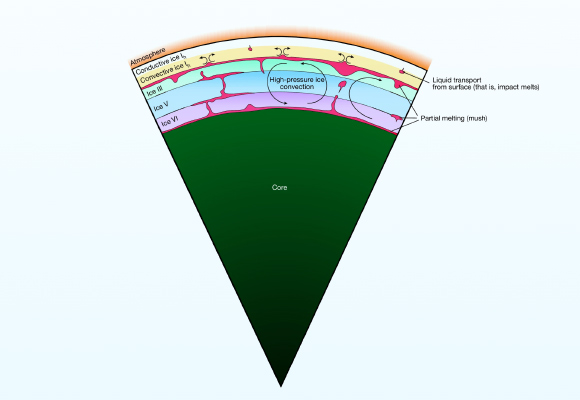
Schematic representation of Titan’s internal structure as elucidated by Petricca et al. Image credit: Petricca et al., doi: 10.1038/s41586-025-09818-x.
The recent investigation, led by Dr. Journaux and his co-authors, introduces an elevated degree of analytical nuance: the temporal aspect.
Titan’s rotational and shape-shifting movements exhibit a temporal lag of approximately 15 hours relative to the apex of Saturn’s gravitational tidal forces.
Analogous to the act of stirring a viscous liquid with a spoon, greater exertion is required to agitate a thick, rheologically complex substance compared to a fluid like water.
The measurement of this temporal delay provided scientists with crucial insights into the energetic expenditure necessary for modifying Titan’s form, thereby enabling inferences regarding the internal viscosity of the moon.
The quantity of energy expended, or dissipated, within Titan’s interior significantly surpassed the estimations anticipated for a global ocean scenario by the research team.
“An exceptionally high rate of energy dissipation within Titan was entirely unexpected,” commented Dr. Flavio Petricca, a postdoctoral researcher affiliated with NASA’s Jet Propulsion Laboratory.
“This finding served as the definitive indicator that Titan’s internal constitution diverges from prior analytical deductions.”
The computational model subsequently proposed by the scientists depicts an internal environment characterized by a more substantial proportion of semi-solid material (slush) and a considerably reduced volume of free-flowing liquid water.
This semi-solid matrix possesses sufficient viscosity to account for the observed temporal lag while still retaining water, thus permitting Titan to undergo morphological changes when subjected to gravitational forces.
“The aqueous strata present on Titan are characterized by such profound depths and immense pressures that the fundamental physics governing water undergo alteration,” explained Dr. Journaux.
“Under these extreme conditions, water and ice exhibit behavioral characteristics distinct from those observed in terrestrial seawater.”
This groundbreaking research endeavor was officially published today in the esteemed journal Nature.
_____
F. Petricca et al. 2025. Titan’s strong tidal dissipation precludes a subsurface ocean. Nature 648, 556-561; doi: 10.1038/s41586-025-09818-x