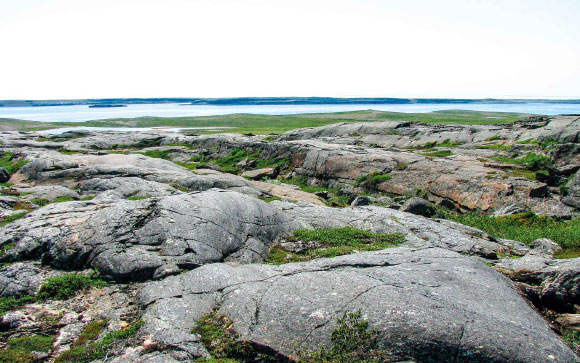
Compelling geological evidence has been uncovered by scientists, indicating the preservation of Hadean-era rock formations, with ages reaching as far back as 4.16 billion years. These ancient relics are situated within a complex geological assemblage known as the Nuvvuagittuq Greenstone Belt, thereby providing an exceptionally rare glimpse into Earth’s nascent stages.

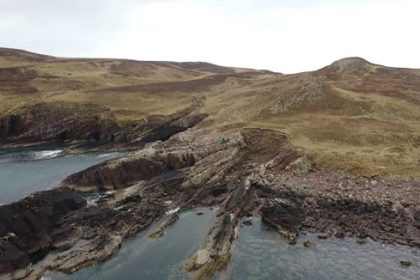
The Nuvvuagittuq Greenstone Belt, Canada. Image credit: Jonathan O’Neil.
A significant portion of Earth’s early geological narrative remains shrouded in mystery, largely attributable to the scarcity of Hadean (predating 4.03 billion years ago) rocks and minerals.
These primordial geological materials are seldom spared from alteration or complete obliteration as the planet’s lithosphere undergoes ceaseless recycling through dynamic tectonic activity.
“The Nuvvuagittuq Greenstone Belt has been posited as a potential candidate for surviving Hadean-age crustal rock,” stated the lead author, Dr. Christian Sole of the University of Ottawa, alongside his research collaborators.
“Nevertheless, this assertion is a subject of considerable debate; some researchers contend that the isotopic data used to support these age estimations may, in fact, reflect more recent geological amalgamation processes rather than the authentic age of the formation itself.”
“Should its Hadean origins be definitively established, the Nuvvuagittuq Greenstone Belt would stand as the most ancient preserved rock sequence documented on our planet.”
“Such a discovery would furnish invaluable insights into the primitive geology of Earth, including the hypothetical environmental conditions conducive to the genesis of life.”
In an effort to precisely ascertain the age of the Nuvvuagittuq Greenstone Belt, the investigative team focused their attention on a particular category of ancient igneous formations – specifically, metagabbroic intrusions – found within the belt.
These intrusive bodies cut across and intersect pre-existing basaltic rocks of greater antiquity. This geological relationship facilitated the researchers’ application of a dual analytical approach, combining uranium-lead (U-Pb) geochronology with both short- and long-lived samarium-neodymium (Sm-Nd) isotopic analyses. This method enabled the determination of a minimum age for the older, more primitive formations (the preceding basaltic rocks).
The Sm-Nd isotopic analyses consistently produced isochron ages clustering around 4.16 billion years, irrespective of the specific sample derivation point or its mineralogical composition.
The convergence of both isotopic systems on the same age, within rocks demonstrably linked by clear evidence of magmatic differentiation, provides robust validation for their crystallization during the Hadean epoch.
Consequently, this finding lends credence to the hypothesis that remnants of mafic crust from the Hadean Eon have indeed endured within the Nuvvuagittuq Greenstone Belt.
“Investigating these rocks is akin to delving into the very genesis of our world,” remarked Dr. Jonathan O’Neil, a distinguished researcher at the University of Ottawa.
“This endeavor empowers us to cultivate a more profound comprehension of how the planet’s initial continental landmasses coalesced and to reconstruct the primordial environmental milieu from which life might have originated.”
These significant research findings have been formally presented and published in the esteemed scientific journal, Science.
_____
C. Sole et al. 2025. Evidence for Hadean mafic intrusions in the Nuvvuagittuq Greenstone Belt, Canada. Science 388 (6754): 1431-1435; doi: 10.1126/science.ads8461