Astronomers harnessing the capabilities of the Atacama Large Millimeter/submillimeter Array (ALMA) have achieved unprecedentedly detailed imagery of 24 debris disks. These dusty formations, residual after the completion of planetary accretion, offer a pivotal glimpse into the transitional epoch situated between planetary genesis and mature exoplanetary architectures.

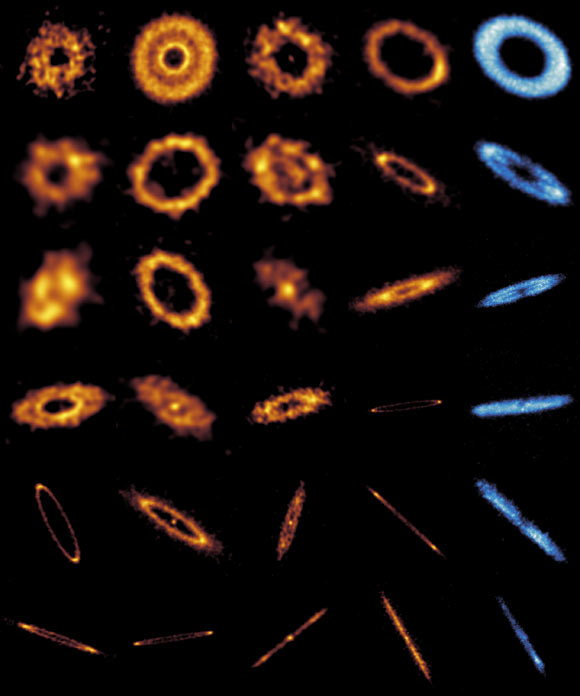
This ARKS gallery of faint debris disks reveals details about their shape: belts with multiple rings, wide smooth halos, sharp edges, and unexpected arcs and clumps, which hint at the presence of planets shaping these disks; and chemical make-up: the amber colors highlight the location and abundance of the dust in the 24 disks surveyed, while the blue their carbon monoxide gas location and abundance in the six gas-rich disks. Image credit: Sebastian Marino / Sorcha Mac Manamon / ARKS Collaboration.
Tenuous collections of dust, referred to as debris disks, are characteristic of both nascent and evolved planetary systems.
The ephemeral nature of this dust, susceptible to degradation from radiation and collisional fragmentation, has long underpinned the prevailing hypothesis that it originates from the disintegration of planetesimals on the order of kilometers in size or even larger.
Consequently, debris disks serve as extraterrestrial counterparts to the asteroid and Kuiper Belts within our own Solar System.
Spanning ages from mere tens to millions of years, these circumstellar structures afford a singular vantage point for scrutinizing the terminal stages of planetary system formation.
Furthermore, they facilitate a crucial linkage between the structural configurations observed in protoplanetary disks and the extant population of fully formed exoplanets.
Debris disks stand in stark contrast to the luminous, gas-laden disks where planets initially coalesce, exhibiting a faintness that is hundreds, if not thousands, of times diminished.
Meredith Hughes, an astronomer affiliated with Wesleyan University, alongside her research cohort, successfully surmounted these observational obstacles, yielding imagery of these disks with an unparalleled degree of resolution.
The deployment of ALMA enabled the acquisition of high-fidelity images pertaining to 24 debris disks orbiting distant stellar bodies.
These observational efforts were integral to the ALMA survey designed to probe exoKuiper belt Substructures, a project known by the acronym ARKS.
“While we have frequently obtained ‘infant photographs’ of planetary formation, the intervening ‘adolescent phase’ has, until this point, remained an elusive missing element,” remarked Dr. Hughes.
“We are now witnessing remarkable heterogeneity – not merely simple annular structures, but rather systems characterized by multiple rings, expansive halos, and pronounced asymmetries, thereby illuminating a dynamic and tumultuous period within the evolutionary histories of planets,” added Dr. Sebastián Marino, a cosmologist at the University of Exeter.
The ARKS initiative represents the most extensive and highest-resolution examination of debris disks undertaken to date, establishing a new benchmark of excellence, comparable to the DSHARP survey but specifically for debris disks.
Approximately one-third of the examined disks exhibit discernible substructures, such as concentric rings or well-defined gaps, which are indicative of residual features from earlier planet-building epochs or sculpted by planetary gravitational forces over extended durations.
While certain disks retain intricate patterns from their formative years, others undergo a smoothing process, expanding into broader annular configurations, mirroring the projected developmental trajectory of our Solar System.
Numerous disks display evidence of both tranquil and agitated zones, with vertically amplified regions, evocative of our Solar System’s own amalgamation of placid classical Kuiper Belt constituents and those perturbed by Neptune’s ancient orbital shifts.
Several disks are observed to retain gaseous components for durations exceeding typical expectations. In particular systems, this persistent gas may exert influence on the chemical composition of developing planets or even propel dust particles into expansive halo structures.
A significant number of these disks present asymmetrical morphologies, characterized by luminous arcs or eccentric outlines, suggesting the gravitational influence of undetected planets, the lingering aftermath of planetary migration events, or interactions between the gaseous and particulate components.
“These disks chronicle a phase wherein planetary orbits underwent considerable perturbation, and colossal impacts, akin to the event that precipitated the formation of Earth’s Moon, played a pivotal role in shaping nascent solar systems,” stated Dr. Luca Matrà, an astrophysicist at Trinity College Dublin.
“By scrutinizing dozens of disks surrounding stars of varying ages and types, the ARKS project has been instrumental in deciphering whether chaotic formations are inherited, shaped by planetary interactions, or result from alternative celestial phenomena.”
“The resolution of these inquiries could shed light on whether the evolutionary path of our Solar System was an anomaly or a commonplace occurrence.”
The findings have been officially disseminated in the esteemed journal Astronomy & Astrophysics.
_____
S. Marino et al. 2026. The ALMA survey to Resolve exoKuiper belt Substructures (ARKS). I. Motivation, sample, data reduction, and results overview. A&A 705, A195; doi: 10.1051/0004-6361/202556489