The sole direct measurement of the radiation milieu surrounding Uranus, captured by NASA’s Voyager 2 in 1986, established a generally accepted paradigm of a planetary system characterized by a comparatively anemic ion radiation belt and a remarkably potent electron radiation belt. Nevertheless, it is plausible that these observations were not contemporaneous with typical conditions. A recent investigation undertaken by scientists at the Southwest Research Institute involved a comparative analysis of the Voyager 2 data with an analogous event documented at Earth. This methodological approach, coupled with a contemporary re-evaluation of the Voyager 2 encounter, posits that the interplay between the solar wind and the magnetosphere of Uranus may have engendered amplified electromagnetic wave activity, capable of propelling electrons to relativistic velocities. This proposition necessitates the exploration of novel, more comprehensive inquiries concerning Uranus and underscores the imperative for a dedicated orbiter mission to the planet.
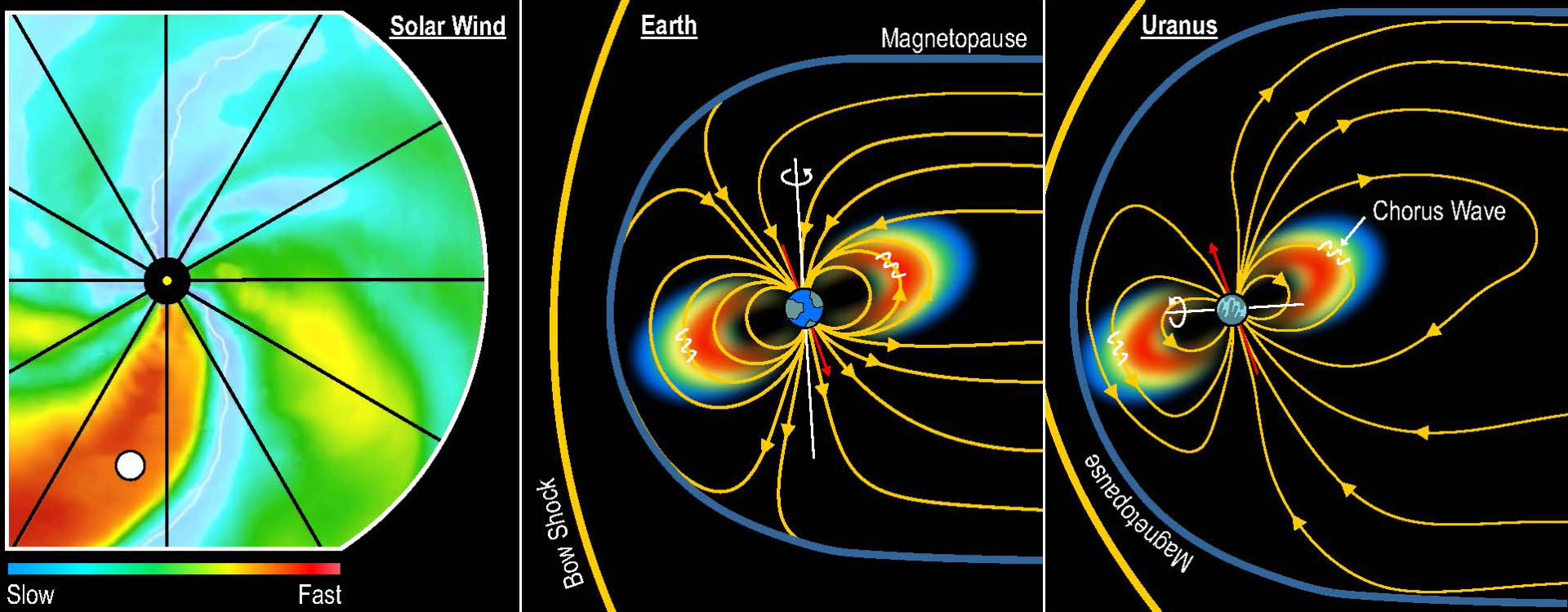
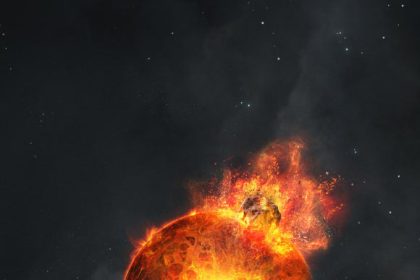
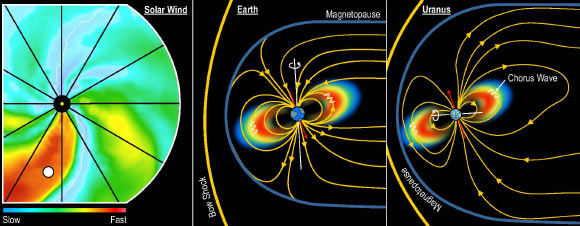
Allen et al. juxtaposed the space weather ramifications of a high-velocity solar wind formation, which precipitated a severe solar storm on Earth in 2019 (depicted in the second panel), against the environmental conditions recorded at Uranus by Voyager 2 in 1986 (illustrated in the third panel). This comparative study aims to potentially resolve a 39-year-old enigma surrounding the exceptionally intense radiation belts detected. Image provided courtesy of SwRI.
During the historic Voyager 2 flyby of Uranus in 1986, the probe registered an unexpectedly robust electron radiation belt, exhibiting intensity levels significantly exceeding prior expectations.
Projected against benchmarks derived from other planetary systems, the electron radiation belt observed at Uranus was notably anomalous.
Consequently, researchers have long pondered the mechanisms by which the Uranian system could sustain such a pronounced trapped electron radiation belt, a phenomenon unprecedented elsewhere in our Solar System.
In light of recent analytical findings, Dr. Robert Allen, a scientist at the Southwest Research Institute, and his collaborators propose that the observations made by Voyager 2 might share crucial similarities with phenomena on Earth influenced by substantial solar wind disturbances.
Their hypothesis suggests that a specific solar wind formation, identified as a co-rotating interaction region, was likely traversing the Uranian system at the time of the encounter.
This event could potentially account for the extraordinarily elevated energy levels documented by Voyager 2.
“Scientific understanding has advanced considerably since the Voyager 2 mission,” commented Dr. Allen.
“We elected to adopt a comparative methodology, examining the Voyager 2 data and contrasting it with Earth-based observations gathered over the subsequent decades.”
The new research indicates that the Uranian system may have been subjected to a space weather event during Voyager 2’s transit, leading to the generation of powerful high-frequency waves, the most intense encountered throughout the entire Voyager 2 mission.
“In 1986, the prevailing scientific consensus held that such waves would cause electrons to disperse and be lost into Uranus’ atmosphere,” Dr. Allen elaborated.
“However, subsequent investigations have revealed that these very same waves, under specific circumstances, can also accelerate electrons, thereby injecting additional energy into planetary systems.”
“In 2019, Earth experienced an event of this nature, which resulted in a substantial acceleration of electrons within its radiation belts,” stated Dr. Sarah Vines, also a scientist at the Southwest Research Institute.
“If a comparable process were active within the Uranian system, it would elucidate the presence of the unexpected surge of energy detected by Voyager 2.”
However, these revelations concurrently provoke a multitude of further interrogative avenues concerning the fundamental physical principles and the sequence of occurrences that would facilitate such intense wave emissions.
“This finding serves as yet another compelling justification for dispatching a mission specifically targeting Uranus,” Dr. Allen emphasized.
“These findings hold significant implications for analogous systems, such as that of Neptune.”
The research findings have been published in the esteemed journal Geophysical Research Letters.
_____
R.C. Allen et al. 2025. Unraveling the Enigma of Uranus’ Electron Radiation Belt: Leveraging Terrestrial Radiation Belt Knowledge in a Reassessment of Voyager 2 Observations. Geophysical Research Letters 52 (22): e2025GL119311; doi: 10.1029/2025GL119311