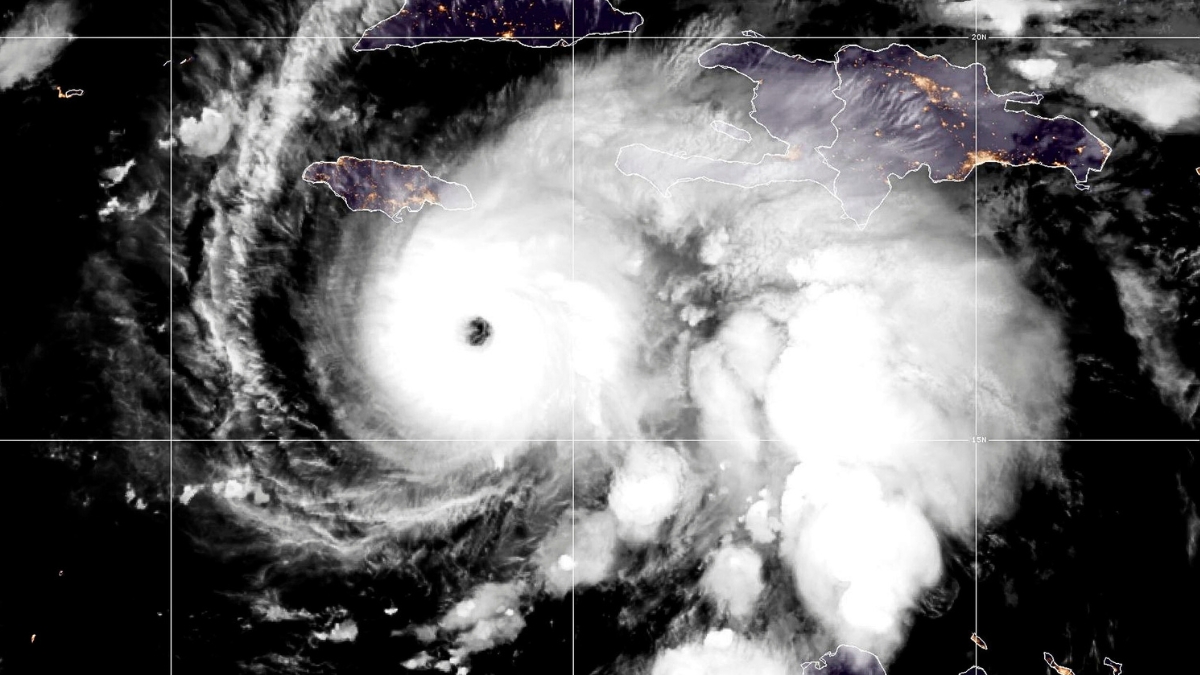
Jamaica is currently grappling with Hurricane Melissa, a tempest unleashing unprecedented wind velocities and prodigious rainfall across the Caribbean archipelago, marking the island’s inaugural encounter with a Category 5 landfall event.
The exceptionally disconcerting nature of Melissa stems not solely from its formidable scale and potency, but from the astounding celerity with which it attained such destructive power. Within a mere twenty-four-hour period, this meteorological phenomenon escalated from a modest tropical depression to a major hurricane, boasting sustained winds of 170 miles per hour.
Meteorologists designate this phenomenon as “rapid intensification.” As global temperatures ascend, this accelerated strengthening of tropical cyclones is becoming an increasingly prevalent occurrence.
These tempestuous systems present a heightened peril precisely because they frequently catch populations unprepared. This is largely attributable to the fact that predicting rapid intensification, while subject to ongoing advancements, continues to pose a significant challenge.
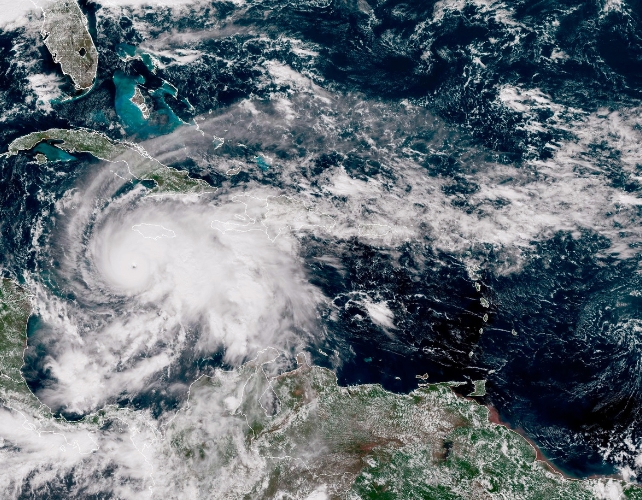
Enhanced predictive capabilities will hinge upon more granular surveillance of a hurricane’s central core – particularly in proximity to the eyewall, the zone of maximum wind speeds – and upon the deployment of higher-fidelity computational models capable of more accurately representing a storm’s intricate architecture. Novel machine learning (AI) methodologies may offer assistance, yet their efficacy remains largely unverified.
Under prevailing circumstances, storms undergoing rapid intensification leave communities with minimal advance notice for evacuation, and governmental bodies with constrained timelines for enacting compensatory measures, such as establishing refuge centers or fortifying vital infrastructure.
This very scenario unfolded with Hurricane Otis in Mexico in 2023 and Typhoon Rai in the Philippines in 2021. Both of these cyclones underwent rapid intensification just prior to making landfall, resulting in hundreds of fatalities due to the inability of individuals to reach secure locations. These instances serve as stark reminders: extreme weather events are surpassing even the most pessimistic projections from our forecasting models.
Fortunately, the potential for Melissa to escalate to a Category 5 hurricane was identified prior to its arrival on Jamaican shores, a factor aided by the storm’s deliberate pace as it approached the island.
Conducive Conditions for Cyclogenesis
A specific confluence of atmospheric and oceanic conditions is propitious for fostering rapid intensification: elevated atmospheric humidity, minimal wind shear (the variation in wind speed with altitude), and elevated sea-surface temperatures.
Contemporary scientific investigation indicates that since the early 1980s, warmer oceanic waters and a more saturated atmosphere have rendered these prerequisite conditions more prevalent. These observable trends cannot be attributed to natural fluctuations; it appears that anthropogenic climate change is playing a substantial role in augmenting the likelihood of rapid intensification.
In the instance of Hurricane Melissa, the discernible influence of climate change is evident across numerous factors contributing to its catastrophic impact. Sea-surface temperatures in the affected region are currently exceeding their typical averages by over a degree Celsius, a condition that may be 500 to 800 times more probable as a consequence of climate change.
Warmer oceans provide an augmented energy reservoir for storm intensification. Furthermore, escalating sea levels exacerbate the destructive potential of storm surges and coastal inundation.
Scientists exhibit a high degree of certainty that precipitation volumes are increasing due to climate change, a phenomenon explained by the enhanced moisture-holding capacity of a warmer atmosphere—a pattern conspicuously observed in the North Atlantic basin.
Melissa’s unhurried trajectory contributes to substantial rainfall accumulation over landmasses. Projections indicated that mountainous areas of Jamaica could potentially receive up to a meter of precipitation, thereby elevating the risk of severe flooding and attendant landslides.

Certain academic studies even posit that climate change is contributing to a deceleration in the forward motion of cyclones themselves (i.e., the rate at which the storm progresses across the geographical area). This diminished speed would necessitate a prolonged presence over land, thereby intensifying rainfall totals.
Sophisticated modeling exercises conducted by a colleague at the University of Reading have substantiated that historical hurricanes impacting Jamaica would have engendered greater volumes of rainfall within the contemporary warmer climate regime.
The escalating propensity for storms to undergo rapid intensification is facilitating their progression to more severe categories, a development that can prove catastrophic when this surge in intensity is inadequately forecast.
As the planet continues to warm, this inherent risk will inevitably escalate. Consequently, it is imperative for scientific researchers to enhance hurricane monitoring and forecasting paradigms, and for emergency management personnel to proactively prepare for scenarios involving intense hurricanes that necessitate rapid response with curtailed preparation windows.
Hurricane Melissa has starkly illuminated these burgeoning risks: storms are intensifying with greater alacrity, striking with increased ferocity, and affording individuals diminished opportunities for timely evacuation.

Authored by Alexander Baker, Research Scientist, National Centre for Atmospheric Science, University of Reading, and Liz Stephens, Professor of Climate Risks and Resilience, University of Reading