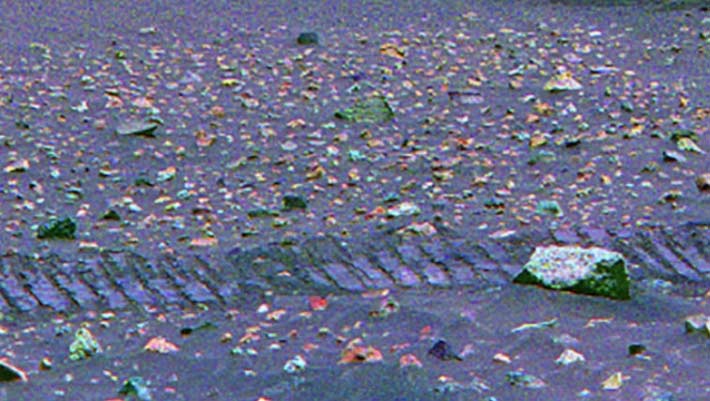
Numerous small, pale rock fragments, identified as float rocks, have been identified by NASA’s Perseverance rover. Certain fragments exhibit spectral characteristics indicative of kaolinite, an aluminum-rich clay mineral. To elucidate their origin, planetary scientists utilized data from Perseverance’s SuperCam and Mastcam-Z instruments. This involved a comparative analysis of the chemical composition and reflectance spectra of these Martian float rocks against deeply weathered paleosols (ancient soils) and hydrothermal kaolin deposits found within Earth’s geological archives. The observed enrichments in aluminum and titanium, juxtaposed with a depletion of iron and magnesium, diverge from the signatures of hydrothermal deposits. Instead, these patterns align more closely with the bleached horizons of paleosols that formed under conditions of abundant rainfall during Earth’s past greenhouse epochs. Consequently, these Martian rocks are posited to represent some of the most hydrologically active periods in the planet’s history.
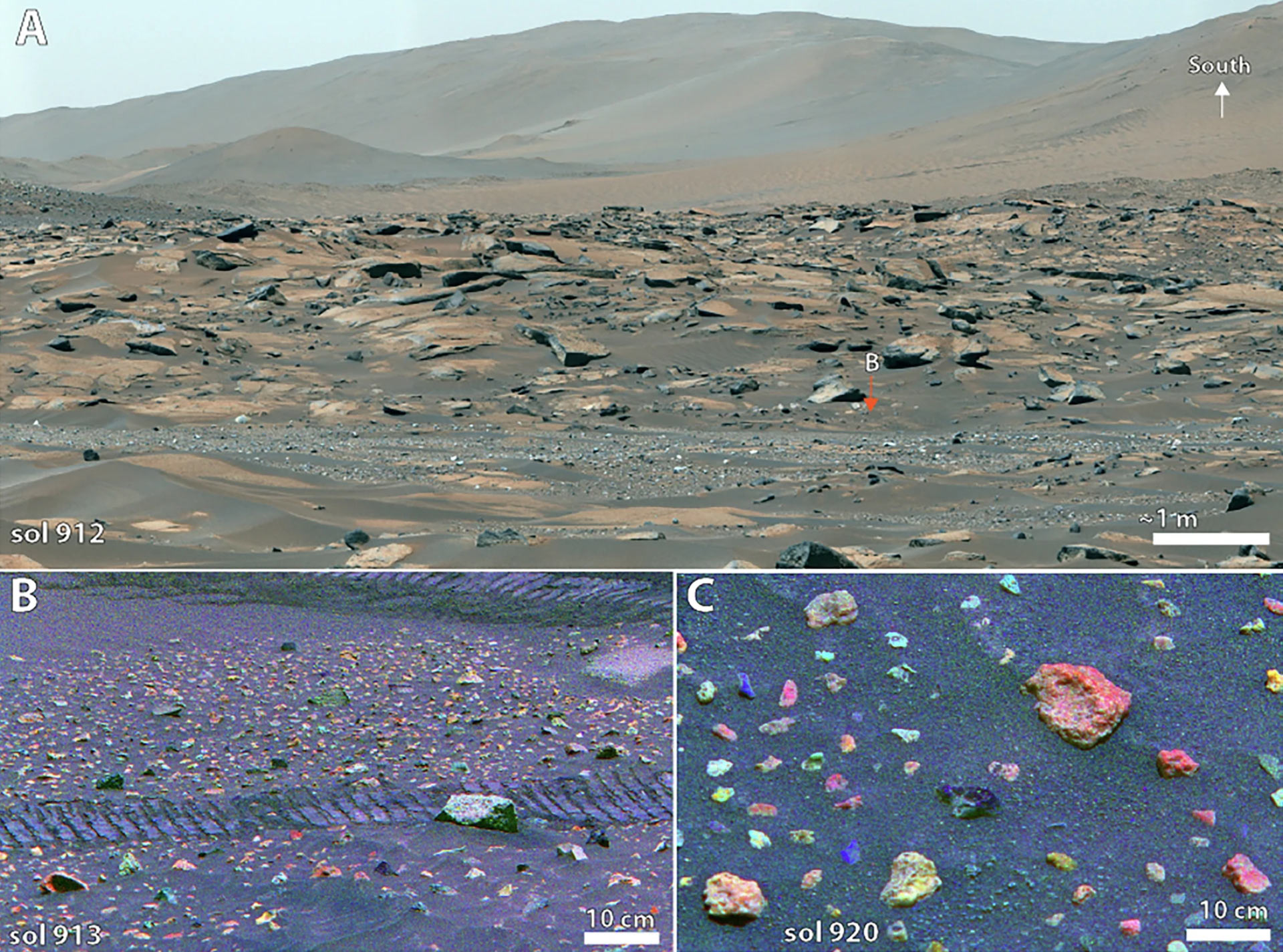
Mastcam-Z landscape and multispectral images of light-toned float rocks atop the Jezero crater Margin Unit near the Hans Amundson Memorial workspace (Sol 912) demonstrating the spectral diversity of this material. Image credit: Broz et al., doi: 10.1038/s43247-025-02856-3.
“Elsewhere on Mars, rocks like these are probably some of the most important outcrops we’ve seen from orbit because they are just so hard to form,” stated Dr. Briony Horgan, who serves as a long-term planner for the Perseverance mission and conducts research at Purdue University.
“You need so much water that we think these could be evidence of an ancient warmer and wetter climate where there was rain falling for millions of years.”
“Tropical climates like rainforests are the most common environments to find kaolinite clay on Earth,” added Dr. Adrian Broz, a postdoctoral researcher at Purdue University.
“So when you see kaolinite on a place like Mars, where it’s barren, cold and with certainly no liquid water at the surface, it tells us that there was once a lot more water than there is today.”
The kaolinite fragments, varying in size from pebbles to boulders, represent the latest contributions to the ongoing discourse concerning Mars’ climate billions of years ago.
Preliminary analyses conducted by the SuperCam and Mastcam-Z instruments were instrumental in comparing the recovered kaolinite to analogous rock formations on Earth.
These Martian fragments could furnish substantial insights not only into the planet’s past environmental phases but also into the geological processes that led to its present desiccated state.
“Kaolinite also carries its own mystery,” Dr. Horgan noted.
“There is no major outcropping nearby where the light-colored rocks could have originated despite being scattered throughout the mission path Perseverance has followed since landing at the Jezero crater in February 2021.”
“The crater used to contain a lake about twice the size of Lake Tahoe.”
“They’re clearly recording an incredible water event, but where did they come from?”
“Maybe they were washed into Jezero’s lake by the river that formed the delta, or maybe they were thrown into Jezero by an impact and they’re just scattered there. We’re not totally sure.”
Satellite imagery has detected significant outcrops of kaolinite in other Martian regions.
“But until we can actually get to these large outcroppings with the rover, these small rocks are our only on-the-ground evidence for how these rocks could have formed,” Dr. Horgan commented.
“And right now the evidence in these rocks really points toward these kinds of ancient warmer and wetter environments.”
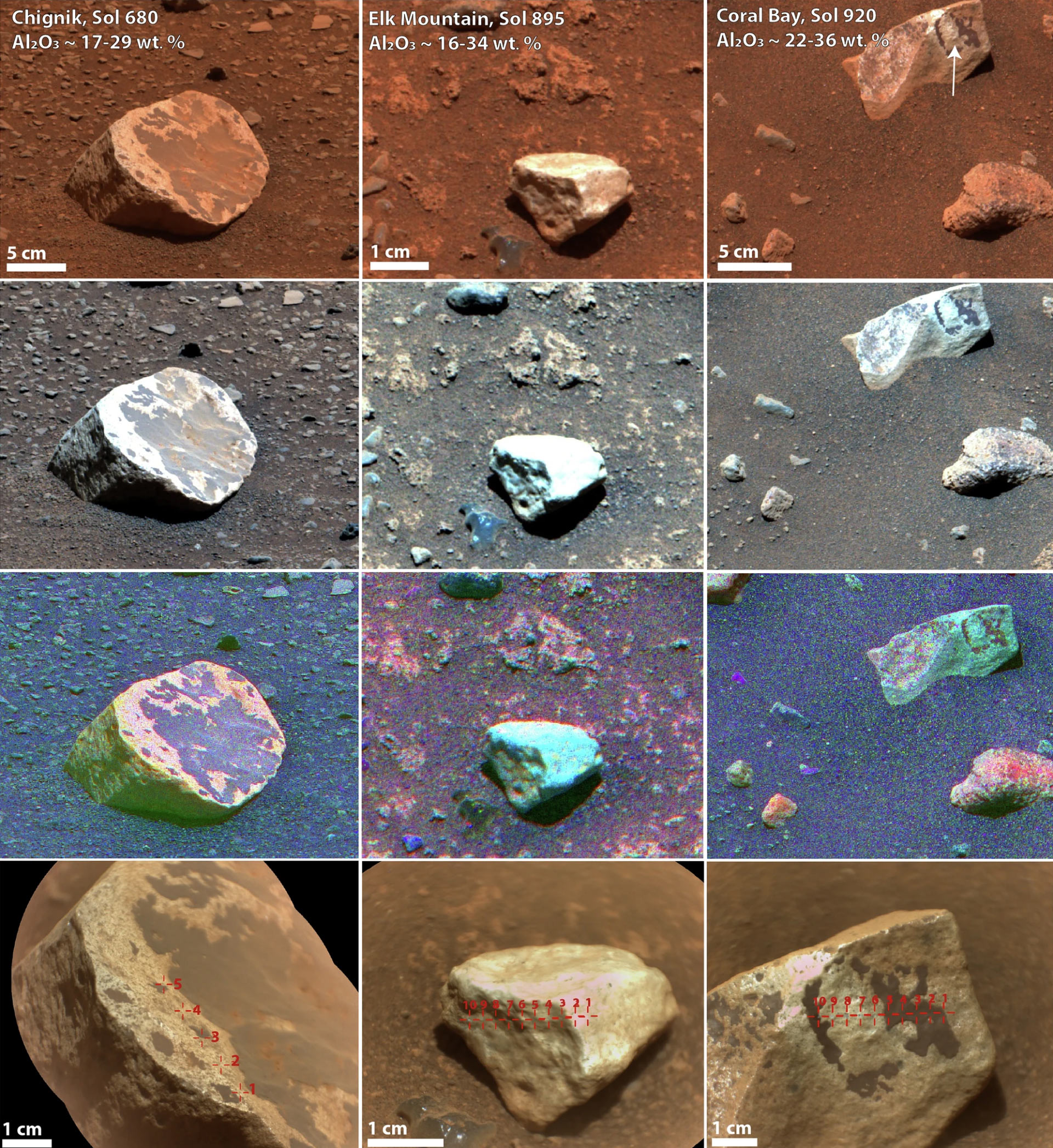
Mastcam-Z and SuperCam observations of the hydrated class of aluminum-rich float rocks at Jezero Crater, Mars. Image credit: Broz et al., doi: 10.1038/s43247-025-02856-3.
The research team conducted a comparative study, contrasting the Martian kaolinite samples examined by Perseverance with rock samples acquired from locations near San Diego, California, and within South Africa. A remarkable similarity was noted between the terrestrial and Martian rock specimens.
In addition to a precipitation-heavy tropical climate, kaolinite also originates on Earth through hydrothermal processes involving the leaching of rock by hot water.
However, this specific geological mechanism imparts a distinct chemical signature to the rock, differentiating it from the alterations caused by lower-temperature leaching over extended geological timescales by rainfall.
The scientists leveraged datasets from three distinct geographical sites to draw parallels between the hydrothermal leaching scenario and the rocks found on Mars.
Rocks on Mars, such as the identified kaolinite formations, function as invaluable time capsules, potentially preserving records of the planet’s environmental history spanning billions of years.
“All life uses water. So when we think about the possibility of these rocks on Mars representing a rainfall-driven environment, that is a really incredible, habitable place where life could have thrived if it were ever on Mars,” Dr. Broz remarked.
The findings of the research team were disseminated in the scientific journal Communications Earth & Environment, accessible via the following publication.
_____
A.P. Broz et al. 2025. Alteration history of aluminum-rich rocks at Jezero crater, Mars. Commun Earth Environ 6, 935; doi: 10.1038/s43247-025-02856-3