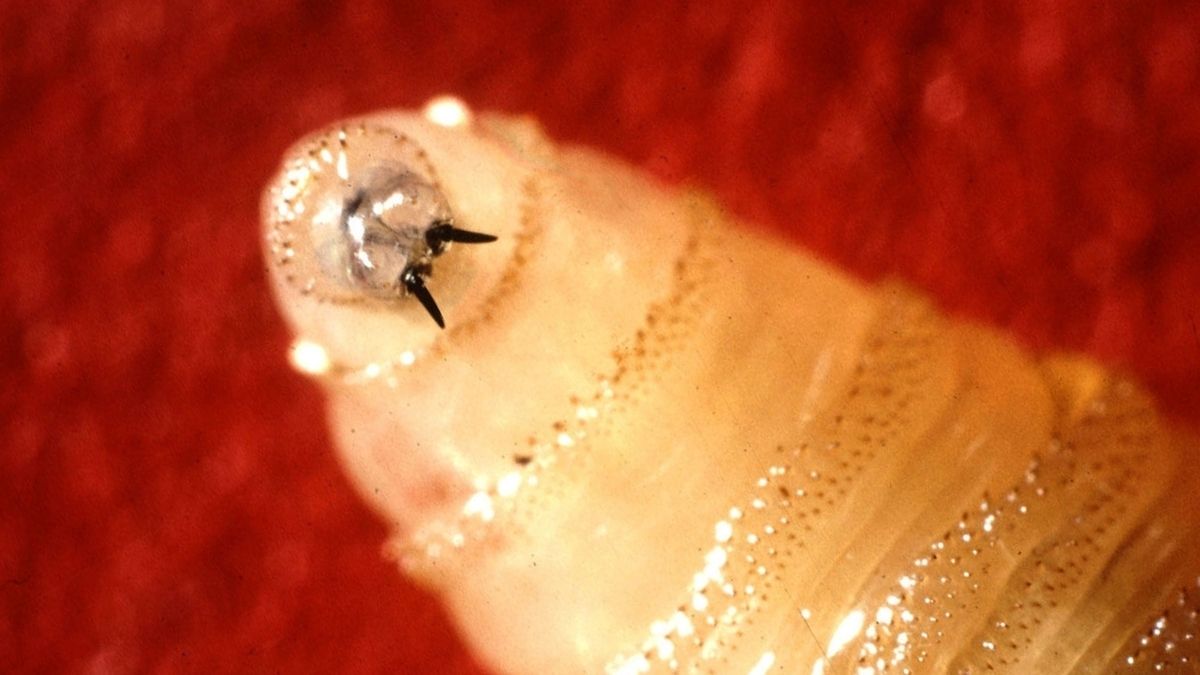
A surge in the New World screwworm (Cochliomyia hominivorax), a parasitic fly whose larvae consume living flesh, has resulted in seven fatalities and afflicted at least 1,190 individuals throughout Mexico and South America. Consequently, the US Centers for Disease Control and Prevention (CDC) is issuing a crucial alert to healthcare professionals regarding its potential ascent into the United States.
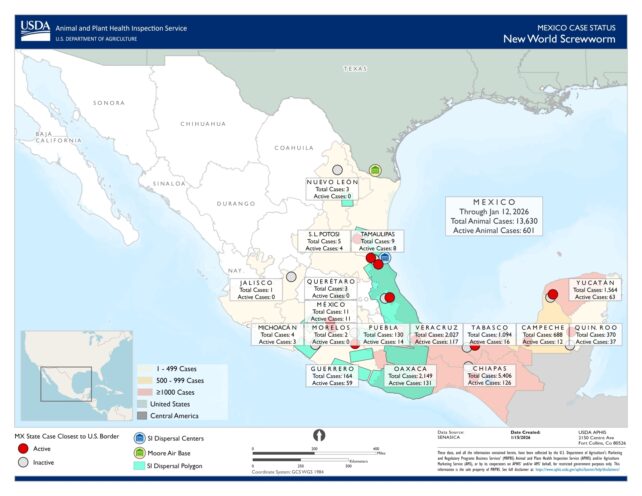
Mexico currently reports 601 active animal infections traversing its territory, with eight cases identified in Tamaulipas, a state that shares a border with Texas. This geographical proximity has prompted the US CDC to disseminate a public health advisory.
The advisory urges physicians, veterinarians, and other stakeholders within the American healthcare infrastructure to maintain vigilance for the screwworm, described as “a devastating pest” that was successfully eradicated from the nation in 1966. A subsequent reappearance occurred in 2017, when deer in Florida were found to be infected following an incursion of the fly larvae in 2016.
The New World screwworm is characterized by its larval stage, which subsists on and burrows into the wounds and mucous membranes of warm-blooded organisms.
While livestock such as cattle, horses, and pigs are the most frequent hosts, this parasite is also capable of depositing its eggs within the tissues of domestic animals like dogs and cats, and alarmingly, humans. Left untreated, these infestations can prove lethal, with the capacity to terminate even a fully grown bovine within a mere week.
Prior to the 1960s, cattle ranchers in Texas contended with approximately one million screwworm afflictions annually.
This historical context underscores the heightened concern surrounding the parasite’s potential encroachment into Texas. As the leading state for cattle production in the US, an outbreak of screwworm could inflict an estimated economic toll of approximately $1.8 billion, according to projections from the US Department of Agriculture.
An intrinsic characteristic of the New World screwworm’s life cycle provided a crucial advantage in earlier eradication efforts: the female fly typically engages in mating only once throughout its 21-day existence, whereas males have the capacity for multiple pairings.
Leveraging this biological trait, scientists initiated a program in 1962 utilizing gamma radiation to produce sterile male flies. These sterilized males were then introduced into the wild, where they successfully mated with numerous wild females, resulting in the production of unfertilized eggs incapable of development.
Vast quantities of these sterilized males were systematically released from aircraft across southern Florida, Texas, California, Arizona, and New Mexico. Through the combined application of the ‘sterile insect technique,’ coupled with chemical treatments for livestock and favorable environmental conditions, the fly was officially declared locally extinct in the US, Mexico, and parts of Central America by 1982.
A dedicated facility situated in Panama, a nation strategically located between North and South America and characterized by the formidable Darien Gap wilderness, has consistently deployed substantial numbers of sterile screwworm flies to establish a protective barrier. However, in 2023, the parasite inexplicably circumvented this defense, resuming its trajectory northward and reaching Mexico by November 2024.
In September 2025, Mexican authorities confirmed an infestation in an eight-month-old calf located a mere 70 miles from the US border.
The CDC attributes this accelerated northward progression of the New World screwworm to several contributing factors, including “unregulated cattle movement, increased transit through the Darien Gap, and the expansion of agricultural activities.”
Furthermore, scientific research has indicated that the escalating effects of climate change may be exacerbating the situation for these flies, with elevated temperatures potentially extending their periods of proliferation and broadening their geographical distribution.
To date, no US-based human or animal infestations linked to this particular outbreak have been officially reported.
“Nevertheless, given the propensity for geographical dissemination, the CDC is issuing this Health Advisory to heighten awareness of the current outbreak and to furnish a comprehensive summary of CDC recommendations for clinicians and public health departments across the United States. These recommendations encompass guidance on case identification and reporting, specimen collection, diagnostic procedures, and treatment protocols for New World screwworm, in addition to public advisories,” the agency elaborates.
The complete health advisory issued by the US CDC is accessible here.