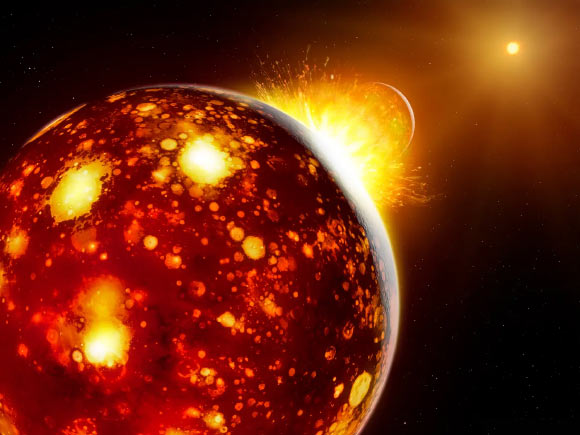
The prevailing scientific hypothesis posits that the Moon’s genesis stemmed from a colossal collision between the nascent Earth and a celestial body known as Theia. A recent investigation, spearheaded by an international consortium of scientists from the United States, Germany, France, and China, involved the meticulous analysis of iron isotope concentrations within lunar specimens, terrestrial rock samples, and meteorites. These extraterrestrial fragments were chosen to represent the potential isotopic signatures of both Theia and proto-Earth during their formation. The findings indicate that Theia, along with the majority of Earth’s primordial constituents, originated from the inner Solar System. Furthermore, their computational models suggest that Theia may have coalesced at an orbit closer to the Sun than Earth.
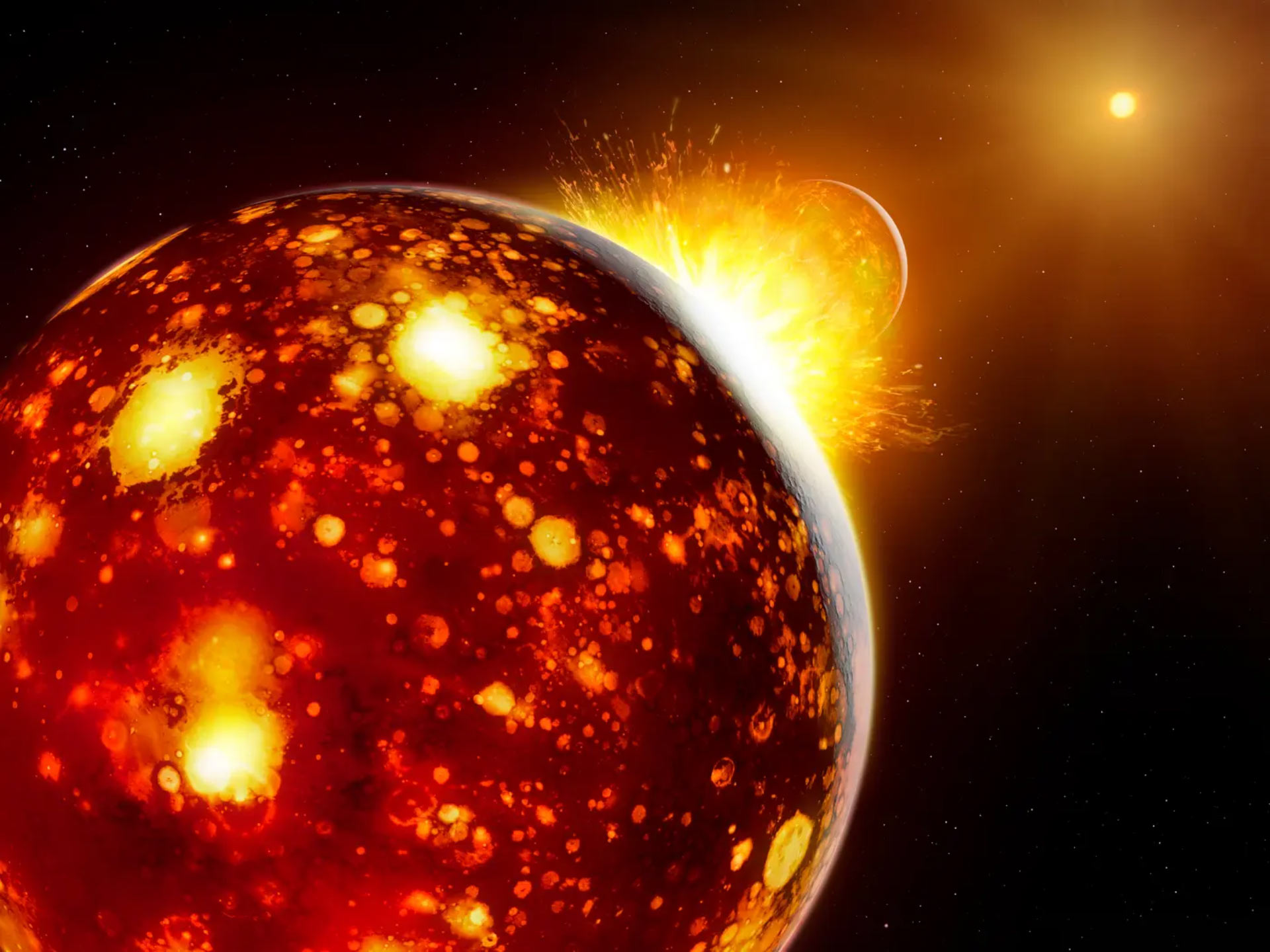
An artist’s impression of the collision between the proto-Earth and Theia. Image credit: MPS / Mark A. Garlick.
“A celestial body’s elemental and isotopic makeup serves as a repository of its entire formation chronology, including its birthplace,” stated Dr. Thorsten Kleine, a senior author on the study and a researcher affiliated with the Max-Planck-Institut für Sonnensystemforschung.
“The precise ratios at which particular metal isotopes are present within a planetary body offer particularly insightful clues.”
“Isotopes represent variations of the same chemical element, distinguished solely by the number of neutrons in their atomic nuclei, and consequently, by their atomic mass.”
“During the formative epoch of the Solar System, the distribution of isotopes for any given element was likely not uniform; for instance, the isotopic ratios observed at the Solar System’s outer periphery may have differed subtly from those found closer to the Sun.”
“Therefore, the isotopic signature of a celestial object intrinsically encodes information regarding the provenance of its original constituent materials.”
In the course of this research, the investigators meticulously quantified the relative abundance of various iron isotopes in samples of Earth and Moon rocks with an exceptionally high degree of accuracy.
Their examination encompassed fifteen terrestrial rock samples and six lunar specimens, which were brought back to Earth by astronauts during the historic Apollo missions.
The outcomes largely align with prior observations; previous analyses of isotopic ratios for chromium, calcium, titanium, and zirconium had already established a remarkable correspondence between Earth and the Moon in these respects.
However, this profound similarity does not permit direct inferences regarding the specific isotopic composition of Theia.
The sheer diversity of plausible collision models renders definitive conclusions elusive.
Although the predominant theoretical frameworks propose that the Moon was predominantly assembled from Theia’s ejected material, alternative hypotheses suggest it could be primarily composed of matter from Earth’s early mantle, or that the materials from Earth and Theia became inextricably intermingled.
To elucidate further the nature of Theia, the scientific team adopted a method akin to planetary reverse engineering.
Leveraging the concordance in isotopic ratios observed in contemporary terrestrial and lunar rocks, the researchers simulated various compositional and dimensional characteristics for Theia, alongside different compositions for the early Earth, to ascertain which combinations could account for the observed final state.
The study’s scope extended beyond iron isotopes to include those of chromium, molybdenum, and zirconium.
The inclusion of these disparate elements provides access to different stages of planetary accretion and differentiation.
Long preceding the cataclysmic impact with Theia, a significant process of elemental segregation had occurred within the proto-Earth.
The formation of Earth’s iron core resulted in the concentration of certain elements, such as iron and molybdenum, within it, leaving them largely depleted in the subsequent rocky mantle.
Consequently, the iron present in Earth’s mantle today could only have been incorporated after the core’s solidification, potentially via impacts from bodies like Theia.
Conversely, elements such as zirconium, which did not partition into the core, serve as chronometers, preserving a record of Earth’s entire formation history.
From the spectrum of mathematically feasible compositional scenarios for Theia and the early Earth generated by their simulations, several were deemed improbable and subsequently discarded.
“The most compelling explanatory framework is that the primary building blocks of both Earth and Theia originated from the inner regions of the Solar System,” commented Dr. Timo Hopp, the study’s lead author and a researcher at the University of Chicago and the Max-Planck-Institut für Sonnensystemforschung.
“It is highly probable that Earth and Theia were closely situated neighbors during their formation.”
“While the isotopic signature of the early Earth can be reasonably approximated by a mixture of known meteorite classes, this generalization does not hold true for Theia.”
“Different classes of meteorites originate from distinct geographical zones within the outer Solar System.”
“These meteorites thus function as reference materials, indicative of the elemental and isotopic materials available during the accretion of the early Earth and Theia.”
“However, in the case of Theia, it is plausible that it incorporated materials from sources not yet identified or characterized within our current understanding.”
“We posit that these additional materials originated from a region situated closer to the Sun than Earth’s orbital path.”
“Therefore, our calculations strongly suggest that Theia coalesced at an orbital distance from the Sun that was interior to that of our planet.”
These groundbreaking findings were officially reported this week in the esteemed scientific journal Science.
_____
Timo Hopp et al. 2025. The Moon-forming impactor Theia originated from the inner Solar System. Science 390 (6775): 819-823; doi: 10.1126/science.ado0623