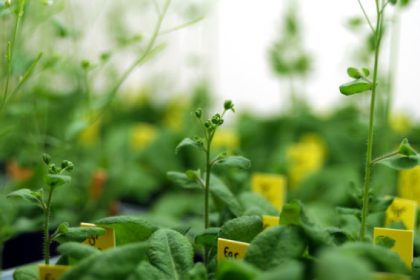
A chromosome-level genome assembly has been successfully generated for the sweetpotato cultivar designated ‘Tanzania.’
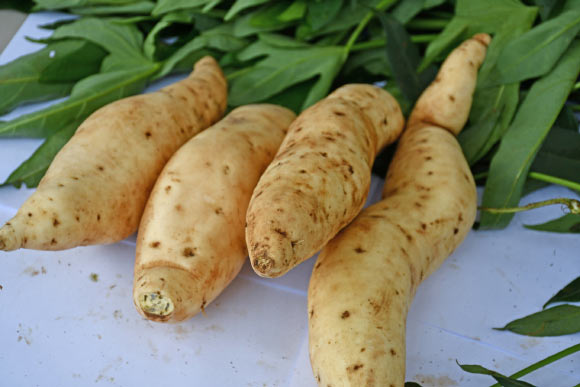
‘Tanzania’ sweetpotato variety. Image credit: Benard Yada, National Crops Resources Research Institute in Uganda.
The sweetpotato stands as a vital global subsistence crop, sustaining innumerable individuals across the planet, particularly within sub-Saharan Africa. Its inherent resilience against climatic adversities renders it an indispensable element for ensuring food security.
However, the intricate genetic blueprint of this ostensibly simple root vegetable has remained largely enigmatic for many years.
The genetic makeup of sweetpotatoes is exceptionally intricate. Whereas humans possess two sets of chromosomes, inherited from each parent, sweetpotatoes exhibit six.
This condition, known as hexaploidy, rendered the process of deciphering their genetic code akin to attempting to reassemble six distinct yet analogous compendiums of knowledge that have been thoroughly intermingled.
Through the application of advanced DNA sequencing methodologies and other sophisticated techniques, Professor Zhangjun Fei from the Boyce Thompson Institute, in conjunction with his research associates, meticulously constructed the first comprehensive genetic profile of ‘Tanzania.’ This specific variety is highly valued in Africa due to its robust disease resistance and elevated dry matter content.
The primary hurdle involved the intricate task of disentangling the plant’s 90 chromosomes and meticulously organizing them into their original six distinct sets, referred to as haplotypes.
The research team achieved the complete separation, or phasing, of this complex genetic configuration, a feat that had not been accomplished previously.
“The availability of this complete, phased genome provides us with an unparalleled degree of clarity,” Professor Fei articulated.
“It empowers us to interpret the sweetpotato’s genetic narrative with remarkable granularity.”
According to the collective findings of the team, the sweetpotato genome is structured as a mosaic, formed from contributions originating from multiple wild ancestors, some of which are yet to be definitively identified.
Approximately one-third of its genetic material originates from Ipomoea aequatoriensis, a wild species indigenous to Ecuador that appears to be a direct descendant of a sweetpotato ancestral form.
A substantial additional segment bears resemblance to a wild Central American species, designated Ipomoea batatas 4x, although the precise ancestral contributor might still await discovery in its natural habitat.
“In contrast to what is observed in wheat, where ancestral contributions can be demarcated within specific genome regions,” stated Dr. Shan Wu, a researcher at the Boyce Thompson Institute.
“Within the sweetpotato, the ancestral sequences are intimately interwoven across the same chromosomes, thereby creating a distinctive genomic architecture.”
This interwoven genetic inheritance suggests that the sweetpotato can be provisionally classified as a segmental allopolyploid—fundamentally a hybrid originating from different species but exhibiting genetic behavior as if it originated from a single progenitor.
This process of genomic fusion and recombination imparts to the sweetpotato its exceptional adaptive capabilities and inherent resistance to diseases, traits that are critically important for resource-limited agriculturalists globally.
“The presence of six sets of chromosomes in the sweetpotato also contributes to its enhanced resilience,” Professor Fei observed.
“With multiple iterations of crucial genes, the plant can maintain redundant copies that facilitate survival during drought conditions, confer resistance to insect pests, and enable adaptation to diverse environmental settings—a phenomenon termed polyploid buffering.”
“Nevertheless, achieving a comprehensive understanding of the sweetpotato’s full genetic potential will necessitate the decoding of numerous cultivars from disparate geographical regions, as each may harbor unique genetic characteristics that have been attenuated in others.”
The research outcomes were disseminated this month in the esteemed journal, Nature Plants.
_____
S. Wu et al. Phased chromosome-level assembly provides insight into the genome architecture of hexaploid sweetpotato. Nat. Plants, published online August 8, 2025; doi: 10.1038/s41477-025-02079-6