An identification has been made of a novel genus and species of nimravid, originating from fossilized remnants unearthed in northern China, dating back to the middle Oligocene epoch. This significant find rectifies a lacuna in our understanding of the Nimravidae family’s prevalence in the eastern Eurasian region.
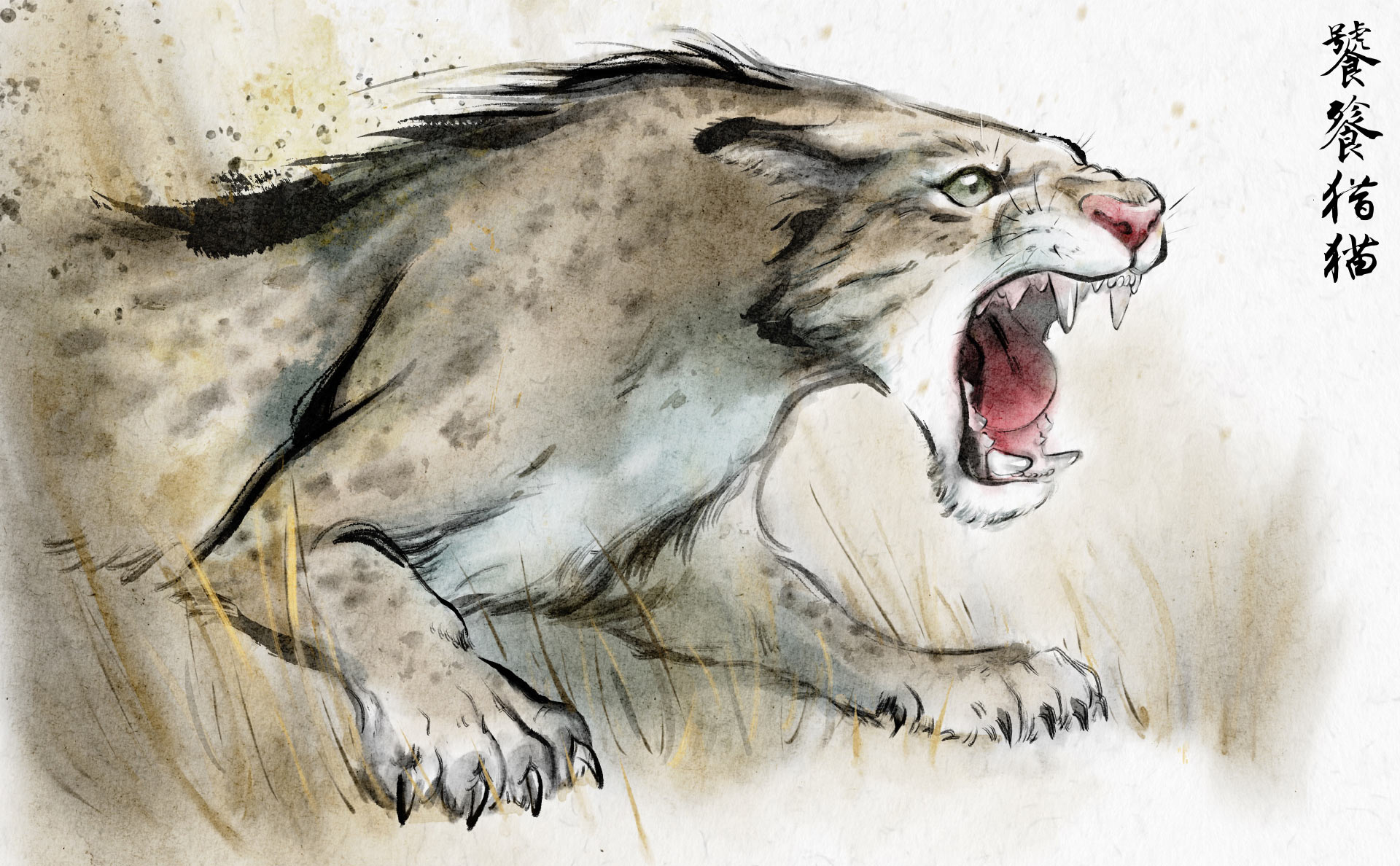
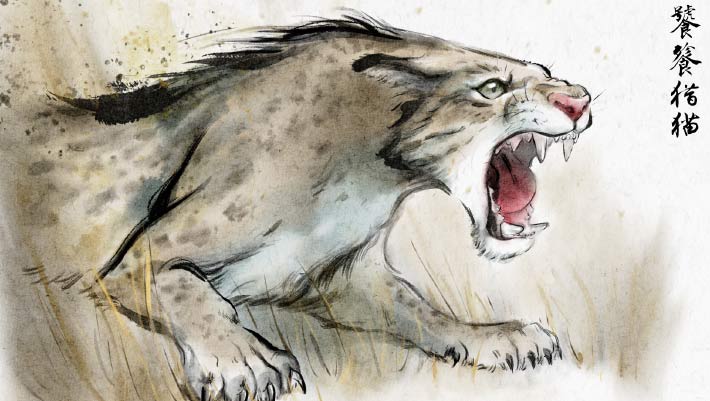
Life reconstruction of Taotienimravus songi in Chinese painting style. Image credit: Yuefeng Song.
Taotienimravus songi inhabited the geographical area now recognized as China during the middle Oligocene period, a span approximately 28 million years ago.
This ancient organism belongs to the Nimravidae, an extinct classification of hypercarnivorous mammals possessing saber-like teeth, frequently referred to as false saber-toothed cats.
“The order Carnivora displays one of the most extensive spectra of body size variation within Mammalia, ranging from roughly 50 grams in the least weasel Mustela nivalis to an average exceeding three tons in the pinniped Mirounga,” stated Dr. Qigao Jiangzuo from the Institute of Vertebrate Paleontology and Paleoanthropology at the Chinese Academy of Sciences, alongside his collaborators.
“Barring a few exceptions like Ursidae, terrestrial carnivores of substantial size — particularly those surpassing 20 kg — typically subsist on a diet of large prey, consuming animals of comparable or even greater mass.”
“The Nimravidae family, commonly known as false sabertooths, constitutes one of the earliest diverging branches within Carnivora, distinguished by their considerable size, craniodental features indicative of hypercarnivory, and presumably, a predatory lifestyle focused on large animals,” they elaborated.
“The earliest definitively identified fossil records of this family, dating from the middle Eocene, already point to highly evolved species exhibiting craniodental morphology akin to that of felids.”
“Nimravidae experienced a diversification throughout the Eocene-Oligocene epochs, with the most complete fossil evidence originating from North America, where numerous skulls and entire skeletal structures have been recovered.”
“Fossiliferous deposits are also prevalent across Eurasia, although the preservation quality tends to be inferior.”
“As the inaugural lineage of Carnivora to evolve significant body mass, Nimravidae serves as an excellent model for examining the early development of the macrocarnivorous niche by Carnivora within an ecological context dramatically altered from present-day conditions.”
The fossilized skeletal remains of Taotienimravus songi were unearthed within the Qingshuiying Formation located in northern China.
An examination of these specimens reveals that the newly identified species represents a non-sabertooth ecomorph, exhibiting an early adaptation for bone-crushing — a characteristic that sets it apart within the Nimravidae family.
It is hypothesized that this creature possessed hunting strategies distinct from other felid-like carnivores, likely employing a tearing bite similar to that observed in hyenas.
“The most salient characteristics of this novel nimravid include its markedly short and stout upper canine teeth and a generally broad palate,” reported the paleontologists.
“The rostrum is exceedingly wide, possibly among the broadest observed in known nimravids.”
“In contrast to many other felid-like carnivores, the premolars are not diminished in size; rather, they are enlarged, resulting in the absence of a diastema, or gap, between the canine and the post-canine dentition.”
“This finding diverges from the typical morphology of most felid-like carnivorans, where a diastema is almost universally present.”
“We infer that this dental configuration is linked to a powerful canine bite and its utilization for deeply penetrating prey.”
The phylogenetic assessment conducted by the research team positions Taotienimravus songi within the Nimravinae subfamily, where it forms a sister lineage to the European and North American genera Nimravus and Dinaelurus.
This specific clade is itself sister to the European lineage comprising Eofelis, Dinailurictis, and Quercylurus.
“An augmentation in body size among the Nimravidae appears to have coincided with the decline of Oxyaenidae, another predatory clade from the Paleogene era,” the investigators noted.
“The initial emergence of macrocarnivorous adaptations within Carnivora, manifested in a felid-like ecomorph, likely reflects competitive dynamics.”
“Nimravidae successfully occupied several ecological niches that were not utilized by Felidae, probably due to a lack of intense competition within Carnivora for a considerable portion of their evolutionary history.
“Our investigation highlights the influence of both abiotic and biotic elements in shaping the availability of ecological niches for these fauna, underscoring the necessity of grounding discussions on niche alteration and evolution within these fundamental considerations.”
A publication detailing this discovery was issued on November 26, 2025, in the journal Proceedings of the Royal Society B.
_____
Qigao Jiangzuo et al. 2025. A new ecomorph of Nimravidae, and the early macrocarnivorous niche exploration in Carnivora. Proc Biol Sci 292 (2059): 20251686; doi: 10.1098/rspb.2025.1686