An immense tabular iceberg, which detached from the Antarctic ice shelf in 1986, is undergoing a striking transformation, rapidly adopting a vibrant blue hue as it hurtles towards inevitable disintegration.
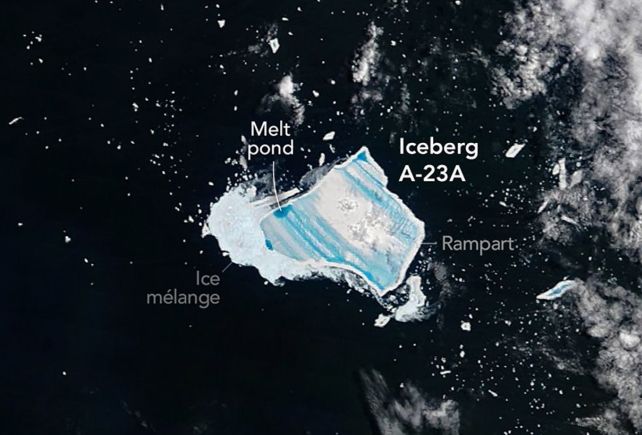
Decades of meticulous observation via Earth satellites reveal that iceberg A-23A has, in a remarkably compressed timeframe, transitioned from a pristine white to a vivid cyan. This chromatic shift is attributed to meltwater accumulating within surface fissures and cavities on the colossal, fracturing ice formation.
This phenomenon signals the imminent dissolution of the berg, one of the most enduring ice masses ever documented, as the presence of meltwater is understood to accelerate its decomposition.
“I do not anticipate that A-23A will survive the entirety of the austral summer,” stated retired Earth scientist Chris Shuman, formerly affiliated with the University of Maryland Baltimore County, in a recent commentary.
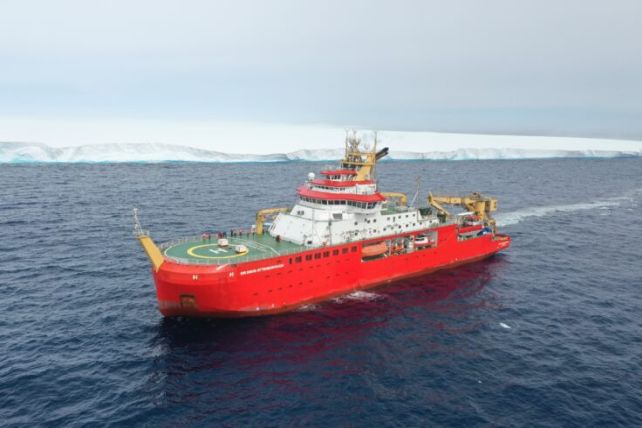
The varied coloration observed in icebergs arises from several physical processes. Predominantly, ice appears white due to the entrapment of numerous air bubbles during its formation. These bubbles significantly augment the scattering and reflection of incident light.
With the passage of time and increased pressure, this ice compresses, expelling the trapped air and thereby enhancing its transparency. Impurities incorporated into the ice can impart a green tint, whereas genuinely pure ice exhibits a distinct blue appearance.
However, the case of A-23A deviates from this standard ‘blue iceberg’ phenomenon. This 40-year-old mass is undergoing rapid melting as it traverses the warmer waters of the Southern Ocean-South Atlantic boundary, situated between the Falkland Islands and South Georgia Island.
Following its separation from Antarctica’s Filchner Ice Shelf in 1986, A-23A initially became grounded on the seafloor of the Weddell Sea, where it remained largely stable for approximately three decades. By 2023, it eventually regained mobility, only to be temporarily ensnared within a swirling vortex known as a Taylor column for an extended period before its subsequent release and peculiar journey.
In March 2025, the iceberg became lodged against the seabed; it dislodged itself in June 2025, after which its decline accelerated considerably.
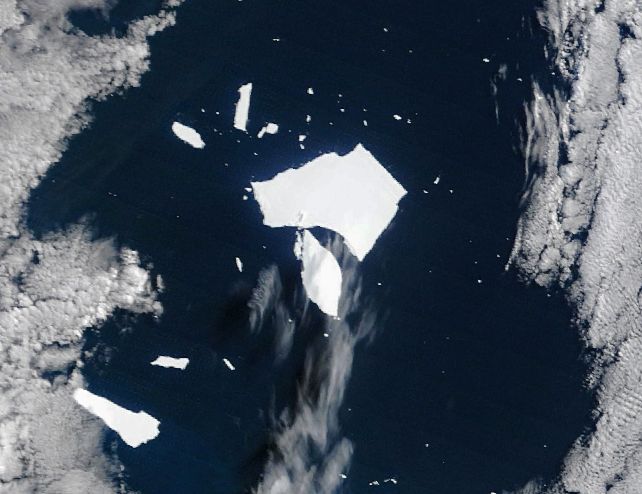
The impending demise of A-23A has been evident for months, with scientific observatories noting an escalating rate of fragmentation. In January 2025, its estimated surface area was calculated at 3,640 square kilometers (1,410 square miles), establishing it at that time as the planet’s largest iceberg. By September, following the detachment of several significant sections, its dimensions had diminished to 1,700 square kilometers.
As of 9 January 2026, its reduced size measured a mere 1,182 square kilometers.
This once colossal ice formation is unlikely to persist much longer; as NASA highlights, A-23A is “on the verge of complete disintegration” due to the accumulation of meltwater within its structure, the gravitational pressure of which exacerbates existing fractures and promotes more rapid breakup.
Satellite imagery also indicates the presence of a whitish border along the berg’s edges. This phenomenon is characterized as a ‘rampart-moat’ effect, resulting from the bending and deformation of the ice at its perimeter as melting occurs at the waterline. The raised rampart effectively confines the meltwater, forcing it to percolate through the ice mass.
Indeed, a region adjacent to this area, identified as “ice melange” in the accompanying imagery, may represent a breach. The sheer weight of the meltwater concentrated at the edges can generate sufficient hydrostatic pressure to create perforations. This outflow of fresh meltwater into the saline ocean leads to a mixture with surrounding ice fragments, potentially forming a slush-like consistency.
The berg is presently en route to a location designated as an iceberg graveyard, situated in proximity to South Georgia Island, where it is expected to melt completely and reintegrate into the oceanic environment.
“I am profoundly appreciative of the satellite infrastructure that has enabled us to track and meticulously document its evolutionary trajectory,” Shuman remarked. “While A-23A faces an inevitable end common to all Antarctic bergs, its journey has been exceptionally prolonged and marked by significant events. It is truly astonishing to consider that its presence with us is drawing to a close.”