Scientists affiliated with the University of Tokyo, among other institutions, have identified extant microbial communities within mineral-laden fissures in rock formations dating back 2 billion years, discovered in South Africa’s Bushveld Igneous Complex.

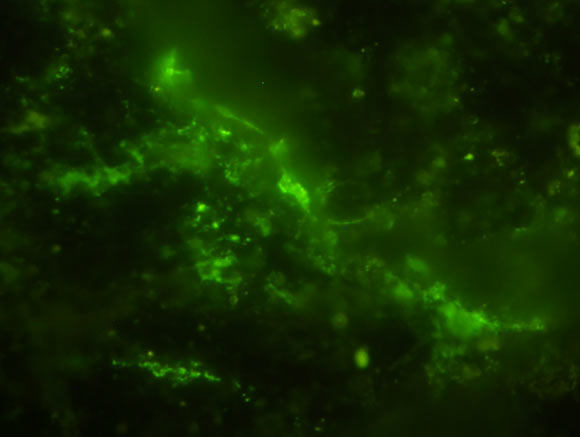
The 2-billion-year-old mafic rock from the Bushveld Igneous Complex revealed that indigenous microbes (stained green) are colonizing veins filled with clay minerals. Image credit: Suzuki et al., doi: 10.1007/s00248-024-02434-8.
“The habitability of 2-billion-year-old rock was previously unknown,” stated Dr. Yohey Suzuki, a researcher from the University of Tokyo.
“Previously, the most ancient geological stratum harboring living microorganisms was a 100-million-year-old deposit recovered from beneath the ocean floor, rendering this a remarkably significant discovery.”
“By examining the genetic material and genomes of such microbes, we may gain insights into the evolutionary trajectory of early life on Earth.”
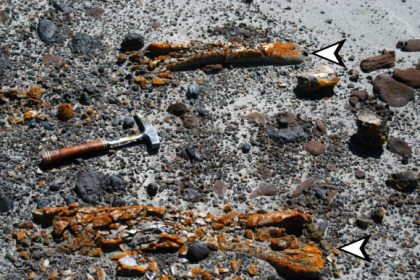
Dr. Suzuki and his associates conducted an analysis of a geological specimen sourced from the Bushveld Igneous Complex, an igneous intrusion located in northeastern South Africa that originated from the slow solidification of magma deep beneath the Earth’s crust.
“Spanning an area of approximately 66,000 km2 (comparable in size to Ireland), with a thickness extending up to 9 km, the Bushveld Igneous Complex encompasses some of the planet’s most abundant ore deposits, including an estimated 70% of the world’s mined platinum,” the researchers noted.
“Given its mode of formation and the minimal geological disturbance it has undergone since, the BIC is hypothesized to have provided a stable environment conducive to the sustained existence of ancient microbial life up to the present day.”
A core sample, measuring 8.5 cm in diameter and 30 cm in length, was extracted from a subterranean depth of 15.28 meters with the assistance of the International Continental Scientific Drilling Program, a non-profit entity supporting geological exploration initiatives.
Following the processing of the rock into thin sections for detailed examination, the research team observed dense aggregations of living microbial cells residing within the rock’s fractures.
Any void spaces adjacent to these cracks were found to be sealed by clay, effectively preventing the egress of the organisms and the ingress of external substances.
The scientific team leveraged a previously established methodology to rigorously confirm the indigenous nature of the microbes within the rock sample, thereby ruling out any possibility of contamination during the extraction or analytical procedures.
Through a process involving the staining of microbial cell DNA and the application of infrared spectroscopy to analyze proteins present in both the microorganisms and the surrounding clay matrix, the researchers validated the viability and uncontaminated status of the microorganisms.
“The presence of subsurface microbes not only on our planet but also the potential for their discovery on extraterrestrial bodies is a subject of considerable interest to me,” Dr. Suzuki remarked.
“Although Martian geology generally consists of older rocks (aged between 2 and 3 billion years), NASA’s Perseverance rover is scheduled to return samples of comparable antiquity to those utilized in this investigation.”
“The successful identification and authenticated verification of microbial life within 2-billion-year-old terrestrial samples imbues me with anticipation regarding our future findings from Martian specimens.”
These findings have been formally documented and published in the esteemed journal Microbial Ecology.
_____
Y. Suzuki et al. 2024. Subsurface Microbial Colonization at Mineral-Filled Veins in 2-Billion-Year-Old Mafic Rock from the Bushveld Igneous Complex, South Africa. Microb Ecol 87, 116; doi: 10.1007/s00248-024-02434-8
This article draws information from a press release issued by the University of Tokyo.