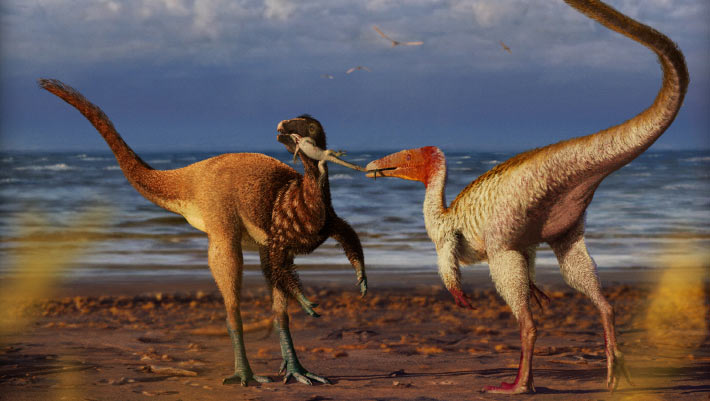
A thorough anatomical re-examination has been conducted by paleontologists on the fossilized remains of two theropod dinosaurs belonging to the coelurosaur group from South America’s Early Cretaceous period: Santanaraptor placidus and Mirischia asymmetrica.
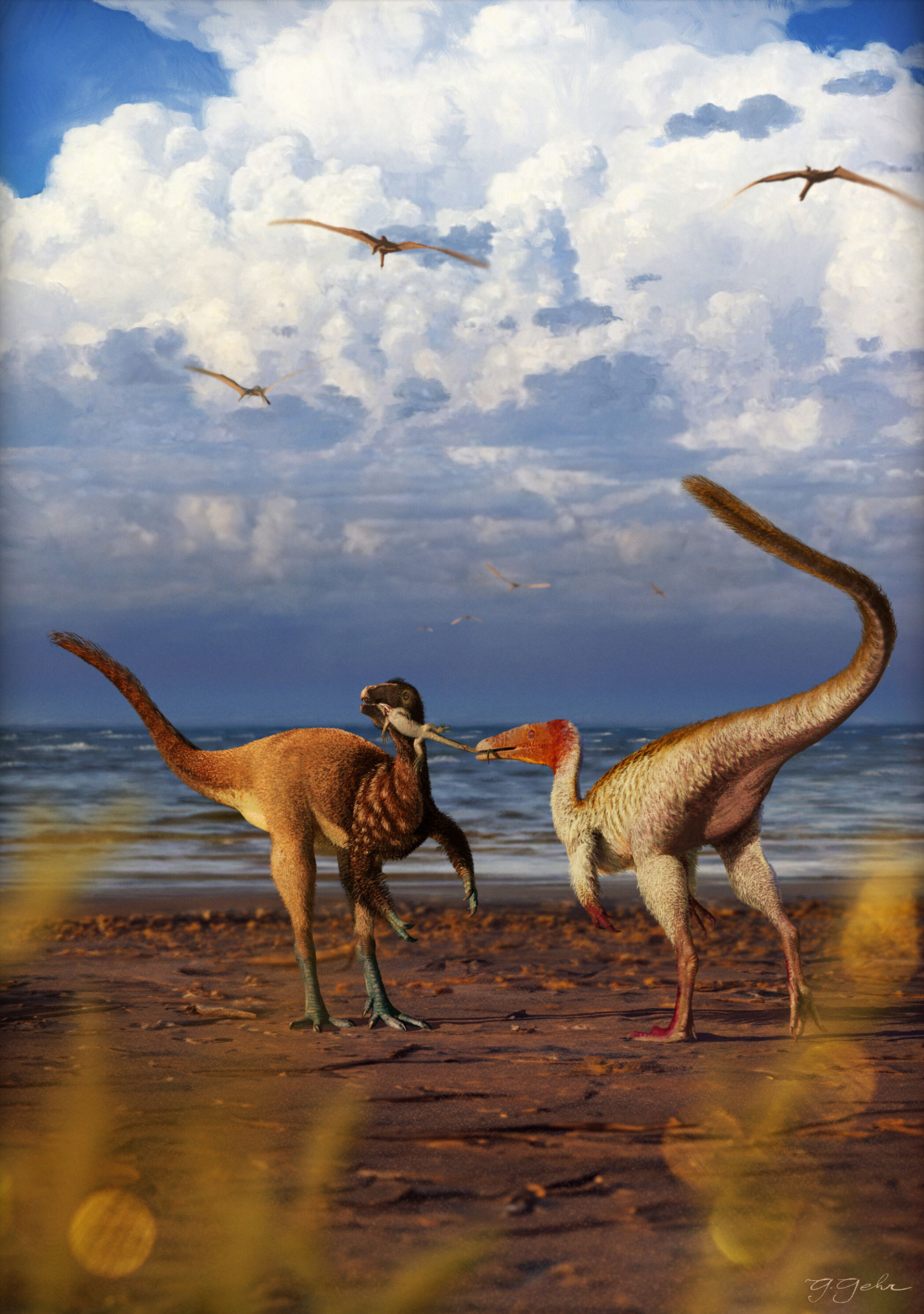
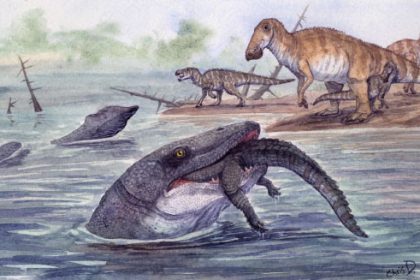
A hypothetical artistic rendition depicting Mirischia asymmetrica and Santanaraptor placidus vying over a lizard, set in the locale now known as northeastern Brazil around 112 million years ago. Credit for the artwork: Guilherme Gehr.
Santanaraptor placidus and Mirischia asymmetrica inhabited the region that is presently Brazil during the Early Cretaceous epoch, approximately 112 million years ago.
The designated holotypes for these coelurosaur species were unearthed from the Romualdo Formation in the years 1996 and 2000, respectively.
“The Romualdo Formation is globally recognized as a significant Early Cretaceous fossil Lagerstätte, renowned for exceptional preservation, which is exposed along the periphery of the Araripe Plateau in northwestern Brazil,” stated Dr. Rafael Delcourt of the Universidade de São Paulo, along with his associates.
“Its macrofossil assemblage comprises one of the most varied and excellently conserved ichthyofaunas from the Mesozoic Era, in addition to plant life, invertebrates, turtles, crocodilians, pterosaurs, and theropod dinosaurs.”
“Among the theropods from the Romualdo Formation, spinosaurs are arguably the most widely recognized, represented by numerous specimens, including the remarkably preserved cranium of Irritator challenger and the rostrum of Angaturama limai.”
“Within the coelurosaurian ranks, Santanaraptor placidus and Mirischia asymmetrica originate from the identical sedimentary layers that have yielded the spinosaurs, specifically, the more extensively studied upper carbonate concretionary beds of the Romualdo Formation.”
In their recently published research, Dr. Delcourt and his collaborating authors, hailing from Brazil, Argentina, and Germany, undertook a revision and comparative analysis of the anatomical features of Santanaraptor placidus and Mirischia asymmetrica. The primary objective was to investigate their evolutionary relationships and the potential for them to be synonymous.
The findings of their investigation position both species within a lineage of basal maniraptoromorph dinosaurs, alongside Juratyrant langhami and Tanycolagreus topwilsoni from the Late Jurassic of Laurasia. This placement suggests an early period of diversification for coelurosaurs in this geographical area.
Notwithstanding minor overlaps in certain skeletal elements, distinct anatomical characteristics have been identified, substantiating their classification as separate species.
“The evolutionary clade encompassing Juratyrant langhami, Mirischia asymmetrica, Tanycolagreus topwilsoni, and Santanaraptor placidus appears to have its origins at least as far back as the Late Jurassic of Laurasia, predating the formation of the Apulian route, which facilitated the interchange of fauna during the Early Cretaceous,” the paleontologists reported.
“Indeed, multiple coelurosaur groups are documented in both Laurasia and Gondwana during that epoch, including the Megaraptora, as well as branches of Ornithomimosauria, Alvarezsauridae, and Dromaeosauridae.”
“Our proposed phylogenetic framework aligns more favorably with the extant biogeographical data than hypotheses that group the Romualdo Formation coelurosaurs with the predominantly Laurasian families Compsognathidae and Tyrannosauroidea.”
“Nevertheless, additional investigations, including more extensive paleontological fieldwork, are indispensable for fully elucidating the early evolutionary radiation of coelurosaurs, and for clarifying the phylogenetic placement of the forms discovered in the Romualdo Formation.”
A scholarly article detailing these discoveries was officially released on November 18, 2025, in the journal The Anatomical Record.
_____
Rafael Delcourt et al. The coelurosaur theropods of the Romualdo Formation, Early Cretaceous (Aptian) of Brazil: Santanaraptor placidus meets Mirischia asymmetrica. The Anatomical Record, published online November 18, 2025; doi: 10.1002/ar.70085