An exceptional celestial body, designated 2025 MN45, has been identified through preliminary data acquired by the Legacy Survey of Space and Time (LSST) Camera—presently the world’s most expansive digital imaging instrument—at the NSF-DOE Vera C. Rubin Observatory.
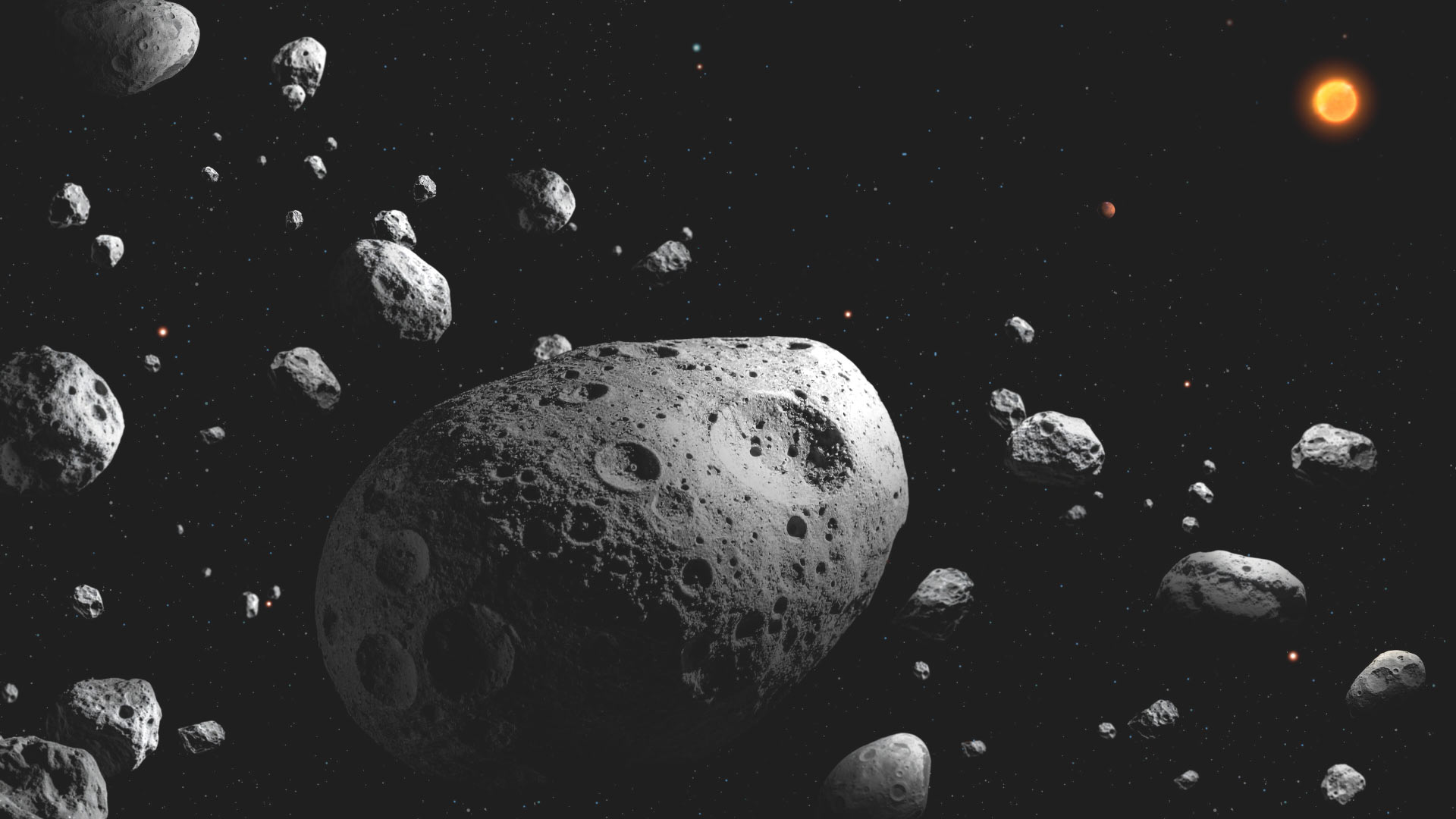
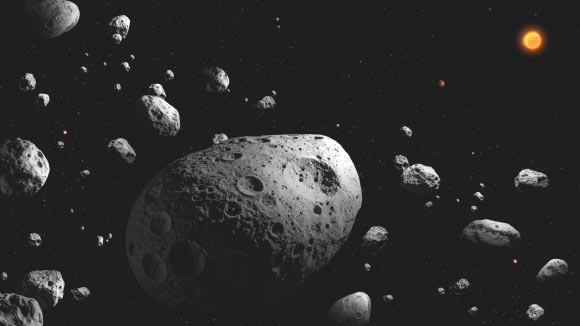
An artist’s impression of the asteroid 2025 MN45. Image credit: NSF-DOE Vera C. Rubin Observatory / NOIRLab / SLAC / AURA / P. Marenfeld.
As asteroids traverse their orbital paths around the Sun, they also exhibit varied rates of rotation.
These rotational velocities not only provide insights into the primordial conditions under which they were formed billions of years ago but also elucidate their internal constitution and developmental trajectory throughout their existence.
Specifically, an asteroid exhibiting rapid rotation may have experienced an acceleration in its spin due to a prior impact with another celestial fragment, thus suggesting it could be a remnant of a larger progenitor object.
Accelerated rotation necessitates that an asteroid possesses sufficient intrinsic structural integrity to avoid disintegration into a multitude of smaller fragments, a phenomenon known as fragmentation.
The prevailing composition of most asteroids is that of “rubble piles,” signifying they are agglomerations of numerous smaller rock fragments held together by gravitational forces. Consequently, their spin rates are constrained by their densities, beyond which they risk structural failure.
For celestial bodies situated within the main asteroid belt, the threshold for rapid rotation, beyond which fragmentation is probable, is established at 2.2 hours. Asteroids exhibiting rotational periods shorter than this benchmark must possess substantial structural coherence to maintain their form.
The greater the rotational velocity of an asteroid above this defined limit, coupled with its dimensions, the more robust its constituent material must be.
A recent scientific publication, appearing in the Astrophysical Journal Letters, furnishes critical data pertaining to asteroid composition and evolutionary processes. Furthermore, it effectively demonstrates how the NSF-DOE Vera C. Rubin Observatory is expanding the frontiers of our understanding within our own Solar System.
Within the scope of this investigation, the researchers have documented 76 asteroids for which reliable rotation periods have been ascertained.
This cohort includes 16 exceptionally swift rotators, characterized by rotational periods ranging from approximately 13 minutes to 2.2 hours, alongside three ultra-fast rotators that complete a full revolution in under five minutes.
All 19 of these newly identified rapid rotators possess dimensions exceeding the length of an American football field, which is approximately 90 meters.
The most rapidly rotating main-belt asteroid discovered to date, 2025 MN45, measures 710 meters in diameter and completes a circumvolution every 1.88 minutes.
This confluence of characteristics designates it as the fastest-spinning asteroid with a diameter surpassing 500 meters that has been observed by astronomers.
“Evidently, this asteroid must be composed of material exhibiting robust tensile strength to remain intact during its exceptionally rapid rotation,” stated Dr. Sarah Greenstreet, an astronomer affiliated with NSF’s NOIRLab and the University of Washington.
“Our calculations indicate that it would require a cohesive strength akin to that of solid rock.”
“This finding is somewhat unexpected, given the prevailing hypothesis that most asteroids are what we term ‘rubble pile’ asteroids—meaning they are composed of numerous small rock fragments and debris that aggregated under gravitational influence during the Solar System’s formation or subsequent impact events.”
“Discoveries such as this extraordinarily fast-rotating asteroid are a direct consequence of the observatory’s unparalleled capacity to deliver high-resolution, time-domain astronomical data, thereby pushing the boundaries of celestial observation,” remarked Regina Rameika, the DOE Associate Director for High Energy Physics.
In addition to 2025 MN45, other noteworthy asteroid discoveries by the research group include 2025 MJ71 (with a rotation period of 1.9 minutes), 2025 MK41 (3.8-minute rotation period), 2025 MV71 (13-minute rotation period), and 2025 MG56 (16-minute rotation period).
These five super- to ultra-fast rotating bodies, all measuring several hundred meters in diameter, join a small number of near-Earth objects as the quickest spinning sub-kilometer asteroids currently known.
“As this research underscores, even in its initial commissioning phases, Rubin is facilitating our investigation of a population of relatively diminutive, extremely rapid-rotating main-belt asteroids that were previously beyond our observational reach,” Dr. Greenstreet added.
_____
Sarah Greenstreet et al. 2026. Lightcurves, Rotation Periods, and Colors for Vera C. Rubin Observatory’s First Asteroid Discoveries. ApJL 996, L33; doi: 10.3847/2041-8213/ae2a30