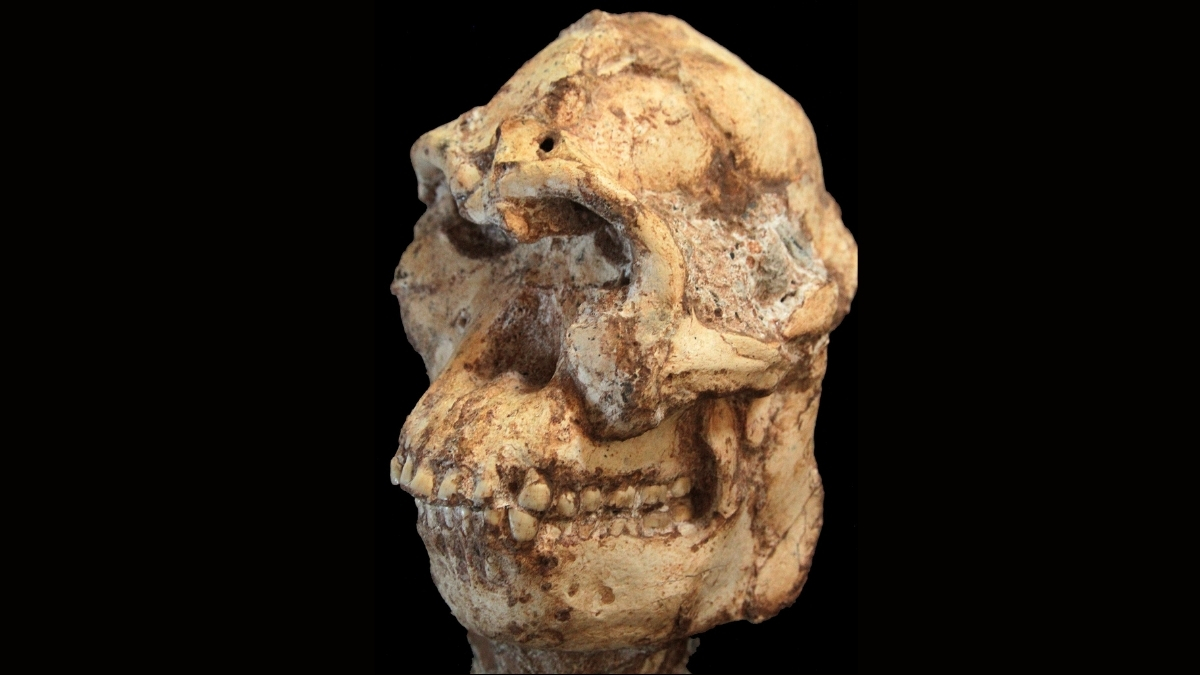
A highly celebrated hominin fossil might be more enigmatic than previously understood. The remains, popularly referred to as “Little Foot,” could potentially represent a distinct, uncatalogued species.
Unearthed within the Sterkfontein cave complex in South Africa, Little Foot is considered the most comprehensive skeleton of an ancient human ancestor ever discovered. However, definitively identifying its specific classification and precise age has presented considerable challenges.
While the scientific community largely concurs that Little Foot belongs to the Australopithecus genus, there is a divergence of opinion regarding its specific species designation. Some researchers advocate for its association with the well-established species A. africanus, whereas those who discovered it proposed its inclusion within the long-standing but less defined category of A. prometheus.
A recent investigation, spearheaded by paleoanthropologist Jesse Martin from La Trobe University in Australia, suggests that neither of these established labels accurately characterizes the specimen.
“Our findings cast doubt on the current classification of Little Foot and underscore the imperative for continued meticulous, evidence-based taxonomic work in the field of human evolution,” stated Martin.
“We contend that it cannot be demonstrably classified as A. prometheus or A. africanus. It is more probable that this represents a previously undocumented relative of humankind.”
Formally cataloged as StW 573, the fossil acquired the moniker Little Foot due to the initial discovery of four small ankle bones in Sterkfontein in 1980. These fragments remained in storage for over a decade before being examined by paleoanthropologist Ronald Clarke, who identified them as belonging to an Australopithecus.
In 1997, Clarke led a scientific expedition back to the cave, successfully locating the remainder of the remains, which formed an exceptionally complete skeleton partially embedded in the cave wall. The arduous process of entirely extracting it from the hard, concrete-like rock matrix in which it was encased took an additional two decades.
Following the complete revelation of the skeletal remains, the team posited that Little Foot was not, as initially surmised, an A. africanus. Instead, they attributed it to A. prometheus, thereby resurrecting a name initially created in 1948 to classify fossils recovered from a specific excavation site in South Africa.
Within the scope of the new research, investigators conducted a detailed comparative analysis of Little Foot’s anatomical features against those of A. africanus specimens and the sole fossil attributed to A. prometheus – a minor cranial fragment designated MLD 1.
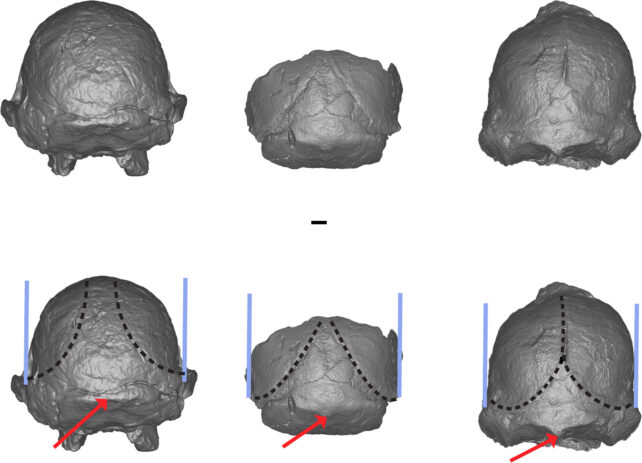
Employing a 3D scanner, the research group generated digital reconstructions of Little Foot, MLD 1, and two A. africanus specimens with an impressive resolution of 300 micrometers. Their analysis revealed no less than five distinct anatomical discrepancies between Little Foot and MLD 1.
“Consequently, there exists no morphological basis for associating StW 573 with MLD 1,” the authors of the study reported, “and on this premise, the classification of StW 573 as A. prometheus is not justifiable.”
The research team extends this argument further, maintaining that MLD 1 exhibits no significant deviations from recognized A. africanus specimens. The authors suggest that, despite its evocative nature, the designation A. prometheus should likely be subsumed under A. africanus as a junior synonym – a proposition that numerous scholars currently advocate.
The researchers deliberately refrain from proposing an official name or definition for the potential new species, preferring to leave that distinction to “the research team that has dedicated over two decades to excavating and meticulously analyzing the extraordinary Little Foot specimen.”
The findings of this investigation have been published in The American Journal of Biological Anthropology.