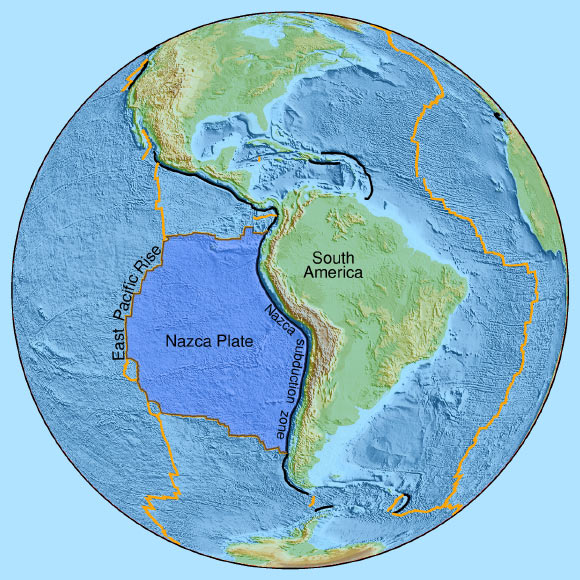
An extensive expanse of ancient ocean floor, dating back to the Mesozoic Era (250 to 120 million years ago), has been discovered deep within Earth’s mantle beneath the East Pacific Rise by a collaborative team of geoscientists from the University of Maryland and the University of Alberta. This discovery occurred at a significant tectonic plate boundary located in the southeastern reaches of the Pacific Ocean.

A map of the East Pacific Rise region where the discovery of an ancient seafloor was made. Image credit: Jingchuan Wang.
Utilizing sophisticated seismic imaging technologies, researcher Jingchuan Wang of the University of Maryland, alongside his colleagues, successfully penetrated Earth’s mantle—the geological stratum situated between the planet’s crust and core—to conduct their investigation.
Their analysis revealed an unusually substantial volume within the mantle transition zone, a geological stratum positioned between approximately 410 and 660 kilometers beneath the Earth’s surface.
This transitional zone serves as a distinct boundary separating the upper and lower mantle regions, its dimensions subject to fluctuations influenced by thermal variations.
Furthermore, the newly identified ancient seafloor deposit may provide an explanation for the peculiar structural characteristics of the Pacific Large Low Shear Velocity Province (LLSVP), an immense geological formation within Earth’s lower mantle. It appears that this vast LLSVP structure is bifurcated by the descending tectonic plate.
Dr. Wang explained, “This region of increased thickness acts as a preserved imprint, akin to a fossilized fingerprint, of primordial seafloor material that entered Earth’s interior through subduction processes approximately 250 million years ago.”
“This provides us with an unprecedented vantage point, offering insights into our planet’s geological history that were previously inaccessible.”
The geological phenomenon of subduction transpires when one tectonic plate descends beneath another, facilitating the reintroduction of surface materials back into Earth’s mantle.
This dynamic geological process commonly leaves behind tangible indicators of tectonic activity, such as volcanic formations, seismic events, and profound oceanic trenches.
Historically, geologists have primarily studied subduction phenomena by meticulously examining rock specimens and sedimentary deposits found at the Earth’s surface.
By meticulously analyzing the propagation patterns of seismic waves as they traversed various subterranean layers, the investigators were able to generate highly detailed cartographic representations of structures concealed deep within the mantle.
“One can conceptualize seismic imaging as being analogous to a CT scan; it has essentially granted us the ability to obtain a cross-sectional visualization of our planet’s internal composition,” Dr. Wang stated.
“Typically, oceanic plates that undergo subduction are entirely assimilated by the Earth, leaving no readily detectable traces on the surface.”
“However, observing this ancient subducting slab through this novel methodology has yielded fresh perspectives on the intricate relationship between deep subterranean geological structures and surface geology, connections that were not readily apparent prior to this study.”
The findings presented by the research team yielded a surprising revelation: material within Earth’s interior was observed to be disseminating at a significantly slower velocity than was previously hypothesized.
The exceptional thickness of the area identified suggests the presence of cooler material within this particular segment of the mantle transition zone, lending credence to the hypothesis that certain oceanic plates become arrested in their descent, halting midway through the mantle.
Dr. Wang elaborated, “We determined that the rate of material descent in this specific zone was approximately half of what we anticipated, indicating that the mantle transition zone can function as a retarding barrier, impeding the flow of material through Earth’s interior.”
“Our discovery prompts new inquiries into the mechanisms by which deep Earth processes exert influence on observable surface features across vast geographical expanses and extended temporal scales.”
The outcomes of this research have been formally documented and published in the esteemed scientific journal Science Advances.
_____
Jingchuan Wang et al. 2024. Mesozoic intraoceanic subduction shaped the lower mantle beneath the East Pacific Rise. Science Advances 10 (39); doi: 10.1126/sciadv.ado1219