The celebrated ‘Harbin cranium,’ estimated to be at least 146,000 years old, has been preliminarily classified as belonging to a distinct species, tentatively named Homo longi.

A reconstruction of the Harbin individual in his habitat. Image credit: Chuang Zhao.
The discovery of the Harbin cranium occurred in 1933 during the construction of a bridge spanning the Songhua River in Harbin City, situated within China’s Heilongjiang province.
Due to its non-systematic recovery and the considerable passage of time, precise details regarding its original excavation site and the geological stratum from which it was unearthed are no longer available.
This fossil exhibits substantial dimensions, surpassing those of all other known archaic human specimens. It is characterized by a relatively elongated and flattened cranial vault, lacking the rounded profile typical of modern human braincases.
Distinctive features include exceptionally large, nearly square eye sockets, pronounced superciliary arches (brow ridges), a broad mandible, and notably prominent dentition.
The estimated endocranial volume of the cranium is 1,420 ml. This measurement falls within the range observed in both Homo sapiens and Neanderthals, and is greater than that of earlier Homo species.
Referred to also as the ‘Dragon man’ fossil, the specimen is presumed to represent a male individual who was less than 50 years of age at the time of death.
In recent investigative work, Dr. Qiaomiei Fu, affiliated with the Institute of Vertebrate Paleontology and Paleoanthropology at the Chinese Academy of Sciences, along with her research associates, undertook a paleoproteomic analysis of the fossil and its associated dental calculus.
Their comprehensive examination revealed an extensive dataset of over 308,000 peptides, encompassing more than 20,000 unique peptide sequences, and confirmed the presence of 95 endogenous proteins.
Furthermore, the analysis identified 122 single amino acid polymorphisms (SAPs) that are specific to hominids, thereby substantiating the Harbin individual’s placement within the Homo genus.
Significantly, the researchers detected three variants exclusive to Denisovans. This finding establishes a clear phylogenetic connection between the Harbin fossil and Denisova 3, a diminutive fragment of finger bone originating from Denisova Cave.
“Prior to this pivotal discovery, the corpus of Denisovan fossil evidence was sparse and fragmented, posing considerable challenges to our comprehension of their physical characteristics and evolutionary trajectory,” remarked the research team.
“The Harbin fossil, now proposed as a novel species, Homo longi, exhibits considerable morphological congruence with Denisovan remains recovered from other archaeological sites.”
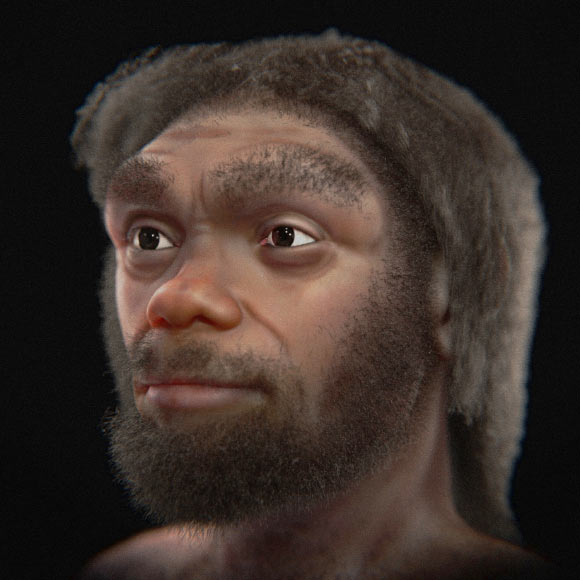
The portrait of the Harbin individual. Image credit: Cicero Moraes, doi: 10.6084/m9.figshare.24648591.
The scientific team also succeeded in the successful extraction of mitochondrial DNA (mtDNA) from the fossilized dental calculus.
The results of this genetic analysis confirmed that the Harbin individual is affiliated with an early mtDNA lineage of Denisovans.
“The retrieved mtDNA falls within the known spectrum of Denisovan mtDNA variability and is closely related to an mtDNA branch previously identified in early Denisovan individuals from southern Siberia, specifically observed in Denisova Cave,” stated the study’s authors.
“This observation strongly indicates that Denisovans occupied a vast geographical territory across Asia during the Middle Pleistocene epoch.”
The confirmation that the Harbin cranium harbors Denisovan mtDNA creates a crucial link between Denisovans and specific morphological attributes. This connection is expected to facilitate the identification of other fossil specimens as Denisovan, particularly in scenarios where ancient DNA preservation is poor or its extraction proves challenging.
For instance, fossil discoveries from Dali, Jinniushan, and Hualongdong exhibit morphological characteristics that are consistent with those of the Harbin cranium, thereby suggesting the plausible representation of Denisovan populations within these sites as well.
“The definitive association of Denisovan mtDNA with the Harbin cranium offers an enhanced understanding of the morphological interrelationships between Denisovans and other Middle Pleistocene hominin fossils from East Asia,” commented the researchers.
“Moreover, the successful recovery of host DNA from dental calculus heralds novel avenues for genetic research concerning Middle Pleistocene hominins.”
_____
Qiaomei Fu et al. The proteome of the Late Middle Pleistocene Harbin individual. Science, published online June 18, 2025; doi: 10.1126/science.adu9677
Qiaomei Fu et al. Denisovan mitochondrial DNA from dental calculus of the >146,000-year-old Harbin cranium. Cell, published online June 18, 2025; doi: 10.1016/j.cell.2025.05.040