A recent analysis conducted by a collective of United States paleontologists has proposed that Nanotyrannus lancensis, a dinosaur historically presumed to be a juvenile Tyrannosaurus rex, is instead a fully developed, distinct species within the smaller tyrannosaurid family. This conclusion is based on an examination of the ceratobranchial, or hyoid bone, of Nanotyrannus lancensis, which provides insights into its developmental trajectory.
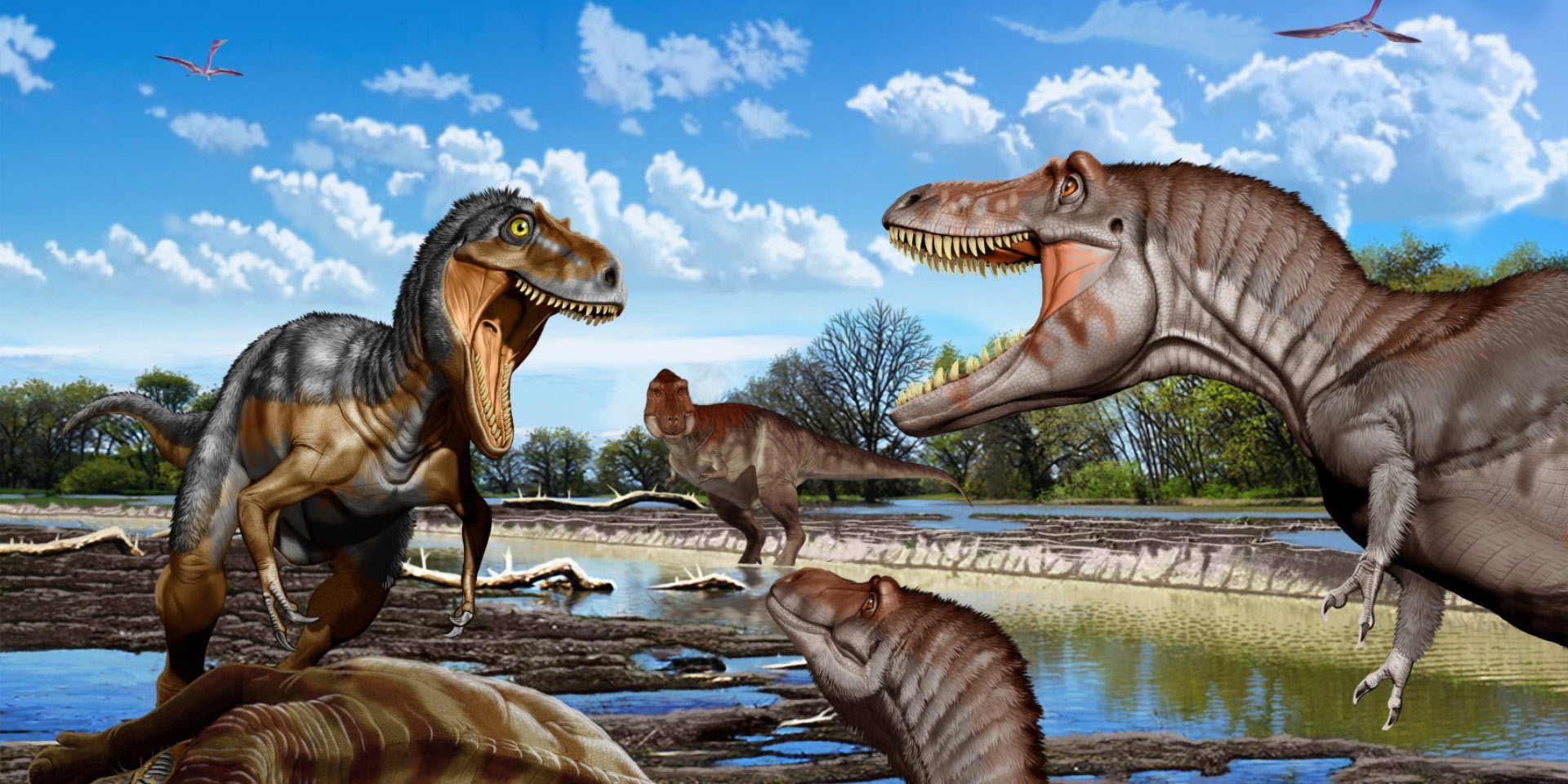
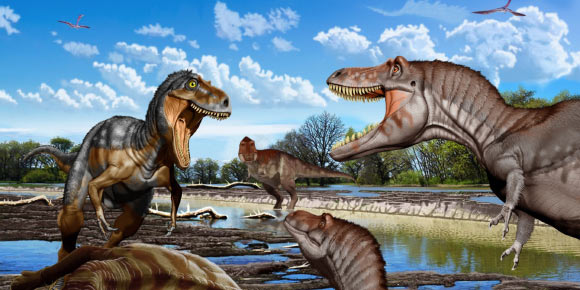
A Late Cretaceous confrontation featuring an adult Nanotyrannus lancensis positioned on the left, facing two juvenile Tyrannosaurus rex, with a sub-adult Tyrannosaurus rex observing from afar. This artwork is credited to Jorge Gonzalez.
The Nanotyrannus lancensis specimen measured approximately 5.5 meters (18 feet) in stature, presenting a considerably smaller profile when contrasted with the more than 12 meters (40 feet) length of Tyrannosaurus rex.
Initially classified as Gorgosaurus upon its discovery in 1942, the holotype specimen of Nanotyrannus lancensis was subsequently re-evaluated in 1988 as a separate species following extensive scientific investigation.
The protracted debate surrounding this classification has largely stemmed from the fact that the holotype comprises an isolated skull, whereas typical evaluations of maturity often rely on the analysis of limb bones.
Up to this point, prior research conducted on other, more complete fossil specimens attributed to Nanotyrannus lancensis had yielded inconsistent findings.
In a novel study, Princeton University paleontologist Christopher Griffin, alongside his research associates, investigated the potential of the microscopic structure within a small laryngeal bone, the ceratobranchial, to serve as a dependable indicator of age and skeletal maturation in fossilized remains.
Dr. Griffin commented, “At that juncture, the prevalent viewpoint held that the Nanotyrannus holotype skull represented an immature Tyrannosaurus rex and not a distinct species.”
He further elaborated, “Our initial assumptions aligned with this prevailing belief. However, upon sampling the hyoid bone and observing characteristics that strongly suggested maturity, we recognized the necessity of scrutinizing that hypothesis more critically.”
The researchers ascertained that the ceratobranchial bone, in both extant archosaur lineages (such as ostriches and crocodilians) and extinct theropods, retains discernible indicators of growth and maturation. This makes it an invaluable element for determining developmental stages, particularly in individuals that had reached full adulthood.
Applying this methodology to the contentious Nanotyrannus lancensis holotype, the team meticulously examined three segments of its ceratobranchial, uncovering several markers indicative of near-complete or fully achieved skeletal maturity.
These findings suggest that Nanotyrannus lancensis represents a taxonomically distinct species that coexisted with Tyrannosaurus rex, hinting at a greater diversity of predatory roles within Late Cretaceous ecosystems than was previously acknowledged.
“The hyoid bone of this carnivore, notable for its smaller size relative to Tyrannosaurus rex, exhibited growth patterns suggesting it was either mature or nearing full maturity,” stated Ashley Poust, a paleontologist at the University of Nebraska State Museum.
He continued, “This discovery provides us with the confidence to retain the name Nanotyrannus, as it is evident that this creature was not on a developmental path to becoming a Tyrannosaurus rex.”
“This scenario implies the presence of at least two distinct sizes of carnivorous dinosaurs within the same ecological setting, which carries significant implications for our understanding of prehistoric ecology and the eventual extinction of the dinosaurs,” he added.
“Enhancing our knowledge of past biodiversity provides a greater appreciation for the scope of the fossil record and the evolutionary transformations of species over time.”
“Furthermore, comprehending the intricate dynamics of any ecosystem is of considerable importance.”
The published research findings are featured in the esteemed journal Science.
_____
Christopher T. Griffin et al. A diminutive tyrannosaur lived alongside Tyrannosaurus rex. Science, published online December 4, 2025; doi: 10.1126/science.adx8706