An unusual ‘shadow’ observed against the residual luminescence of the Big Bang has brought to light a colossal cosmic structure in the nascent Universe, challenging our established models of cosmic evolution.
This structure, identified as the galaxy cluster SPT2349-56, was detected a scant 1.4 billion years post-Big Bang. The gaseous environment within it exhibits temperatures significantly exceeding theoretical predictions. The process of gravitational heating in a galaxy cluster is anticipated to be a gradual one, requiring billions of years to reach the thermal intensity observed in SPT2349-56.
“We did not anticipate encountering such a intensely heated cluster atmosphere so early in cosmic history,” stated Dazhi Zhou, a doctoral candidate in astrophysics affiliated with the University of British Columbia in Canada.
“Initially, I harbored doubts about the observed signal due to its extraordinary magnitude, which seemed improbable. However, following extensive verification spanning several months, we have confirmed that this gas is at least five times hotter than projected, and indeed, surpasses the temperature and energy levels found in numerous contemporary clusters.”
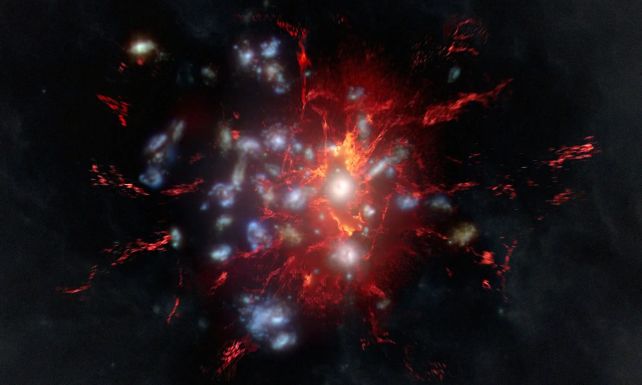
SPT2349-56 was initially identified in 2010 through data acquired by the South Pole Telescope in Antarctica, with preliminary indications pointing to its anomalous nature. Subsequent observations, published in 2018, corroborated that the object comprised over 30 galaxies engaged in vigorous star formation at a rate 1,000 times that of the Milky Way, all converging on a collision trajectory.
Given that this extraordinary cosmic event was unfolding in the early Universe, approximately 12.4 billion years ago, astrophysicists presumed it could offer crucial insights into galaxy evolution during a pivotal epoch in cosmic history.
Under the leadership of Zhou, an international consortium utilized the highly sensitive Atacama Large Millimeter/submillimeter Array (ALMA) to probe the cosmic microwave background (CMB) – the subtle, pervasive radiation field that originated when the Universe cooled sufficiently to permit light to propagate freely.
The objective was to detect a specific phenomenon known as a Sunyaev-Zeldovich effect. This distortion arises from the interaction between photons of the CMB and electrons present in the hot gas found within galaxy clusters. The remarkable uniformity of the CMB allows these resultant ‘shadows’ to create a detectable contrast.
A galaxy cluster represents a region of spacetime where gravitational forces are amplified as constituent galaxies draw closer to one another. This intensified gravity acts upon the internal gas, referred to as the intracluster medium, compressing and accelerating it, thereby elevating its energy content.
SPT2349-56 stands out as an exceptional exemplar of an early-Universe galaxy cluster, both in terms of its scale and its star-forming activity. Prior investigations had already indicated a substantial quantity of molecular gas within the cluster. Zhou and his collaborators conducted a more detailed examination of this gas to ascertain what it could reveal about the cluster’s internal dynamics.
“Comprehending galaxy clusters is fundamental to understanding the most massive galaxies in the Universe,” observed astrophysicist Scott Chapman, associated with Dalhousie University and formerly with the National Research Council of Canada.
“These colossal galaxies are predominantly situated within clusters, and their evolutionary trajectories are profoundly shaped by the intense environmental conditions of these clusters during their formation, including the influence of the intracluster medium.”
The Sunyaev-Zeldovich signal detected by ALMA was not merely discernible but remarkably strong. Subsequent analysis revealed an unequivocal thermal signature indicative of electron temperatures exceeding 10 million Kelvin. While the researchers had anticipated detecting a warm intracluster medium at an early stage, this observation far surpassed their expectations.
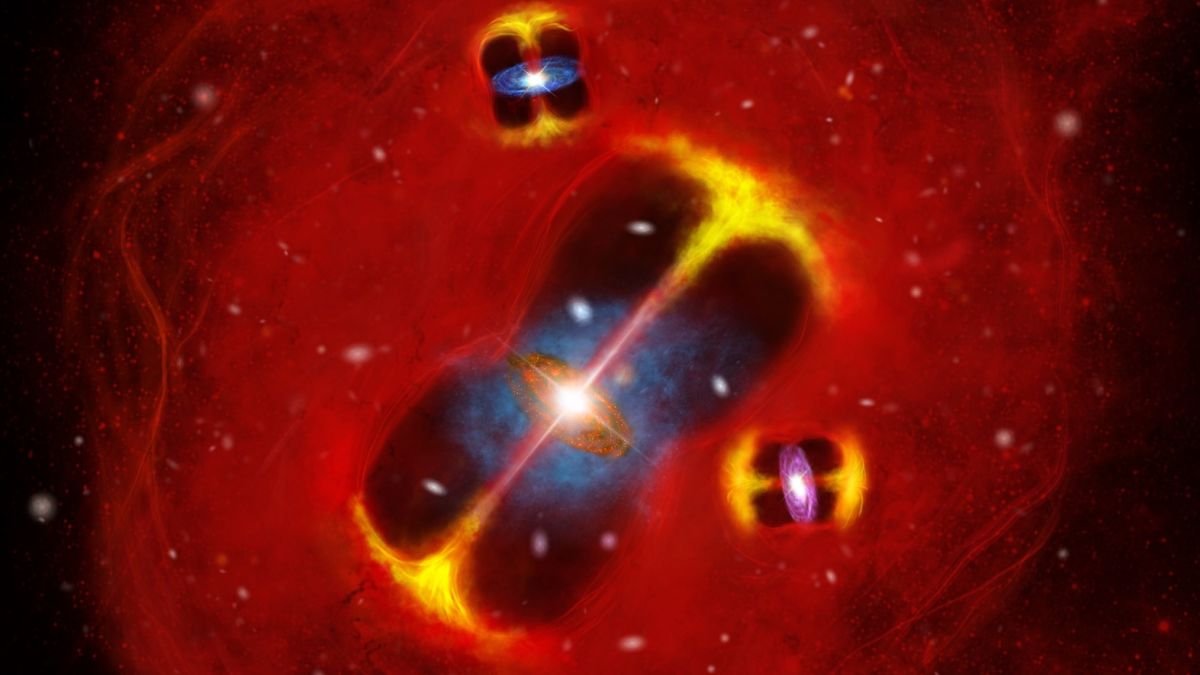
Existing theoretical frameworks offer no plausible explanation for gravity alone to generate such elevated temperatures. The research team posits that energetic jets emanating from at least three supermassive black holes within SPT2349-56 may be contributing significant additional energy.
“This finding suggests that certain entities in the early Universe, likely three recently identified supermassive black holes within the cluster, were already injecting vast quantities of energy into their surroundings and actively shaping the nascent cluster. This activity occurred far earlier and with greater intensity than previously conceived,” elaborated Chapman.
Consequently, this implies that our current theoretical models of galaxy cluster evolution are incomplete. It underscores the necessity of considering the entire cluster ecosystem, even during the early Universe, when certain dynamic processes might not be expected to be present.
“Our aim is to elucidate the interplay between intense star formation, active black holes, and this superheated atmosphere, and to understand what these interactions reveal about the formation processes of present-day galaxy clusters,” stated Zhou.