Fossilized vertebral elements, initially presumed to belong to woolly mammoths, have ultimately been identified as originating from a completely different and unexpected creature.
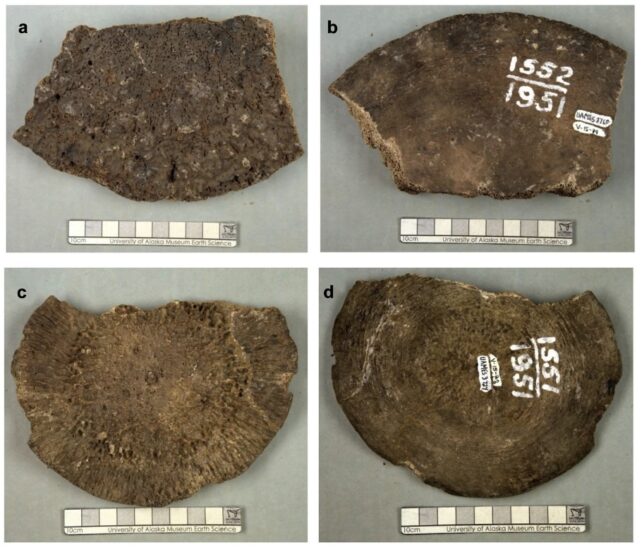
During a 1951 expedition into the Alaskan interior, situated north of Fairbanks within the paleogeographic region of Beringia, archaeologist Otto Geist unearthed these specimens – two epiphyseal plates from a mammalian vertebral column.
Given their morphology and provenance, Geist’s initial attribution to the woolly mammoth (Mammuthus primigenius) was a logical conclusion. The region is a known repository for Late Pleistocene megafauna, and the substantial dimensions of the skeletal fragments strongly suggested an elephantid affinity.
The bones were subsequently transferred to the University of Alaska’s Museum of the North, where they remained in archival storage for over seven decades.
Through the museum’s ‘Adopt-a-Mammoth‘ initiative, the fossils were finally subjected to radiocarbon dating, a process that has generated more enigmas than resolutions.
The dating revealed these bones to be significantly younger than what would be expected for woolly mammoths, with carbon isotope analysis indicating an age of approximately 2,000 to 3,000 years.
In contrast, mammoths are generally understood to have become extinct around 13,000 years ago, with only a few isolated populations persisting until roughly 4,000 years ago.
“The discovery of mammoth fossils in interior Alaska dating to the Late Holocene would have represented an extraordinary finding, marking the youngest mammoth fossil ever documented,” stated University of Alaska Fairbanks biogeochemist Matthew Wooller and his colleagues in a peer-reviewed publication.
“If confirmed, these findings would place the specimens several millennia later than the most recent evidence of mammoths in eastern Beringia.”
Prior to revising the established timeline of mammoth extinction, the research team opted to verify the initial species identification. This proved to be a prudent decision.
“The radiocarbon data, along with associated stable isotope analyses, were the initial indicators that something was not as expected,” they documented.
The isotopic composition of the bones revealed considerably elevated concentrations of nitrogen-15 and carbon-13 compared to what would be typical for a herbivorous terrestrial animal like the woolly mammoth. While these isotopes can be present in terrestrial fauna, they are far more prevalent in marine organisms, leading to their accumulation in marine creatures.
No mammoth specimens from eastern Beringia have ever exhibited such a chemical signature, given that the remote interior of Alaska is not associated with abundant marine resources.
“This provided our initial clue that the specimens likely originated from a marine environment,” Wooller and his team elaborated.
Both mammoth and whale specialists concurred that identifying the specimens solely by their physical characteristics was unfeasible; ancient DNA analysis was deemed crucial for definitively establishing the specimens’ true nature.
While the specimens were too degraded to yield nuclear DNA, mitochondrial DNA was successfully extracted and compared against that of the Northern Pacific Right whale (Eubalaena japonica) and the Common Minke whale (Balaenoptera acutorostrata).
“Although the perplexing radiocarbon dates of these two specimens have been explained by the revelation that the presumed mammoth fossils were, in fact, whale remains, this discovery introduced another equally puzzling enigma,” Wooller and his team highlighted.
“How did the remains of two whales, dating back over a millennium, end up in the interior of Alaska, situated more than 400 kilometers (250 miles) from the nearest coastline?”
Several hypotheses were proposed to account for this anomaly. The first posits an “inland whale incursion” via ancient estuarine systems and river channels, a scenario considered highly improbable given the immense size of these whale species and the comparatively limited scale of Alaska’s inland waterways, not to mention their insufficiency of suitable whale sustenance. Nevertheless, the authors acknowledge that occasional instances of “wayward cetaceans” are not altogether unprecedented.
An alternative theory suggests that the bones were transported from a distant coastline by prehistoric human populations. While this phenomenon has been documented in other regions, it has never been observed in interior Alaska.
Finally, the possibility of an administrative error cannot be entirely discounted. Otto Geist’s collections encompassed specimens from various Alaskan locales, and he made numerous donations to the university in the early 1950s. A mix-up in the museum’s cataloging system remains a potential explanation.
This situation serves as a striking illustration of the enduring physical resemblances among our marine mammal relatives.
“Ultimately, this matter may never be definitively resolved,” Wooller and his team wrote. “However, this endeavor has successfully eliminated these specimens as candidates for being among the last mammoths.”
The findings of this research were published in the Journal of Quaternary Science.