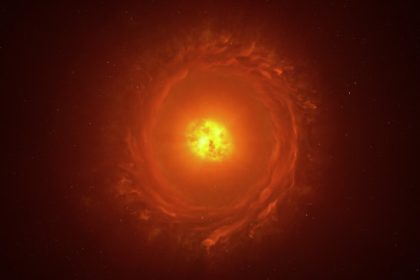
In a significant astronomical breakthrough, researchers leveraging the capabilities of the NASA/ESA Hubble Space Telescope have definitively authenticated the presence of starless, hydrogen-abundant entities predominantly composed of dark matter. These structures, identified as Reionization-Limited H I Clouds (RELHICs), represent remnants from the nascent Universe that challenge established paradigms of galactic evolution and may indicate the existence of undiscovered populations of analogous formations.
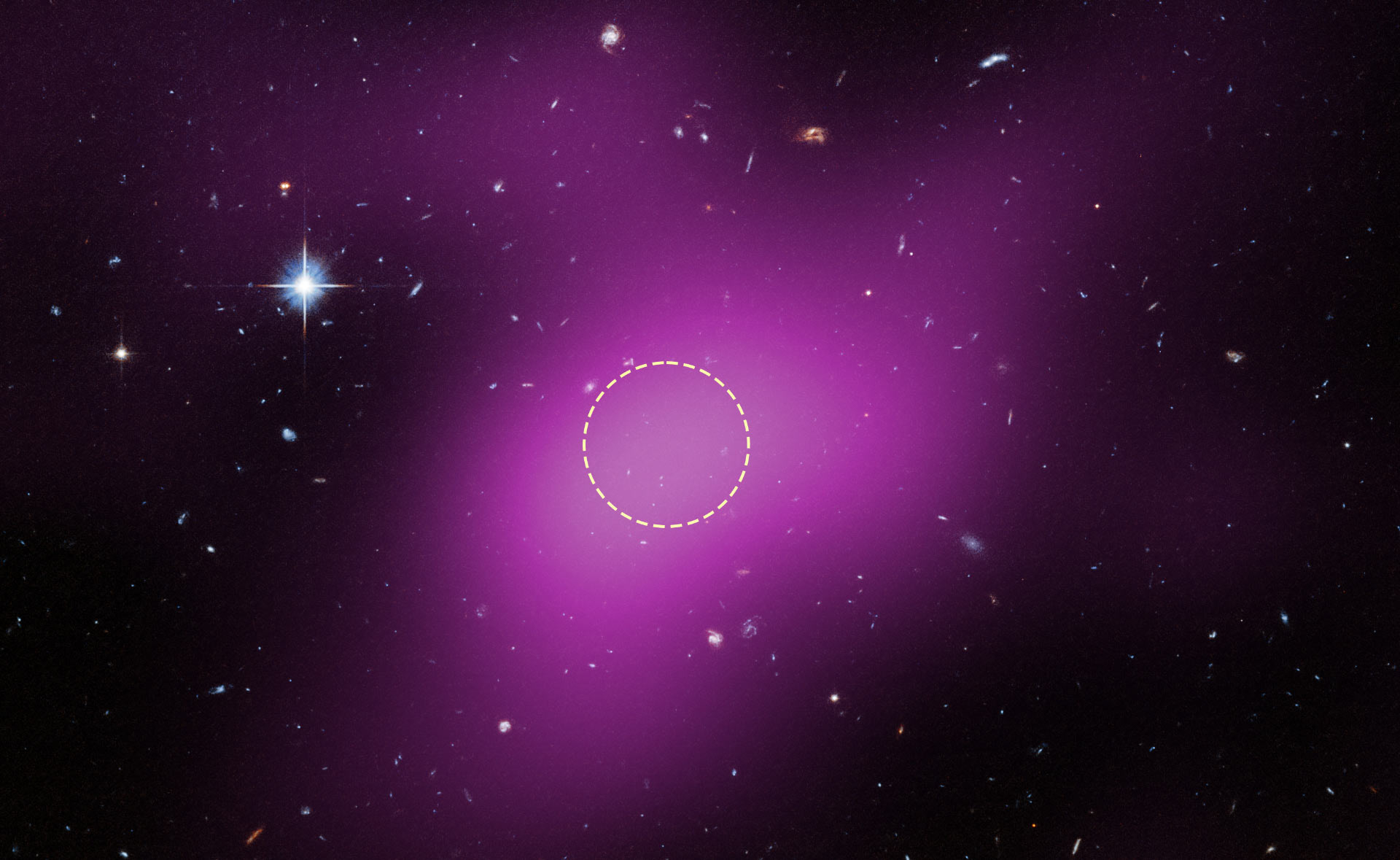
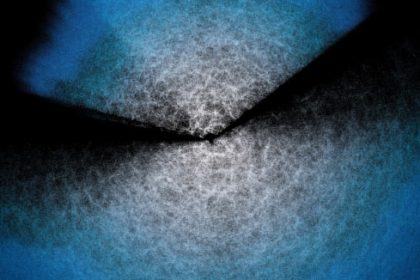
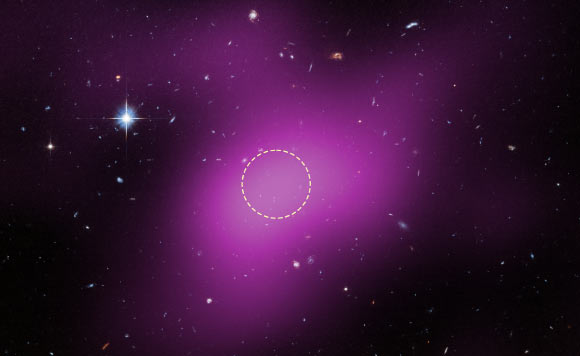
This image shows the location of the RELHIC object Cloud-9. Image credit: NASA / ESA / VLA / Gagandeep Anand, STScI / Alejandro Benitez-Llambay, University of Milano-Bicocca / Joseph DePasquale, STScI.
The entity designated Cloud-9, a prime example of a RELHIC, was initially detected through the observational prowess of the Five-hundred-meter Aperture Spherical Telescope (FAST). Its existence was subsequently corroborated through independent investigations employing the Very Large Array (VLA) and the Green Bank Telescope (GBT).
Dr. Alejandro Benitez-Llambay, an astrophysicist affiliated with Milano-Bicocca University, characterized the discovery as an instance of a “failed galaxy.”
He further elaborated that scientific understanding often advances more profoundly through the study of anomalies or setbacks than through straightforward successes. In this particular context, the conspicuous absence of stellar bodies serves as the very evidence validating the underlying hypothesis.
“This finding suggests that we have encountered a fundamental, pre-galactic constituent within the local cosmic environment that has not yet undergone stellar formation,” he stated.
The central region of Cloud-9, comprised of neutral hydrogen, spans an impressive diameter of approximately 4,900 light-years.
Situated in proximity to the spiral galaxy Messier 94, this object exhibits a comparable recession velocity, thus placing it at an estimated distance of 14.3 million light-years from our planet.
Dr. Andrew Fox, an astronomer at the Association of Universities for Research in Astronomy/Space Telescope Science Institute (AURA/STScI) representing ESA, commented, “This cloud offers a unique vantage point for observing the dark Universe.”
He expounded on the theoretical expectation that dark matter constitutes the predominant mass component of the Universe, yet its inherent lack of light emission renders it exceedingly challenging to identify.
“Cloud-9 affords us an uncommon glimpse into a cloud that is overwhelmingly dominated by dark matter,” he added.
The research team utilized Hubble’s Advanced Camera for Surveys (ACS) to meticulously scan Cloud-9 for any discernible luminous or stellar constituents.
Their rigorous analysis has conclusively ruled out the presence of any dwarf galaxy possessing a detectable stellar mass.
The researchers noted that “the lack of observable stars strongly supports the interpretation of this system as a RELHIC—that is, a starless dark matter halo permeated by hydrostatic gas in thermal equilibrium with the pervasive cosmic ultraviolet radiation field.”
Cloud-9 emerges as the leading contender among identified compact HI clouds, providing empirical validation for a fundamental tenet of the prevailing cosmological framework, namely the ΛCDM (Lambda Cold Dark Matter) model.
This theoretical model postulates the existence of gas-rich, starless dark matter halos at sub-galactic mass scales that never achieve stellar ignition.
The investigators concluded that “the identification of Cloud-9 also aids in delimiting the present-day threshold halo mass requisite for galaxy formation, bringing us closer to comprehending the disparities between dark matter halos that host galaxies and those that remain devoid of stellar populations.”
The comprehensive details of these findings are published this week in the distinguished journal, the Astrophysical Journal Letters.
_____
Gagandeep S. Anand et al. 2025. The First RELHIC? Cloud-9 is a Starless Gas Cloud. ApJL 993, L55; doi: 10.3847/2041-8213/ae1584