For two millennia, a persistent epidemic ravaged Eurasia, predating the infamous Black Death. Until now, evidence of this ancient scourge had been solely confined to human skeletal remains, leaving its transmission pathways a profound mystery. However, recent investigations have illuminated the likely animal perpetrator behind this widespread Bronze Age malady.
An interdisciplinary cohort of archaeologists undertook an extensive examination of ancient DNA fragments extracted from the osseous and dental tissues of Bronze Age ovines, caprines, and bovines. This endeavor formed a component of a comprehensive, ongoing research initiative designed to chart the migratory patterns of these domesticated species in parallel with human movements originating from the Fertile Crescent across the Eurasian landmass.
Retrieving intact ancient animal DNA is an exceptionally challenging undertaking. These genetic samples are invariably fragmented and heavily compromised by microbial residues from organisms that inhabited the animal during its lifetime and persisted long after its demise.
“When we analyze the DNA of livestock from ancient contexts, we encounter a convoluted genetic milieu of contamination,” stated Taylor Hermes, an archaeologist at the University of Arkansas, in a recent interview.
“While this significantly impedes our ability to isolate the animal’s genetic signature, it simultaneously presents an avenue for identifying pathogens that afflicted both the herds and the individuals who tended them.”
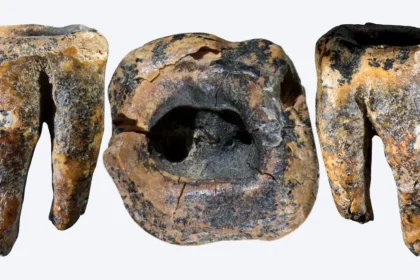
Among the various microorganisms identified in the remnants of a 4,000-year-old domesticated sheep, exhumed from the Arkaim archaeological site in Russia’s Southern Ural Mountains, was a particularly arresting pathogen. This discovery brought the research to an abrupt halt.
Within a single tooth specimen, the genetic material of the plague bacterium, Yersinia pestis, was detected. This particular strain, dating from the Bronze Age, lacked the capacity to infect fleas, a mechanism it would later exploit during the medieval period.
Given that Y. pestis had not yet evolved the ability to utilize fleas as vectors during the Bronze Age, scholars have long pondered the mechanisms by which the plague disseminated so extensively among human populations. The presence of identical plague strains in human remains unearthed at disparate geographical locations, separated by thousands of kilometers, attested to a significant mortality rate.
This marks the inaugural discovery of the Late Neolithic Bronze Age lineage of this bacterium within a non-human animal host. The findings, initially disseminated in a preprint, have subsequently undergone rigorous peer review.
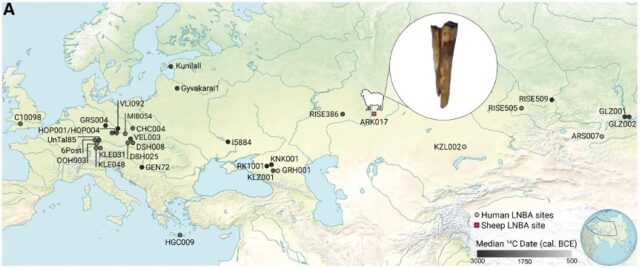
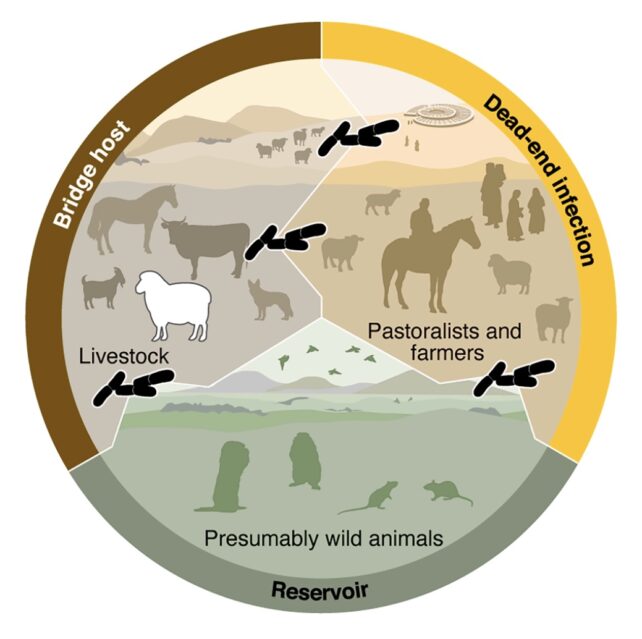
It is conceivable that domestic sheep, traversing the expansive steppe grasslands of Eurasia, may have come into contact with a wild animal harboring the pathogen, without succumbing to illness themselves. Subsequently, they could have facilitated its spread among other flocks and their human caretakers. Nevertheless, the research team acknowledges that the possibility of human-to-sheep transmission cannot be definitively excluded.
“The propagation must have involved more than just human migration. Our infected sheep provided a pivotal breakthrough,” stated Hermes.
“We now conceptualize this as an interplay between human populations, their livestock, and an as-yet-unidentified natural reservoir, potentially comprising rodents inhabiting the Eurasian steppe grasslands or migratory avian species.”
The identification of ancient pathogen DNA is fraught with difficulties. Unlike human remains, animal carcasses are typically not subjected to the same meticulous burial practices, resulting in less favorable preservation conditions.
Furthermore, a significant proportion of excavated domestic animal specimens represent the remnants of human culinary activities, meaning they have likely undergone cooking processes that effectively degrade DNA.
“Additionally, humans tend to avoid consuming animals exhibiting visible signs of illness, thus faunal assemblages are likely skewed towards healthier specimens,” observed biologist Ian Light-Maka of the Max Planck Institute for Infection Biology, alongside Hermes and their colleagues, in their recently published work.
“Even if infected animals are consumed, a single individual might transmit the disease to numerous people, and the likelihood of that specific animal being discovered and subsequently studied remains low.”
This represents only the third instance where a strain of Y. pestis has been detected in ancient fauna. The preceding discoveries involved a medieval rodent and a Neolithic canine; however, those particular DNA samples were too degraded to yield definitive conclusions.
Hermes highlighted the significance of the most recent find, noting that the Arkaim site, where the infected sheep was unearthed, is a human settlement associated with the Sintashta culture. This culture is recognized for its advanced bronze weaponry, mastery of horse riding, and its genetic influence in Central Asia. Traces of the Late Neolithic Bronze Age (LNBA) plague strain have also been identified in individuals from this culture.
During the period when this infected sheep was alive, the Sintashta people were in the nascent stages of expanding their livestock populations. Their proficiency in horsemanship enabled them to traverse vast distances rapidly, potentially increasing their exposure to wild species that served as reservoirs for the plague.
“Nonetheless, a singular genome is insufficient for a comprehensive understanding of the LNBA lineage’s ecological dynamics across the diverse cultures and geographical regions impacted by this prehistoric plague. Our findings indicate that its reservoir remains at large,” the authors concluded.