Significant gold deposits are predominantly discovered within quartz veins. The prevailing scientific consensus suggests that gold precipitates from mineral-rich fluids, characterized by high temperatures and abundant carbon dioxide, as a consequence of alterations in temperature, pressure, or the chemical composition of these fluids. Nevertheless, the prevalent existence of substantial gold nuggets presents a challenge to this hypothesis, especially given the low concentration of gold in such fluids and the inherently inert nature of quartz. Quartz stands as the sole ubiquitous piezoelectric mineral on Earth. The cyclical seismic activity integral to the genesis of gold deposits implies that quartz crystals within veins undergo numerous stress episodes. Recent investigations conducted by researchers from Monash University, CSIRO Mineral Resources, and the Australian Centre for Neutron Scattering indicate that mechanical stress applied to quartz crystals can generate sufficient electrical potential to facilitate the electrochemical deposition of gold from solution and the aggregation of gold nanoparticles.
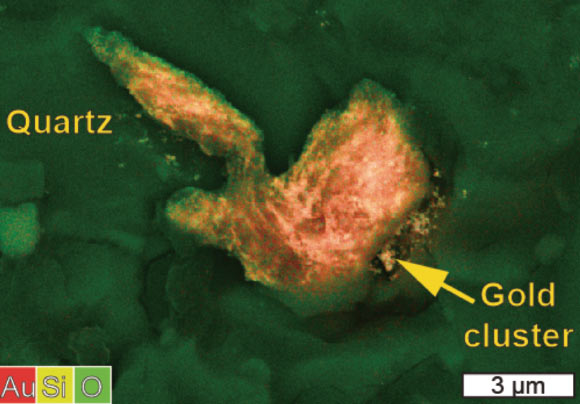
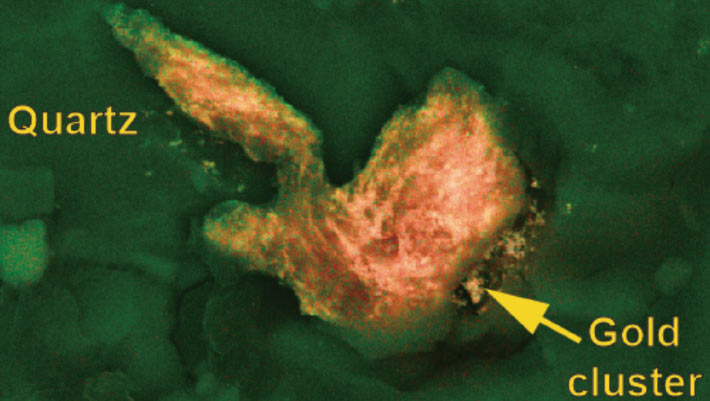
Energy dispersive spectroscopic map of the sample studied by Voisey et al. Image credit: Chris Voisey.
“The allure and scarcity of gold nuggets have been central to gold prospecting endeavors for centuries,” stated Chris Voisey, a geologist at Monash University.
“The conventional explanation posits that gold precipitates from geothermal, water-saturated fluids traversing fractures in the Earth’s lithosphere.”
“As these fluids undergo thermal dissipation or chemical modifications, gold separates from solution and becomes entombed within quartz veins.”
“Although this theoretical framework is widely embraced, it falls short of comprehensively accounting for the formation of large gold nuggets, particularly when considering the exceedingly low gold concentrations present in these fluids.”
Dr. Voisey and his research associates explored an innovative hypothesis centered on piezoelectricity.
Quartz, the mineral commonly associated with these gold occurrences, possesses a distinct characteristic known as piezoelectricity – the generation of an electrical charge in response to applied mechanical stress.
This physical principle is already familiar from everyday applications such as quartz watches and igniters for gas grills, where a modest mechanical impulse yields a considerable electrical voltage.
Could the stresses induced by seismic events within the Earth operate similarly?
To empirically validate this proposition, the research team devised and executed an experimental setup designed to emulate the environmental conditions that quartz might encounter during an earthquake.
Quartz specimens were immersed in a gold-laden fluid, and mechanical stress was applied using a motorized apparatus to simulate seismic vibrations.
Following the experimental phase, the subjected quartz samples were subjected to microscopic analysis to ascertain whether any gold deposition had occurred.
“The outcomes were truly remarkable,” commented Professor Andy Tomkins from Monash University.
“The stressed quartz not only facilitated the electrochemical deposition of gold onto its surface but also fostered the creation and accumulation of gold nanoparticles.”
“Notably, the gold exhibited a propensity to deposit onto pre-existing gold particles rather than initiating the formation of entirely new ones.”
“This behavior is attributable to the fact that, whereas quartz functions as an electrical insulator, gold is a conductive material.”
“Once an initial deposit of gold forms, it acts as a preferential site for subsequent growth, effectively coating the gold grains with additional gold.”
“Our findings furnish a credible explanation for the genesis of substantial gold nuggets within quartz veins,” Dr. Voisey asserted.
The iterative application of stress to quartz by seismic events generates piezoelectric voltages capable of reducing dissolved gold from the surrounding fluid, thereby inducing its precipitation.
Over extended geological timescales, this process can lead to the accumulation of considerable gold deposits, ultimately resulting in the formation of the massive nuggets that have historically captivated both prospectors and geologists.
“Fundamentally, the quartz functions as an intrinsic electrical generator, with gold serving as the electrode, progressively accumulating more gold with each seismic occurrence,” Dr. Voisey elaborated.
“This mechanism offers a potential explanation for the frequent association of large gold nuggets with quartz veins found in seismically active mineral deposits.”
“This novel insight into gold nugget formation not only elucidates a long-standing geological enigma but also underscores the interconnectedness of the Earth’s physical and chemical processes.”
A document detailing these findings has been published today in the esteemed journal Nature Geoscience.
_____
C.R. Voisey et al. Gold nugget formation from earthquake-induced piezoelectricity in quartz. Nat. Geosci, published September 2, 2024; doi: 10.1038/s41561-024-01514-1