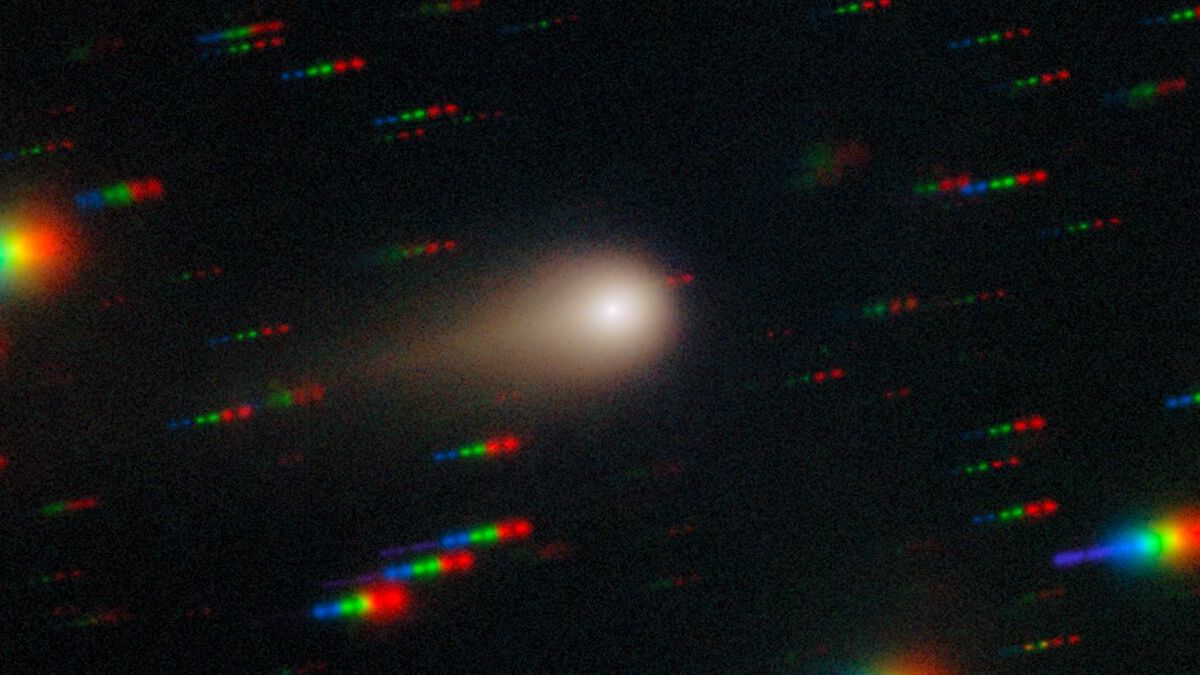
A comprehensive examination conducted to detect evidence of radio-transmitting apparatus within the interstellar comet 3I/ATLAS has yielded no indications of extraterrestrial signals, revealing a complete absence of cometary radio emissions.
The initiative, known as Breakthrough Listen, leveraged the capabilities of one of the globe’s preeminent and most sensitive radio observatories, the 100-meter Green Bank Telescope. Observations were sustained for several hours as the comet approached its closest point to Earth, perigee, on December 19, 2025.
The research contingent meticulously scanned a broad spectrum of radio frequencies for artificial technosignatures. While numerous signals were registered, none were attributable to the comet itself.
This outcome is not particularly surprising, as there are no inherent characteristics of 3I/ATLAS that suggest anything other than its classification as a comet. Nevertheless, given this unique astronomical event, it would have been remiss not to conduct an investigation.
3I/ATLAS was initially identified on July 1, 2025, with orbital calculations confirming its origin outside our Solar System. The comet reached its closest proximity to the Sun, known as perihelion, in late October. Its closest approach to our planet, perigee, occurred nearly two months subsequently as it continued its outward trajectory into interstellar space.
At its perigee, the comet was approximately 270 million kilometers (168 million miles) distant. This distance, though nearly double Earth’s average separation from the Sun (150 million kilometers), was still sufficiently close for detailed observational study.
On December 18, a research group, headed by astronomer Ben Jacobson-Bell from the University of California, Berkeley, utilized the Green Bank Telescope to monitor the comet for a five-hour duration.
Had the comet emitted a radio transmission of the type the search was designed to identify within this observational window, the Green Bank Telescope would have successfully detected it.
To ensure the authenticity of signals received by the telescope and to confirm their origin from 3I/ATLAS, the observation methodology involved alternating between pointing at the comet and at other celestial regions. This was executed in a progressively outward-reaching pattern known as an ABACAD configuration, with a five-minute interval between each target.
Following the subtraction of signals originating from other celestial locations, the researchers identified nine potential radio signals. Subsequent, more precise scrutiny revealed that these nine signals were indeed artificial but were, in fact, radio-frequency interference emanating from terrestrial human technologies present on and around Earth.
A disappointing conclusion, to say the least.
It is important to clarify that this finding does not definitively eliminate the possibility of 3I/ATLAS harboring extraterrestrial technology. It is not unprecedented for human-made spacecraft to experience extended periods of radio silence. Indeed, by the time the Voyager probes have traversed distances comparable to 3I/ATLAS’s journey, potentially for billions of years if they remain functional, their power sources will have long been depleted.
However, all other available data pertaining to 3I/ATLAS are entirely consistent with its nature as a comet.
“This celestial body is unequivocally a comet,” stated Amit Kshatriya, associate administrator at NASA, in November. “Its appearance and behavior align with that of a comet, and all evidence supports this designation. Nevertheless, its origin outside the Solar System renders it exceptionally fascinating, exciting, and scientifically significant.”
Therefore, the rationale behind conducting such an investigation, even with a low probability of discovering artificial signals, lies in the fundamental nature of scientific inquiry. Even a null result provides valuable information. In this specific instance, the absence of detected signals indicates, at a minimum, that 3I/ATLAS is not functioning as an alien beacon broadcasting messages across the Solar System via radio frequencies.
While this was largely understood beforehand, this investigation has reinforced that understanding, which is beneficial for future research endeavors.
Furthermore, although scientists held a strong degree of certainty that 3I/ATLAS was not an alien probe, one must consider the potential regret of missing such a discovery due solely to overconfidence or an unwillingness to perform a direct observation.
Initiatives like these also offer broader benefits.
“These discussions provide the general public with insight into the remarkable observations being conducted, the intellectual engagement of scientists, and the vast array of possibilities that exist,” commented physicist Paul Ginsparg of Cornell University, the progenitor of arXiv, to ScienceAlert in 2019.
“Envisioning speculative scenarios can sometimes pave the way for the development of advanced instrumentation, which may subsequently either validate or disprove such hypotheses, or reveal entirely unforeseen phenomena. This dynamic is precisely what imbues science with its inherent excitement.”
The findings from this observational campaign are accessible on the preprint server arXiv.