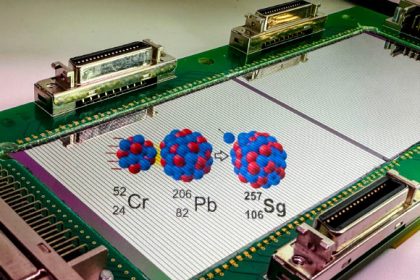
Utilizing the focal-plane spectrometer integrated with the gas-filled recoil separator at the Accelerator Laboratory of the University of Jyväskylä, Finland, a team of physicists has documented two instances of decay originating from the novel isotope astatine-188 (188At), characterized by its composition of 85 protons and 103 neutrons.
Kokkonen et al. report the discovery of the new atomic nucleus 188At, which is the heaviest proton-emitting isotope known to date.
“Proton emission is an infrequent manifestation of radioactive decay where the atomic nucleus expels a proton, thereby advancing toward a more stable state,” articulated Henna Kokkonen, a doctoral candidate at the University of Jyväskylä.
“The newly identified nucleus, 188At, is currently the lightest documented isotope of astatine, comprising 85 protons and 103 neutrons.”
“Investigating such exotic nuclei presents considerable difficulties due to their exceedingly brief half-lives and limited production rates, necessitating the deployment of highly accurate methodologies.”
“The production of this nucleus was achieved through a fusion-evaporation reaction, involving the bombardment of a natural silver target with a 84Sr ion beam,” explained Dr. Kalle Auranen, also affiliated with the University of Jyväskylä.
“The identification of the new isotope was accomplished employing the detector array of the RITU recoil separator.”
Beyond the empirical findings, the researchers augmented a theoretical framework to interpret the collected experimental data.
The research group posits that 188At can be conceptualized as possessing a pronounced prolate shape, often likened to a ‘watermelon.’
“The characteristics of this nucleus indicate a shift in the trend observed in the binding energy of the valence proton,” stated Kokkonen.
“This observation may potentially be attributed to an interaction previously unencountered in heavy nuclei.”
“The detection of new isotopes is a globally infrequent occurrence, and this marks the second occasion I have had the privilege of contributing to such a significant historical breakthrough.”
“Every experimental endeavor is fraught with challenges, and it is immensely gratifying to engage in research that enhances our comprehension of the extreme boundaries of matter and the intricate structure of atomic nuclei.”
The authors intend to further advance theoretical investigations into heavy nuclei undergoing charged-particle decay and their evolving shapes, aiming to refine current estimations of decay energy and half-life by observing a greater number of 188At decay events.
“Of comparable interest would be the examination of the decay characteristics of the currently undiscovered nucleus 189At, which might also exhibit proton-emitting properties, though this remains to be ascertained in subsequent experimental campaigns,” they concluded.
Their publication appeared in the esteemed journal Nature Communications.
_____
H. Kokkonen et al. 2025. New proton emitter 188At implies an interaction unprecedented in heavy nuclei. Nat Commun 16, 4985; doi: 10.1038/s41467-025-60259-6