A recently published article in the esteemed journal ChemSystemsChem by Professor Tony Jia of Hiroshima University and his collaborators presents a novel conceptual framework termed the ‘prebiotic gel-first’ model. This hypothesis posits that the genesis of life may have transpired within gel-like structures tethered to surfaces. Furthermore, the researchers delve into the possibility of ‘xeno-films,’ which are analogous to alien biofilms constructed from extraterrestrial materials, or a combination of terrestrial and non-terrestrial components. They underscore the critical importance of agnostic life-detection methodologies in the pursuit of both known and unknown forms of existence.
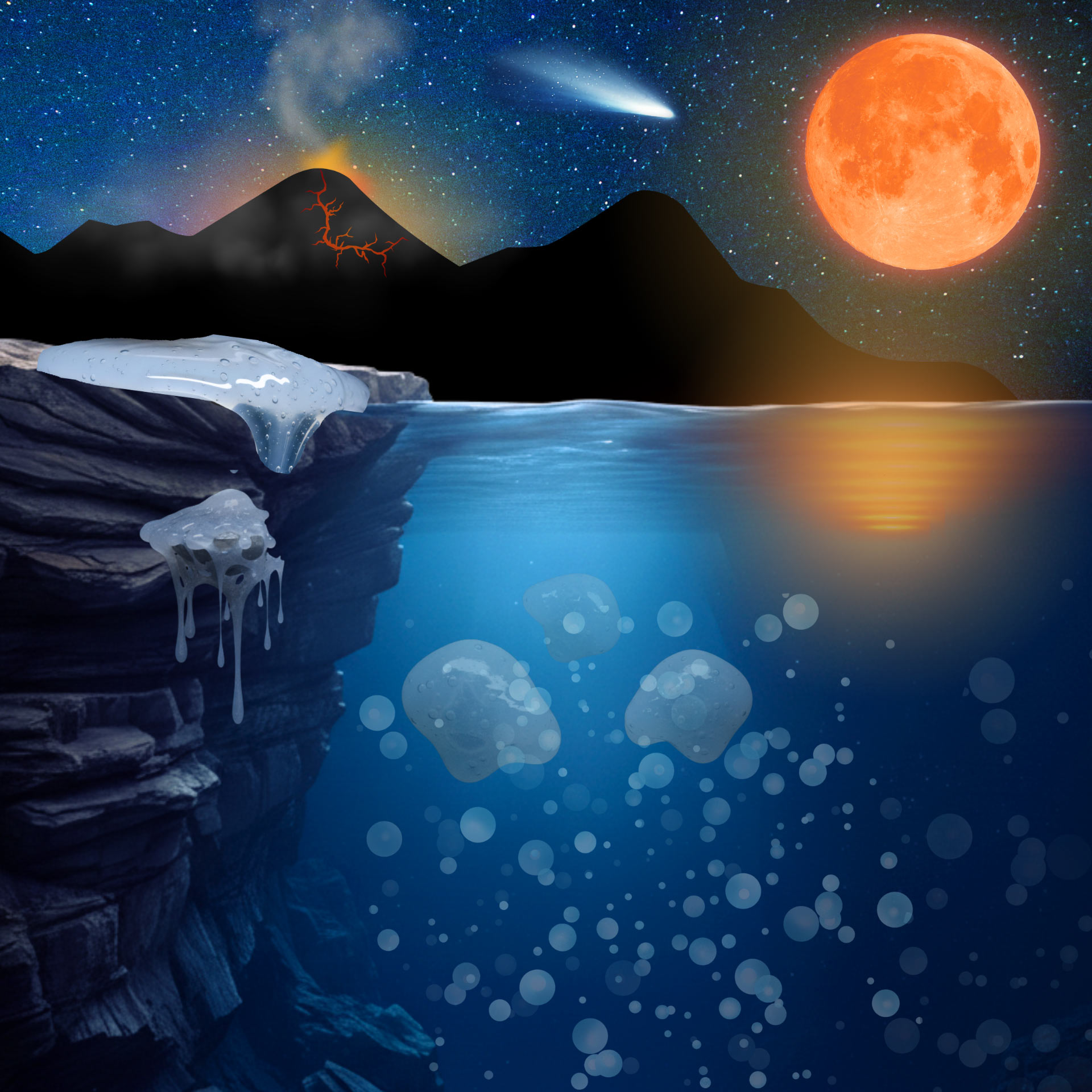
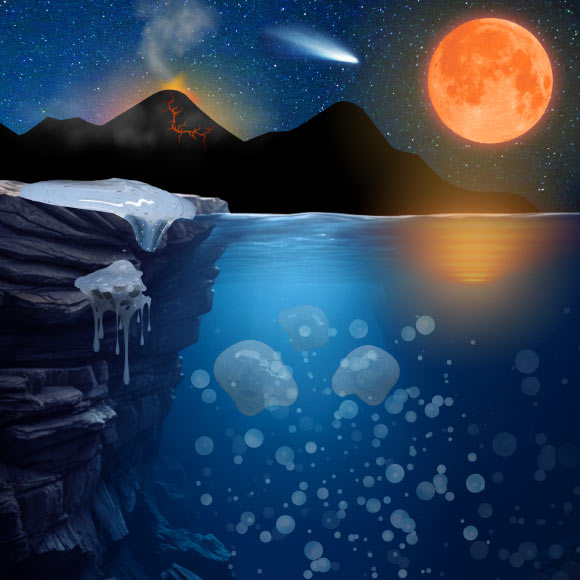
An artist’s impression of a prebiotic gel on the Early Earth’s surface. Image credit: Nirmell Satthiyasilan.
The enduring enigma of life’s inception has been a subject of profound contemplation for humanity throughout recorded history, as articulated by Professor Jia and his co-authors.
While direct observation of the initial emergence of life remains beyond our temporal reach, scientific inquiry continues to reconstruct plausible narratives by integrating insights from the disciplines of chemistry, physics, and geology.
It is noted that numerous theoretical frameworks concentrate on the roles of biomolecules and biopolymers; however, the theory proposed in this study integrates the significance of gelatinous substances in the context of life’s origins.
Within their newly articulated ‘prebiotic gel-first’ framework, the investigators theorize that life could have originated inside gel matrices anchored to surfaces. These sticky, semi-solid substances share characteristics with extant microbial biofilms, which are thin aggregations of bacteria that proliferate extensively on various substrates, including geological formations, aquatic environments, and artificial structures.
Drawing upon principles from soft-matter chemistry and contemporary biological understanding, the authors contend that such rudimentary gels might have furnished the essential structural scaffolding and functional capacity for nascent chemical systems to achieve escalating complexity, predating the advent of the first cellular entities.
By effectively sequestering and organizing molecular components, prebiotic gels possibly surmounted critical obstacles in pre-life chemistry through facilitating molecular concentration, selective retention of substances, and buffering against environmental fluctuations.
Within these gel environments, early chemical systems may have developed proto-metabolic processes and self-replicating capabilities, thus laying the groundwork for subsequent biological evolution.
Dr. Kuhan Chandru, a researcher affiliated with the Space Science Center at the National University of Malaysia, commented that this represents one among numerous hypotheses within the broad spectrum of origin-of-life research.
“Nevertheless, given that the role of gels has been largely neglected in prior discussions, our objective was to consolidate disparate research findings into a coherent narrative that positions primitive gels at the vanguard of this inquiry,” Dr. Chandru added.
The scientific team further extends this concept into the domain of astrobiology, postulating that analogous gel-like systems might be prevalent on celestial bodies beyond Earth.
These hypothetical ‘xeno-films’ could function as extraterrestrial counterparts to terrestrial biofilms, composed of distinct chemical constituents that are uniquely available in specific extraterrestrial settings.
This broadened perspective expands the parameters for astrobiological investigations into life beyond our planet, suggesting that structural configurations, rather than specific chemical signatures, might become the primary focus for future life-detection missions.
The researchers intend to empirically validate their model by investigating the formation of such gels from simple chemical precursors under early Earth conditions and assessing the properties these gels could impart to emerging chemical systems.
Dr. Ramona Khanum, also associated with the Space Science Center at the National University of Malaysia, expressed, “We also aspire for our work to stimulate further exploration of this and other under-researched origin-of-life theories among colleagues in the field.”
_____
Ramona Khanum et al. Prebiotic Gels as the Cradle of Life. ChemSystemsChem, published online November 19, 2025; doi: 10.1002/syst.202500038