The magnetosphere enveloping Saturn harbors captured plasma and energetic charged particles that continuously subject Enceladus’ surface to radiation. This plasma comprises diverse charged particles, notably water-group ions, primarily generated by high-energy electrons interacting with material ejected from the moon’s plumes. While analyses from NASA’s Cassini spacecraft have revealed that intense plasma bombardment darkens the reflective spectra of Saturn’s inner, icy satellites like Mimas and Tethys, creating distinctive bullseye patterns on their surfaces, the ramifications of similar plasma exposure on Enceladus remain uncharacterized and elusive to ascertain.

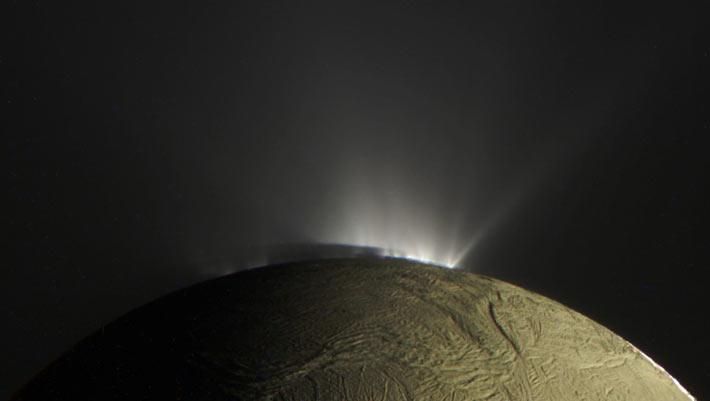
Saturn’s moon Enceladus with a plume. Image credit: NASA / JPL-Caltech / SSI / Kevin M. Gill.
“Although the detection of complex organic molecules within Enceladus’ environment stands as a significant indicator for assessing the moon’s potential habitability, the findings suggest that radiation-induced chemical processes occurring on the surface and within the plumes could equally be responsible for the synthesis of these compounds,” commented Dr. Grace Richards, a researcher affiliated with the Istituto Nazionale di Astrofisica e Planetologia Spaziale.
Enceladus’ prominent plumes were initially identified in 2005 through observations made by NASA’s Cassini mission.
These plumes originate from elongated fissures, known as ‘tiger stripes,’ situated in the southern polar region of Enceladus.
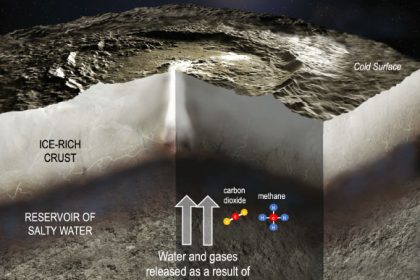
The water source is understood to be a subterranean ocean, with the energetic impetus for heating this ocean and generating the observed plumes attributed to the gravitational tidal forces exerted by the colossal planet Saturn as it deforms Enceladus’ internal structure.
During its transit through these plumes, the Cassini probe sampled their constituents, revealing a composition rich in salts and a variety of organic compounds.
Given that organic compounds, when dissolved in a subsurface aqueous environment, possess the capacity to assemble into prebiotic molecules—the foundational building blocks of life—these discoveries generated considerable interest among astrobiologists.
However, the recent research indicates that exposure to radiation within Saturn’s formidable magnetosphere might instead catalyze the formation of these organic compounds directly on Enceladus’ icy exterior. This revelation casts doubt upon their direct astrobiological significance.
In the course of their investigation, Dr. Richards and her collaborators meticulously recreated the compositional characteristics of ice found on the surface and lining the fissures of Enceladus’ ‘tiger stripes.’
This simulated ice consisted of water, carbon dioxide, methane, and ammonia, and was subjected to cryogenic conditions, cooled to a temperature of minus 200 degrees Celsius.
Subsequently, the researchers subjected the ice samples to ionic bombardment, effectively replicating the specific radiation environment encircling Enceladus.
The impinging ions engaged in chemical reactions with the ice’s constituent elements, leading to the generation of a wide array of molecular species, including carbon monoxide, cyanate, and ammonium.
Furthermore, the experiments yielded molecular precursors for amino acids, the constituent chains of which form proteins essential for driving metabolic processes, cellular repair, and nutrient transport in living organisms.
Certain molecules resulting from this simulated process have been previously identified on Enceladus’ surface, while others have also been detected within its plumes.
“It is plausible that molecules considered prebiotic could form in situ through radiation-driven transformations, rather than exclusively originating from the subsurface ocean,” Dr. Richards stated.
“While this does not preclude the possibility of Enceladus’ ocean being habitable, it necessitates a more cautious approach to making such assumptions solely based on the plume’s chemical composition.”
“The challenge of discerning between organic substances derived from the ocean and those generated by radiation interacting with the surface and the ‘tiger stripes’ will be considerable.”
“The acquisition of additional data from forthcoming missions will be imperative, including the proposed Enceladus mission currently under consideration as part of the Voyage 2050 recommendations for the European Space Agency’s science program extending to mid-century.”
The team’s research outcomes were formally presented earlier this month at the EPSC-DPS2025 Joint Meeting, held in Helsinki, Finland.
_____
Grace Richards et al. 2025. Water-Group Ion Irradiation Studies of Enceladus Surface Analogues. EPSC Abstracts 18: EPSC-DPS2025-264; doi: 10.5194/epsc-dps2025-264